
Georgia Needs To Take A Hard Look At School Spending.
Several factors are converging that put pressure on K-12 education budgets. Let’s consider a few of them.
Fewer babies = fewer students.
Demographers for many years have taken note of declining birth rates among Americans. Experts say that to keep a nation’s population stable, families need to have 2.1 children. This number, known as the Total Fertility Rate (TFR), sits at 1.6 here in the United States. We aren’t replacing ourselves, and now this is showing up in kindergarten enrollment across the country. According to Marguerite Roza of Georgetown University’s Edunomics Lab:
Nationally, we can expect a 0.5% decline in enrollment per year. Some districts will be hit much harder. Over the next decade, Los Angeles Unified will lose about a third of its enrollment.
None of this should be a surprise. When enrollment is down in the youngest grades, it means there are fewer students in the pipeline
Georgia, as we shall see in a moment, has mostly been spared this demographic shrink because people with children are still moving to our state, but not at the rate we’ve seen in the past.
More employees = higher costs.
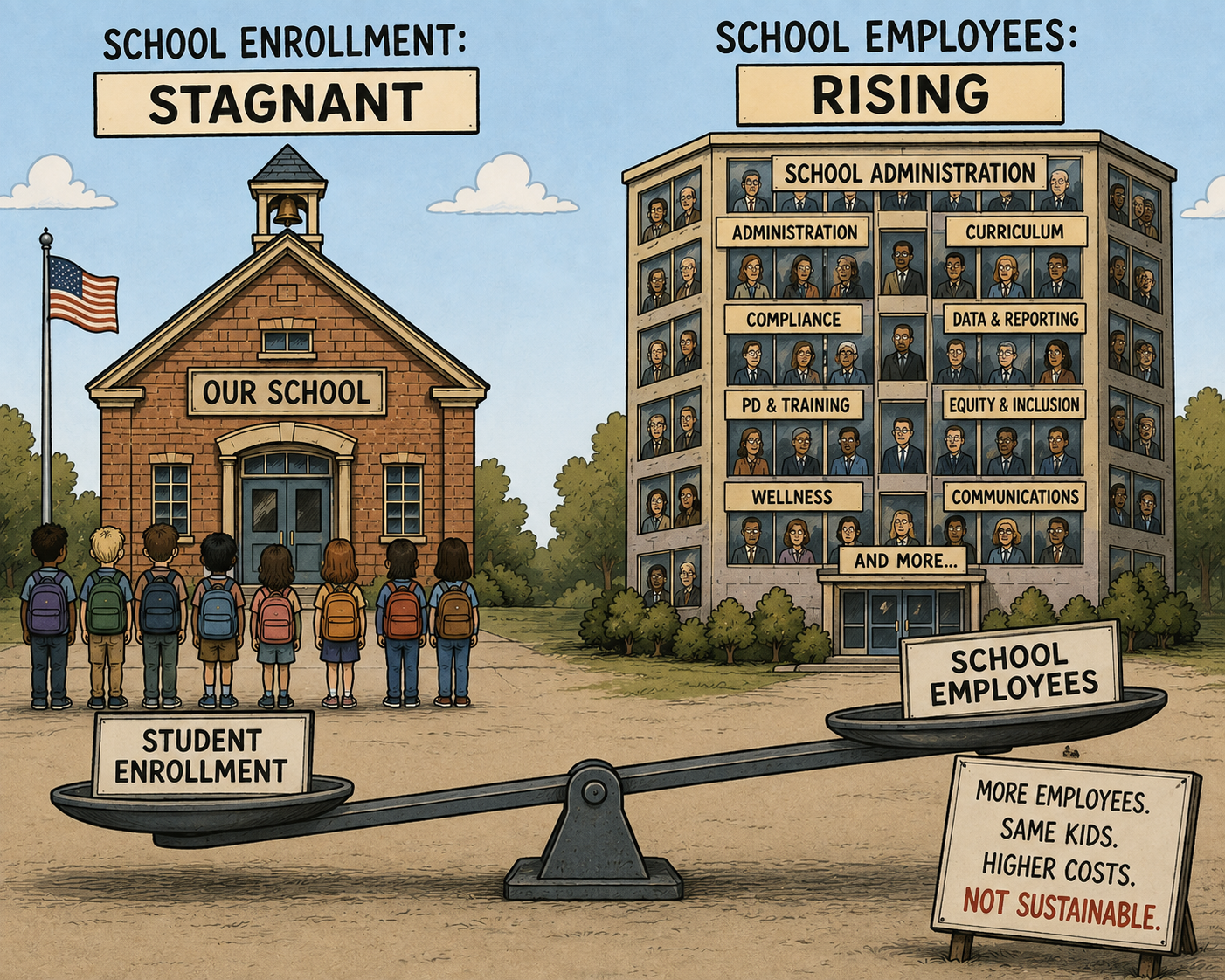
Meanwhile, as the K-12 student population has declined, the number of school employees has increased.
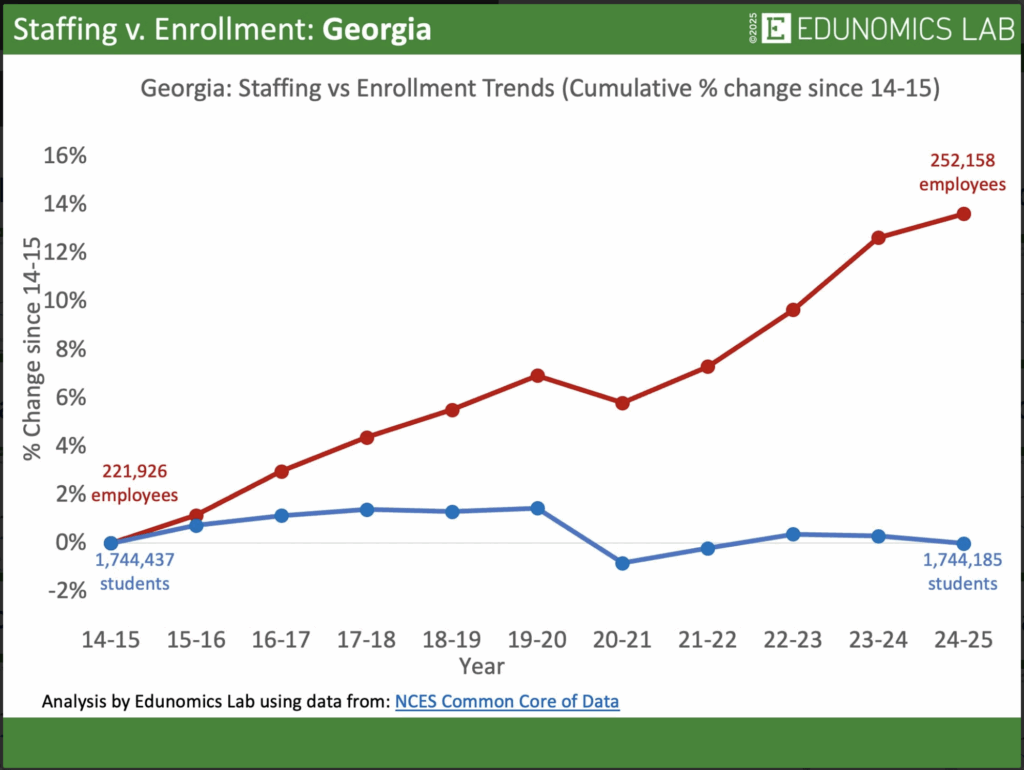
As you can see, Georgia’s student population has remained flat over the last decade, while the number of school system employees has increased by over 30,000. Many of these new employees are not classroom teachers, but support and administrative staff, as this chart, shown at a panel discussion on this very topic at the State Policy Network conference, demonstrates:
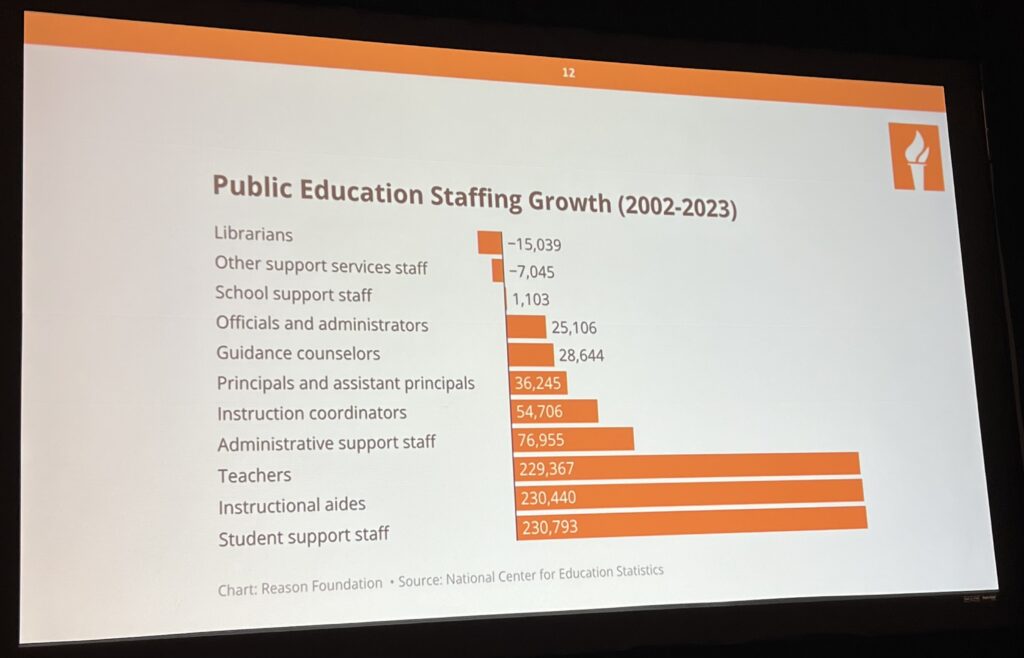
The national trends shown here are true in Georgia as well. Some of these non-classroom staff are the result of new policies meant to lessen the load for the classroom teacher, but many others are decisions made by local districts.
If the student population in our state remains flat or even decreases over the next decade, can we justify adding non-classroom staff at the rate we have over the past decade?
We cannot ignore the rising costs of healthcare, which the Affordable Care Act was supposed to fix, as well as the impact of inflation and tariffs on the cost of goods schools must purchase each and every day. Diesel fuel prices at $5.49 per gallon ain’t helping either.
The time for hard choices has arrived.
Peach Pundit has brought to your attention the dismal financial management of Dublin City Schools, which led to new legislation and the removal of their elected Board of Education. Concerned that a similar situation might develop in Catoosa County Public Schools (CCPS), Representative Mitchell Horner called for an audit of CCPS financials. The audit was recently completed, and Rep. Horner had this to say on his Facebook page:
First, the good news: the audit did not find corruption, missing money, or materially inaccurate financial statements. Which we expected and are happy to confirm. The financial records reviewed were generally accurate and compliant which previous audits have shown on procedure. That is important, and it should be acknowledged.
But the audit also confirmed the central financial concern that led the delegation to seek a deeper review in the first place: the district’s financial trajectory was not structurally sustainable. Recurring expenditures exceeded recurring revenues in every year reviewed except FY2022, and unassigned reserves fell below the 5% benchmark in FY2024 and FY2025.
Cherry Bekaert also reports that Catoosa ranked last among 16 Northwest Georgia school districts in overall fiscal health and had scored “Critical” in the previous two fiscal years.
Kudos to Rep. Horner for pushing for this audit. Now CCPS must make some hard choices. The current path is unsustainable.
In fact, all 180 of Georgia’s school districts should take a hard look at enrollment and staffing trends and their financial trajectory, and make the necessary adjustments now, before a real financial crisis arrives. The demographic trends aren’t likely to change anytime soon, which could cause even systems accustomed to ever-increasing student populations to experience a drop-off.
