

Department of Agriculture Proactively Lessens Licensure Burden on Small Business Owners
Editor’s Note: This is a guest post by By Tony West, State Director of Americans for Prosperity Georgia. And personally I am excited to see so much progress being made by the Georgia General Assembly on the issue of regulatory reform, as I too have introduced legislation to tackle this issue in the past.
Commissioner Tyler Harper and the team at the Department of Agriculture deserve credit for something you don’t see every day: a government agency voluntarily relinquishing authority. Earlier this month the Department announced it would no longer be requiring or issuing licenses for cottage food operations. Cottage food operators make non-potentially hazardous foods from a home kitchen, most often cookies and cakes, but there are over a dozen approved foods.
This action didn’t come completely out of the blue. Rep. Leesa Hagan worked on this issue for a few years and her bill became law July 1st . Under HB 398, cottage food regulations were updated to allow retail sales, and also added dill pickles and uncut fruits and vegetables to the list of approved products for sale. We at AFP certainly celebrated the passage and signing of this bill, as cutting red tape and expanding economic freedom are exactly what we’re all about.
This is just the latest move Georgia has taken to reduce the burden of occupational licensure. In 2023, Rep. Chuck Martin’s HB 155 allowed for expedited recognition of out-of-state licensed holders when they move to our state. In 2024, the legislature removed licensure requirements for makeup application and hair blow-dry styling, which I’ve argued was a common-sense reform, despite the gnashing of teeth coming from some quarters at the time. This year, Rep. Reeves’ HB 579 became law, which streamlines the licensure process and removes barriers for people wanting to work.
What could be next for occupational licensure reform under the Gold Dome? While one-off license removals and reforms to the internal processes of license approvals are great, a systematic approach that considers the necessity of a license would be even better in the long-term. Rep. Joseph Gullet introduced HB 575 in 2023 that is a unique idea to find less restrictive alternatives to licensing. Unfortunately, it never made it to the House floor. A fresh approach to occupational licensing would recognize that there are various alternatives to regulating an occupation, as illustrated by John K. Ross, a researcher for the Institute for Justice:
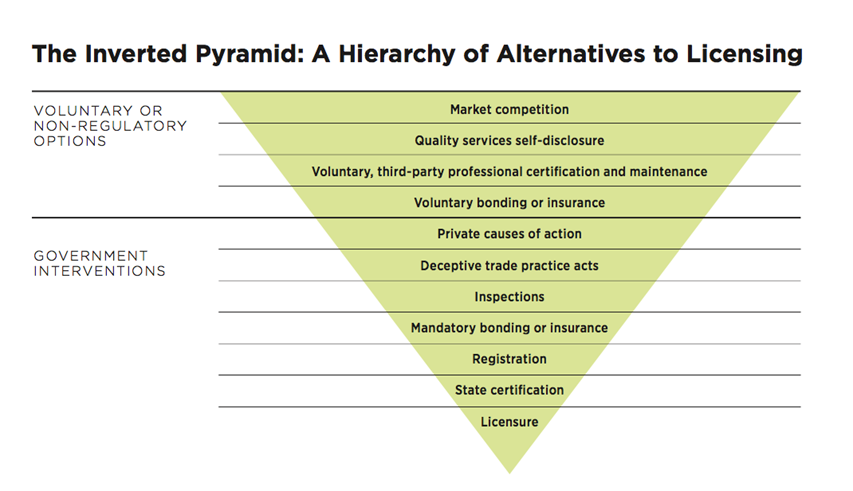
Its unfortunate that in many legislatures across the country, the first step in government intervention into an occupation is the most burdensome to people: licensure. Policy leaders in the executive and legislative branches should commit to an across the board review of all occupational regulations to reduce unhelpful barriers to Georgians trying to make a living. Committing to reducing our regulatory requirements for each occupation to the least burdensome standard of any border state we aren’t better than already would be a great start, accompanied by a review process to change oversight measures to less harmful options as found in this inverted pyramid.
I’m not sure if the fine folks at the Department of Agriculture have ever seen this inverted pyramid image, but it is reflected in their action with the cottage food license. They removed the licensure requirement, but retained within their regulatory authority inspections and registration. This is a bonafide example of the government reducing the size and scope of its own intervention in the private economy, and it should be recognized and commended for it.
