
Rights Aren’t Up for a Vote, Geoff.
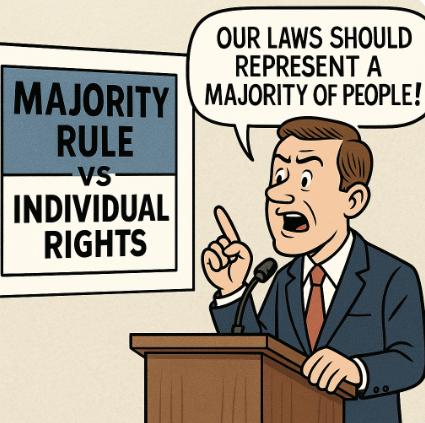
Former Lt. Governor Geoff Duncan went on the Politically Georgia podcast this week to talk about his party switch and his “new” world view and approach to governing. If you haven’t heard it, the segment runs through his decision to become a Democrat, his positions on guns and abortion, and his belief that Georgia laws should “represent a majority of Georgians” on issues that include fundamental rights.
Some of it was predictable. Some of it was infuriating. And all of it was a reminder that we need to be crystal clear about what rights actually are and what they are not.
Early in the conversation Duncan said, “I think we’ve got to get to a spot where we represent a majority of Georgians, not just one certain sector of an opinion.” It was at this point I could start feeling the tops of my ears get warm.
This isn’t about whether Geoff wears a red jersey or a blue one. It’s about his stated belief, repeated several times in the interview, that basic questions of liberty should be decided by majority preference. That idea sounds nice in a focus group but in practice, it’s dangerous.
That one line sets the tone for the rest of his remarks and it explains why so much of what he said is a problem. It sounds reasonable if you do not think about it too hard. I mean, who could argue with the idea of representing the majority? The trouble is that when you apply this standard to issues of fundamental rights, you are no longer talking about representation. You are talking about permission slips that can be revoked when the crowd changes its mind.
Rights are not meant to ebb and flow with public opinion. They are not privileges you hold only until 50 percent plus one decide you should not. If they can be voted away they are not rights at all. The whole point of a constitution is to put some things beyond the reach of the majority, whether that majority is in the legislature or in the streets.
This is exactly what I wrote about in my editor’s note on the Dobbs decision. In that piece I pointed to the Tenth Amendment as a reminder that government powers are limited. That includes the power to infringe on rights simply because a majority wants to. Appealing to “what most people want” is not a governing philosophy. It is a justification for eroding rights when they become unpopular.
When Duncan was asked if his support for Georgia’s heartbeat bill was a mistake, he said, “I think the mistake was that I mistook my personal views and thought that every Georgian should have those personal views.” That answer might sound reflective, but it is a dodge. Supporting a law that protects what you believe to be a fundamental right is not “imposing” your personal views any more than voting to protect free speech is imposing your preference for what people say. If you believe something is a right, you have a duty to defend it for everyone, not set it aside because some portion of the public disagrees. Calling that “a mistake” reduces the protection of rights to a matter of personal taste rather than principle.
And what an incredible amount of flexible thinking on Duncan’s part. Just last week he was telling us that loving your neighbor was best served by imposing government programs on the people. And now he is saying he should not have imposed his views on Georgians to protect a fundamental human right. He’s all twisted.
And let us not forget, the heartbeat bill was about protecting the right of an individual human to live. Duncan reduces that right to something that should be debated, compromised and subject to the whims of the majority. No thanks.
Duncan also used that “love my neighbor” schtick when he talked about “re-litigating” Georgia’s heartbeat bill to find a compromise. Setting aside that his new party wants abortion on demand and there is no compromise so that I do not digress too far… Compromise has its place, but compromising on the recognition of a right is not neighborly, it is surrender. Mike Dudgeon made this point well in his recent Peach Pundit column, Loving Your Neighbor as a Republican. Real love for your neighbor is rooted in conviction, not convenience, and sometimes it means standing against the majority when the majority is wrong. If you believe a right exists, whether it is speech, self-defense, due process, or the right to life, you do not trade it away to meet the majority halfway. Once a right is on the bargaining table it is already lost.
This is where Duncan’s majority standard collapses. If the majority decides a certain religion is too extreme, does that justify restricting it? If the majority decides a certain viewpoint is too dangerous, does that justify censoring it? If the majority decides you do not need the means to defend yourself, does that justify confiscating them?
In a free society the answer is no, no, and no.
And if your standard is “whatever the majority wants,” sooner or later you will find yourself in the minority wondering where your rights went.
It is fine to say you want to have more conversations about policy. We should have those conversations. But a conversation is not the same thing as a constitutional protection. Mike Dudgeon’s piece is a reminder that the conservative instinct is to protect the rights of the individual, even when doing so is unpopular. That is as true when you are in the majority as it is when you are not, and a major source of why I get sideways with my own party at times.
Geoff Duncan’s majority-rule standard might be politically fashionable, but it is no substitute for principle. The test for any policy should not be whether most people support it at the moment, that is the very definition of politics over principle. The test is whether it respects and protects the inherent rights of every individual. Get that wrong and the rest is just window dressing.
One last thought that is deeply personal. I have grown weary of writing and talking about Geoff Duncan because at one point I considered him amongst my closest friends. These days I take a great amount of inspiration from Nathan’s role to David. And this is a lot easier to talk about when it is Stacey Abrams using the words I heard come out of Geoff’s mouth today. But they are now both equally wrong and represent an equal threat to our fundamental rights.
And I will never grow tired of standing up for those rights.
