
Catoosa County GOP Learns The Hard Way That Court Orders Actually Mean Something
There is a brand new order out of Catoosa County Superior Court that ought to be printed and nailed to the wall of every county GOP office in Georgia.
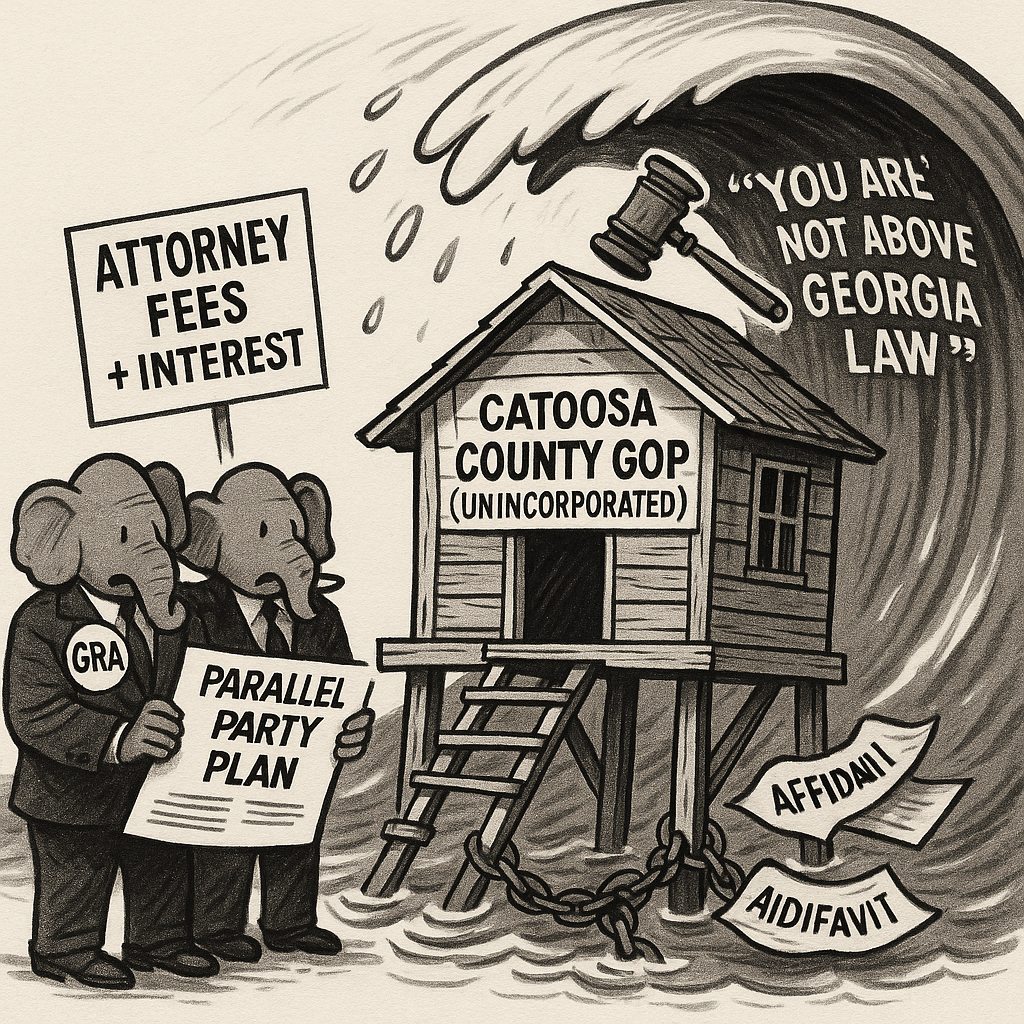
Short version: the same Catoosa County Republican Party that tried to keep four candidates off the ballot under Alex Johnson’s “Accountability Rule” just got hammered. The judge found they ignored court orders, refused to follow Georgia law on qualifying, and left themselves personally on the hook for a big pile of attorney’s fees that will grow with interest the longer they drag this out.
Remember, this whole mess started when the Catoosa GOP tried to impose a “qualifying affidavit” requirement cooked up in tandem with the Georgia Republican Assembly, the parallel outfit I lovingly mockingly refer to as the Goofballs Rejects and A-holes. Their local rules said you could not run as a Republican unless the county committee pre approved you within the last twelve months and signed off on a notarized affidavit. The Georgia Supreme Court has already summarized those rules pretty clearly.
The four candidates targeted by this stunt, Steven Henry, Larry Black, Jeff Long, and Vanita Hullender, went to court and got a temporary restraining order stopping the party from blocking their qualification. When the party still refused, the court issued another order that bypassed the local GOP and told the Board of Elections to qualify them anyway.
In the court’s words, parties who want to throw out election results have to “do everything within their power” to get their claims decided before the election, and the Catoosa folks simply did not.
Now the trial court has come back around to clean up the part they left hanging. Translation: consequences.
An “Unincorporated Association” That Just Bought Itself A Real Bill
One of my favorite pieces of this saga has been watching the same crowd that screams about “Georgia Republican Party, Inc.” and “GOP Inc cabals” run their own county party as “an unincorporated association.” That is not me being cute. That is how they styled themselves in their own filings with the court:
“CATOOSA COUNTY REPUBLICAN PARTY, AN UNINCORPORATED ASSOCIATION”
Meanwhile, the actual state GOP is on file with the Secretary of State as “Georgia Republican Party, Inc.,” a straightforward nonprofit corporation that exists so the party can have a bank account, sign leases, and comply with federal and state campaign finance law.
The conspiracy theory world has spent years building a humdinger around that “Inc.” They rant about a “corporate cabal” and whisper that the party is secretly a private corporation with no members. Then in Catoosa they apparently bought their own rhetoric. They did not bother to incorporate, and they used that same “accountability” ideology to justify keeping four Republicans off the ballot.
That worked right up until a judge looked at it and said, essentially, “you people are not above Georgia law.”
Because they are an unincorporated association, there is no corporate shield here. When the court turns fee awards into a money judgment, it does not just sit on some abstract “Catoosa County Republican Party” entity. It attaches to the real people whose names are listed as respondents and officers.
You can call it grassroots all you want. The clerk still knows where to send the fi fa.
The Court Has Had It With Their Games
The Catoosa GOP refused to qualify four candidates because they did not like their politics, the candidates went to state court and won, the party refused to comply, and the court had to bypass them entirely to get the candidates on the ballot.
This latest order is the state judge finally saying, “enough.”
The judge lays out a few basic points that should not be controversial for anyone who has actually read the Election Code:
- Georgia law sets out how you qualify to run in a party primary. See OCGA 21 2 153.
- If you meet the statutory requirements, you qualify.
- Parties that do not like a candidate have a process to challenge that candidate under the challenge statutes, OCGA 21 2 6 and 21 2 522.
- What you do not get to do is invent a brand new “affidavit” veto power and then refuse to follow court orders when you get caught.
The Supreme Court already noted that the so called “qualifying affidavit” rule was being used to keep these four candidates off the ballot because of “subjective determinations and substantive issues like disagreements on tax policy and property rights,” not any neutral procedural rule.
In other words, this was never about procedure. This was Alex Johnson’s Accountability Rule dressed up as local party process and the judge has now followed that logic to its obvious conclusion. If you are going to try to run a parallel party inside the GOP, and you are going to use that scheme to keep people off the ballot, you do not get to ignore court orders when the state says no.
Also, that meaningless resolution passed at the State Convention this year in an attempt to keep Brad Raffensperger from qualifying for Governor next year? Yeah, just don’t. It isn’t legal and some folks in Catoosa are learning that the hard way right now.
Personally On The Hook, With Interest
From what I can see, the order does three big things.
First, it finds that the Catoosa GOP and specific officers willfully defied the court’s earlier orders. When a court tells you to stop blocking candidates from qualifying and you keep doing it anyway, that is not “civil disobedience.” That is contempt.
Second, it takes the attorney’s fees that the winning candidates racked up and turns them into a money judgment against the party and the named officers. Under Georgia law, once that happens, post judgment interest kicks in at the statutory rate, which is the prime rate plus three percent. Every month they refuse to pay, the bill gets a little bigger. There is a big difference between grandstanding on Facebook about “fake Republicans” and watching interest compound on a judgment with your name on it. Garnishments may become these folks new reality.
Third, it drives a stake through the heart of the local “affidavit” scheme. The court has already treated the candidates as properly qualified Republicans for purposes of the 2024 primary. This new order reinforces the reality that county parties do not get to veto ballot access with a secret internal vote, then run to court complaining about “forced speech” when someone calls them on it.
A Warning For Every County Party Playing With Fire
The court has now clearly said that when you ignore the law, ignore court orders, and treat your county party like a private club instead of a participant in a public election process, real people are going to pay real money.
You can believe whatever you want about “Inc.” cabals and allegedly shadowy corporate party structures. You can build parallel organizations like the GRA and whisper about how you are the only “real” Republicans. You can invent “Accountability Rules” that sound tough in a Signal chat.
What you cannot do is pretend that your little internal revolution suspends the Georgia Code.
Catoosa County just found that out the hard way. The rest of the Goofballs Rejects and A-holes around the state might want to take the hint. Follow the law, or the next stack of legal bills that accrues prime plus interest might have your name on it instead.
The court makes detailed findings of willful contempt:
- It finds that the Catoosa County Republican Party and specific officers/members:
- Willfully violated the March 7, 2024 TRO by still refusing to qualify the Petitioners.
- Expanded the litigation, were “stubborn and litigious,” and even testified that they would refuse to obey further orders.
- As a result, the court:
- Holds the party and named individuals in willful contempt under O.C.G.A. § 15-6-8, and
- Imposes $500 fines on:
- The Catoosa County Republican Party itself, and
- Each of the following: Beth Cass, Ruth Fant, Sherre Bales, Joanna Hildreth, Marie Moore, Debbie Morrison, Jack Byars, Mary Bugea, and Regina Gray.
- The court also finds that the standard for awarding attorney’s fees under O.C.G.A. § 9-15-14(b) has been met:
- The Respondents’ behavior forced unnecessary litigation and repeated court appearances.
- The emergency nature of the case and their refusal to follow orders justified fee shifting.
It then awards attorney’s fees and expenses as follows (against a group of named party actors including James and Mary Coles, Fant, Hildreth, Lamar, etc.):
- For Petitioner Jeffery Long:
- $35,940.00 in attorney’s fees
- $1,312.45 in expenses
- For Petitioner Steven Henry:
- $21,340.00 in attorney’s fees
- $784.18 in expenses
- For Petitioner Larry Black:
- $9,000.00 in attorney’s fees
- For Petitioner Vanita Hullander:
- $4,827.50 in attorney’s fees
Total award across all four, including expenses, is just over $73,000.
The order says these amounts are enforceable as a money judgment under O.C.G.A. § 9-15-14(f).
