
More on the 315,000 Fulton Votes Story
I don’t know if the Dear Readers of Peach Pundit think this is a highly organized machine, but they’d be mistaken if they do. A great example of this happened over the weekend when conservative social media lost their collective minds over a story that circulated about 315,000 “illegal” votes cast in the 2020 Presidential Election in Georgia. I had drafted a 2,400 word deep dive into that topic (spoiler alert; those votes are not illegal) when I got a text from Jason Shepherd notifying me he had written on the same topic.
Jason did a great job breaking down the why part of how those now screaming about the election being stolen are doing so from their butts. So, go read his post first and then come back here because I want to go a little bit deeper into the weeds and also look forward to what happens if the people who are pushing this false narrative get what they want.
So let me state the thesis up front: rules violations deserve accountability, not retroactive vote deletion. You cannot allow government employees to delete legitimate votes either purposefully or through their inaction.
For those who didn’t go read Jason’s post first, the heart of the controversy were claims made by David Cross at a recent State Election Board meeting that poll workers in Fulton County failed to sign the zero and tabulation tapes across several precincts. He went on to claim, erroneously or out of context, the following:
- “These signed tapes are the sole legal certification that the reported totals are authentic.”
- That some tapes were produced at, “impossibly late times.”
- That Fulton had no legal authority to certify the election.
- That Brad Raffensperger accepted the vote tallies without questioning them.
- That this wasn’t, “partisan, [It] is statutory, [It’s] the law.”
What’s in the law?
So let’s tackle the last one first and take a look at what the law read on this subject back in 2020 (remember, the law has changed since then) which can be found in O.C.G.A. § 21-2-374 (2020): “Precinct ballot scanners shall produce a zero tape prior to any ballots being inserted on the day of any primary or election.”
Do you see a signature requirement? No. You don’t. And the concept of the tabulation tape, the receipts printed after the votes have been counted on those machines, doesn’t show up in the 2020 version of Georgia’s election law at all. Both signature requirements show up, actually, in the rules that were created by the State Election Board back when Brad Raffensperger was the chair of that board.
So let me be clear about a very important point; the rules are important and must be followed. Any violation should spell accountability and consequences for the person who violated them. What that accountability looks like is very important, but at no time should the voters be punished by having their ballots discarded because a government employee goofed up. We’ll come back to that.
So while I do not want to discount the importance of the rules, I point this out because Cross’s hyperbole of calling these statutory violations when they were not has led to salacious and click bait headlines calling the votes fraudulent.
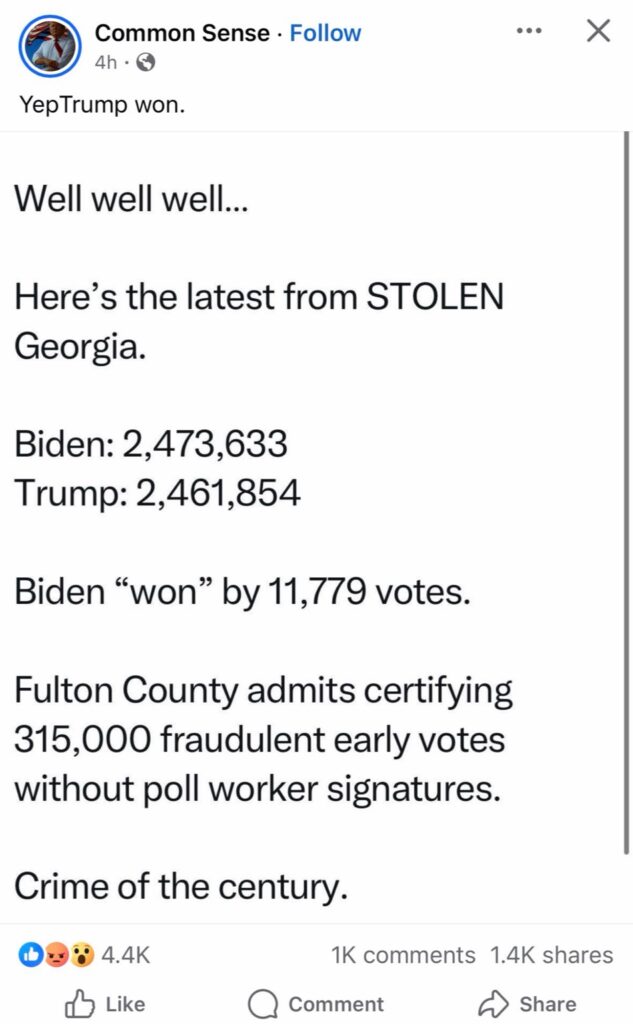
Which brings me to what was admitted by the attorney for Fulton County. At no time did she say they had violated the law. She admitted that the tapes did not have the required signatures and that it was a violation of the rule. That has been extrapolated by many to mean the law. Again, not the same thing.
In plain English, a law is something the legislature actually votes on and passes, then the governor signs, it lives in the code and it is the baseline rulebook for what the state requires. A rule is different, it is written by an agency or board that the legislature has authorized to fill in the details, the rule is meant to carry out the law in the real world, like the step by step procedures election workers follow on Election Day. Rules still matter, they can be enforceable, and people can get in trouble for ignoring them, but they are not the same thing as a statute, because they were not passed by elected lawmakers. That distinction matters when people argue that “the law was violated,” because sometimes what they really mean is that a procedure in an agency rule was not followed, which may call for corrective action and accountability, but it is a different claim than saying the legislature’s law itself was broken, and it also affects what the remedy can be if someone wants a court to step in. Again, we will come back to that.
Did Raffensperger Not Question the Election?
Cross’s line that Secretary Raffensperger supposedly “accepted” Fulton’s numbers and “folded” them into the statewide total “without questioning them,” as if the state just shrugged, rubber stamped whatever Fulton handed over, and moved on. That framing is powerful, because it makes the rest of the argument feel inevitable, if the Secretary of State never questioned anything, then of course you should be furious, and of course you should assume the worst, but the problem is that it is not a fair description of what actually happened in Georgia after the 2020 election.
Start with the most obvious rebuttal, Georgia did question the outcome, publicly, aggressively, and in ways that are specifically designed to catch real errors, including outcome changing ones. Raffensperger announced a risk-limiting audit of the presidential race that, because of the tight margin, triggered what became a full manual hand tally of the ballots statewide, and his office announced that the audit “upheld and reaffirmed” the original outcome produced by the machine tally. The Carter Center, which observed the audit as the only credentialed nonpartisan observer, described it as the largest hand tally of a race in U.S. history, and its report explains how the audit was implemented and what it found, which is a far cry from “without question.”
Then there is the rest of the timeline people conveniently forget when they repeat the “no questions asked” line. Georgia certified results after the audit process, the Trump campaign requested a recount, and Georgia recertified the result after that recount was completed, again, not exactly the behavior of someone who is refusing to look under the hood.
None of this means paperwork failures should be ignored, and none of it means rules violations do not matter, they do, and accountability is part of integrity, but the “Raffensperger accepted it without question” talking point only works if you pretend the audit, the hand tally, the recount, and the recertification never happened.
Are the tapes the “sole legal certification” that the reported totals are authentic.
No one who understands how elections work would make this claim.
Georgia does not run elections on a single piece of paper. A signed results tape is one checkpoint, it is like a receipt that helps anchor what a specific scanner recorded at a specific time, but it is not the entire accounting system, and the absence of that signature does not magically erase the other records, the other cross-checks, and the other safeguards that exist precisely because humans sometimes screw up documentation.
For example, at the precinct level you have the basic reconciliation that has to make sense for the election to hang together, the number of voters checked in, the number of ballots cast, the number of ballots scanned, the number of spoiled ballots, the number of ballots that went into the emergency bin if a scanner was down, those figures are tracked on separate forms and compared, and when they do not match there is supposed to be an explanation, and that reconciliation process does not disappear just because a signature line is blank on a tape. Then you have the chain-of-custody controls, seals, envelopes, labels tied to specific scanners, memory cards packaged with the tapes, transport logs, the boring but essential “who touched what and when,” and again, a missing signature is a problem inside that system, but it is not the system itself.
And on top of the precinct documentation, you have the county and state level safeguards that exist specifically to validate totals beyond a single tape. Certification is performed by election officials after the canvass and consolidation process, not by a poll worker’s pen, and in 2020 Georgia went much further than the minimum, the state conducted the risk-limiting audit of the presidential race that became a full manual hand tally, which is about as direct a check as you can possibly do, humans looking at paper ballots and counting them, and that process reaffirmed the reported outcome. That matters, because when someone tells you “unsigned tapes mean we have no idea if the totals are real,” they are asking you to pretend a statewide hand count, a recount process, and the other post-election review steps did not exist, even though those safeguards are exactly what you would look to when you are trying to separate a paperwork failure from an actual miscount.
So the simple way to say it, and I want readers to keep this straight in their heads, is that unsigned tapes can be evidence of sloppiness, bad training, and rules being ignored, and that should trigger enforcement and accountability. But it is not proof of fraud, it is not proof the totals were wrong, and it is not the only way authenticity is established, because authenticity in a real election is established by the whole web of records and cross-checks working together.
Is it Impossible (in 2020) for votes to still be counted at 2AM?
Cross also leans hard on what he calls “impossibly late hours,” pointing to tabulator tapes that show a “poll closing time” like 2:09 a.m., and he presents that as if Fulton literally kept the polls open into the middle of the night, which would obviously be illegal, and therefore must be proof of something dark and deliberate. But that is not what a late timestamp on a tape actually proves, because what you are usually looking at on those tapes is the time the tape was printed during closeout and reporting, not evidence that voters were casting ballots at 2:09 in the morning. And the context Cross skips is that back in 2020 early in-person voting equipment and memory devices often got closed, uploaded, and reconciled at the elections office on election night, after the statutory poll-closing time, and sometimes well after midnight, especially because they were dealing with high-volume units that have been running for days at advanced polling locations.
Georgia law is clear about when Election Day polls are supposed to be open, 7:00 a.m. to 7:00 p.m., and that is exactly why the “2:09 a.m.” rhetoric is so effective, it makes it sound like somebody just ignored the statute. But the other side of that same reality is also true: in 2020, Georgia’s rules for absentee and early processing explicitly allowed counties to scan accepted absentee ballots before Election Day while prohibiting any tallying or tabulation until the time for the closing of the polls on Election Day, which means the act of producing totals and the paperwork that goes with it is, by design, something that happens after polls close, and in a large jurisdiction, that process can run late into the night without implying ballots were being secretly cast.
Dominion voting machines used for early voting have thousands and thousands more ballots captured than day of election voting machines. As a result, the machines used for early voting take a lot more time to tabulate the results, often hours longer. Waiting to start this process until after 7:00 PM makes a 2:09 AM timestamp plausible and likely, especially in larger jurisdictions where the same people processing absentee ballots are responsible for kicking off the tabulation of machines across 30+ locations.
It is also important to know that when the General Assembly passed SB 202 they now require reporting of early vote totals by 8:00 PM. If I were giving the benefit of the doubt, it may be possible for people to confuse current law with what was in place back in 2020, when no such requirement existed.
Back to the SEB meeting itself, you can see a version of this operational reality being described out loud, the discussion explains that the system would not allow certain early vote results to be loaded until the polls were closed, and once those cards were loaded on election night, they were able to close out and successfully upload results, which is exactly the kind of mundane, unsexy explanation that produces late-night timestamps without producing late-night voting.
So, if somebody wants to argue that “2:09 a.m.” is evidence of fraud, they have to do more than wave at a timestamp and act scandalized, they have to show that ballots were cast when the polls were supposed to be closed, or that results were unlawfully generated early, or that chain of custody was actually broken in a way that changed counts, and a late printed tape, standing alone, simply does not clear that bar.
Cross’s Claim that Fulton had no legal authority to certify the election
David Cross wants us to believe that a missing signature on a tape is not just a compliance screwup, it is a legal nullifier, that the votes become “uncertified by definition,” and therefore the county either never had authority to certify them in the first place or the certification is void. This would then become the rhetorical runway for people to shout “illegal votes” and demand retroactive decertification.
This argument collapses a line that matters, the line between what the law says and what the State Election Board rules require, and it also ignores what Georgia’s election code actually does with errors.
Start with the rules, because that is where the signature language lives. The SEB’s election rules say poll officials “shall” print three result tapes and “shall sign each tape,” and they spell out where those tapes and the memory card go afterward. That is a real requirement, and if it was not done, that is a real rules violation.
But the leap from “rules violation” to “county had no authority to certify” is not supported by the statute. In 2020, Georgia law placed the duty to compute, canvass, tabulate, and then certify the consolidated returns on the county superintendent, and it sets deadlines for doing it. The statute does not say, “and if a poll worker fails to sign a tape, the superintendent loses authority and the votes are legally uncertified.” It says the superintendent publicly canvasses, investigates discrepancies, corrects errors, and then certifies and transmits the consolidated returns.
Even more telling, the code anticipates that certifications sometimes have problems and get fixed, it does not treat the first paperwork failure as an automatic election death sentence. If the Secretary of State finds an error in the certified returns, the Secretary “shall notify the county” and “direct the county to correct and recertify,” and then the Secretary issues a new certification based on the corrected returns. That is how the law is designed to work: correction, recertification, and documentation, not retroactive mass invalidation by slogan.
And if someone believes an irregularity is serious enough to change the result, Georgia law provides a specific remedy, an election contest in superior court. That option exists for a reason, elections cannot be left in limbo forever, and “decertify it years later” is not a tool the statute hands to activists who show up at a board meeting with a nuclear demand.
Cross’s Requested Remedy is Illegal and would Crush the Concept of Fair Elections
When Cross says “decertify,” he is asking you to imagine there is some clean, retroactive “undo” button sitting on the State Election Board’s desk, like the Board can reach back into 2020, peel Fulton’s advanced voting totals out of the certified returns, and stamp the whole thing “uncertified” after the fact. But that is not how Georgia’s system is built, and it is not how election law works in practice. Georgia law has a certification process, and it has a contest process, and the contest process is the mechanism for challenging outcomes, with tight deadlines, in court, on specific grounds, not years later in a public meeting because somebody does not like how a paperwork dispute sounds on social media.
If you want to see the guardrail in black and white, look at the election contest statute, it says a petition to contest an election “shall be filed” within five days after certification, or within five days after certification following a recount, and it lays out what has to be alleged. That is not a technicality, it is the entire point, elections have to end, the law provides a narrow window to challenge them, courts adjudicate those challenges, and then the state moves on, because a system that can be reopened years later on demand is not a secure system, it is a chaos machine.
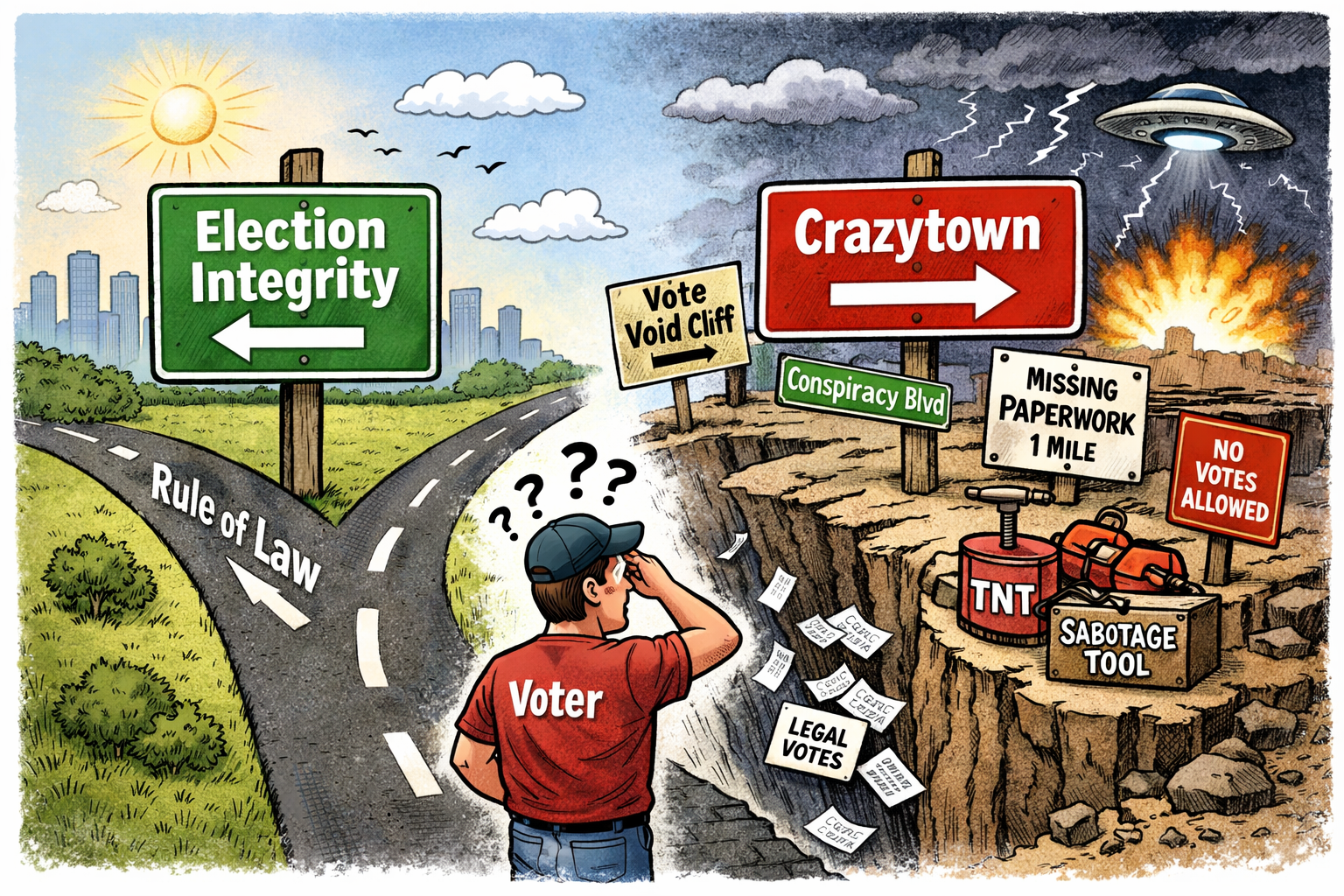
Now, yes, the State Election Board has real authority, it can investigate, it can subpoena, it can enforce the chapter and the rules, and it can refer matters for further action, but that is about compliance, enforcement, and accountability, not about rewriting certified results whenever a complaint is filed. And the Secretary of State’s own Elections Division says it plainly on its “How To Request An Investigation” page, the SEB “has no authority to order a new election” or “change an election result,” and a request filed with that form “will not alter the results of an election.” That is the opposite of what Cross is selling, and it is why the “decertify it” demand belongs in Crazytown, because it pretends the Board can do something the state’s own published guidance says it cannot do.
And if you want to zoom out even further, Georgia courts have been moving in the exact opposite direction of Cross’s theory, emphasizing that certification is a mandatory duty for election officials, and that disputes about irregularities are supposed to be raised through the channels the law provides, not by refusing certification or trying to create an ad hoc veto after the fact. So when you hear “decertify,” what you are really hearing is not a realistic legal remedy, you are hearing a political demand dressed up as an integrity cure. And the reason it sounds appealing to people who are angry is the same reason it is dangerous, because it trains voters to think elections are provisional forever, subject to being invalidated whenever somebody finds a procedural flaw and decides to treat it like a kill switch.
What Cross is asking for is not election integrity, it is lunacy.
If you build a system where missing signatures from poll workers can retroactively invalidate hundreds of thousands of lawful votes, you have created the perfect sabotage tool. A bad actor could see results they dislike and conveniently “forget” to sign, hoping to blow up the election after the fact. Allowing this type of error to weaponize paperwork to undo an election is Crazytown.
Closing Thoughts
Here’s the bottom line, and it is the part that gets lost when people turn a rules violation into a viral “stolen election” headline. If a poll worker failed to sign a required tape, that is a real problem, it reflects sloppiness, poor training, or a breakdown in supervision, and it deserves consequences for the people responsible, but it is not, by itself, proof that the totals were wrong, and it is not a magic wand that turns lawful votes into “illegal” votes by definition.
And this is why the remedy matters as much as the accusation. If you normalize the idea that missing paperwork can retroactively void hundreds of thousands of ballots, you are not building integrity, you are building a sabotage tool. You are telling every future bad actor, “If you ever want to blow up an election you do not like, you do not have to hack anything or persuade anyone, just make sure the signature line stays blank.” That is not conservative, it is not rule of law, and it is not remotely compatible with the idea that elections have to end so the people can govern themselves.
So yes, demand compliance, demand accountability, demand competence. If the rules say sign the tapes, then sign the tapes, every time, in every precinct, with supervisors who actually verify it, and with discipline when it does not happen. Fix training, fix checklists, fix closeout procedures, and if an investigation shows intentional misconduct, prosecute it. But do not punish voters because a government employee goofed up, and do not pretend the State Election Board has some retroactive “undo” authority that the law does not give it.
If you want to persuade serious people, stop leading with slogans and start leading with evidence, and with remedies that fit the legal system we actually have. Elections are not meant to be provisional forever, they are meant to be run cleanly, challenged promptly through the channels the law provides, and then finalized. Anything else is not election integrity, it is Crazytown, and it is exactly how you train the public to distrust outcomes no matter what the facts say.
Yes. I used Crazytown several times. I can think of no better home for some of these shortsighted folks.

Wait a sec…
This graf puzzles me: “Cross also leans hard on what he calls “impossibly late hours,” pointing to tabulator tapes that show a “poll closing time” like 2:09 a.m., and he presents that as if Fulton literally kept the polls open into the middle of the night, which would obviously be illegal, and therefore must be proof of something dark and deliberate. But that is not what a late timestamp on a tape actually proves, because what you are usually looking at on those tapes is the time the tape was printed during closeout and reporting, not evidence that voters were casting ballots at 2:09 in the morning. And the context Cross skips is that back in 2020 early in-person voting equipment and memory devices often got closed, uploaded, and reconciled at the elections office on election night, after the statutory poll-closing time, and sometimes well after midnight, especially because they were dealing with high-volume units that have been running for days at advanced polling locations.”
I’m an election worker in Virginia. The idea that an early voting location (Fulton had 37, you said) would close the polls but NOT run tapes and properly shut down the machines so the thumb drives could be removed and put in the right places is the real CRAZY TOWN.
In my eight years working the polls, we are always careful to close the polls and the scanners the right way. We wouldn’t dream of shlepping an unclosed, unsecured scanner back to election HQ without having run the tapess (we run and sign multiple copies, always), then unlocking the machine and breaking the plastic seals to get into the compartment where the USB stick is secured to remove and secure it.
You’re telling me that 36 out of 37 early voting locations just packed up the machines unclosed, brought them to the election HQ, and left them???
Explain this please.
They were not the Election Day machines, they were the early, in person machines from over 30 locations. This machines were transported to a central location after early voting ended.
They also ran the tapes. They exist. The law did not require they be signed, but the rules did and that was a new rule because before 2020 Georgia used Diebold touchscreens.
I also am saying there were rules violations. That is not disputed.
But none of it shows votes were changed.
That’s a bigger breach than just forgetting to sign the tapes.
I’m going by what I have been trained to do in Virginia, which I assume is similar practice in Georgia.
What that means is that the morons who were serving as precinct chiefs for each of the 36 (out of 37) early voting locations don’t know their job.
If those tally tapes are timestamped at 2:00 in the morning, it means a lot more. It means they didn’t close the Diebold scanners properly when the polls were closed (in Virginia that’s 7PM. We run four or five copies of the tally tapes within minutes of poll closing.)
It also means they didn’t break the seals and remove the USB sticks properly. That means there’s no record that the scanners were closed and stopped accepting votes until it was done at HQ. At 2AM.
I would get my head handed to me if I did something that flagrantly wrong.
No, they didn’t know their job. This is not disputed. And heads have been handed out, the Fulton County elections supervisor has been gone for years.
I was on the House committee that looked into various issues of that election. I’m not excusing any of the incompetence displayed in that election as well as the primary earlier in the year. We heard testimony about people hired the day before the primary to work the polls.
But you are getting things mixed up too. We didn’t use diebold in 2020. It was also the first year of Dominion and using a paper ballot, so the testing process was new. The zero tape had never existed in Georgia until that year.
Also, these were the early in person machines and the tabulation process didn’t begin until after polls closed. They also sat at the central location from the time early voting ended until they started counting after polls closed.
Thanks for clarifying that about which machines were used.
It still puzzles me that so many of the early vote scanners were not closed properly. You say the “tabulation process didn’t begin until after polls closed” and that the machines sat, unclosed, at HQ from the time early voting ended until they started counting after polls closed.
So there were 36 (or thereabouts) UNCLOSED scanners sitting somewhere at election headquarters for what? A week? A couple days? Whatever the gap between the end of early voting and election day was, I guess.
I’m checking with the Director of Elections in my county to find out how we do things here, since I’ve never worked an early vote precinct. But I’d expect some kind of nightly closing of those machines or, at the very least, that if they have to remain “open” overnight while early voting is going on, that they be under tight guard and locked away securely.
Does the Dominion machine keep an internal log of voting times? Would it establish that no votes were scanned after the polls closed? If not, what safeguard would have shown that the polls were really closed on time?
We report our hourly vote totals (not results) to HQ using an iPhone app, so they can track how many people are coming. Obviously that’s harder with early voting machines but given the volume of votes that were cast early in Fulton, didn’t someone insist?
The tally tapes we print out at the end of voting don’t show me an hourly breakdown of the # of votes cast, just the totals. But that’s okay because in Virginia we’re scrupulous about closing the machines out within a couple minutes of 7:00pm. It’s literally the first thing we do after locking the door to the polling station. This article of yours makes me understand better WHY that is so, so critical.