

Curious Stats from Atlanta
Professionally, I’ve been a public policy analyst for about a decade, with brief stints in campaigns and an unfortunate run in a law firm (zero stars, do not recommend working in law firms). Why does this matter? Well, let me tell you a story about the City of Atlanta and some of the curiosities I have found. This post will likely be the first post of an ongoing series of indefinite length (H/T Roman Mars for the saying). It all began with a driveway that was supposed to be a three-week project finished in May of 2025. It’s September, and I still have no driveway.
When policy analysts get bored or irritated, it can bring about heartburn for other people. We know how to find information, and some, like me, can be real “extra” to borrow from my foster kid, who happens also to be a teenager with lots of thoughts. When I received the stop work order on my driveway in July, literally the day before the concrete was supposed to be poured, I was peeved. I thought the contractor had obtained the necessary permits, and the contractor thought I did. Communication is essential in all relationships; folks, don’t forget that.
One thing I learned from my priest is that when you get angry, you should instead get curious. I had an inklng that in the City of Atlanta, there were probably a lot of people who worked for the city but didn’t actually live in the city. And whoo boy did that inkling turn out to be correct. TL;DR 3045ish of 9672 employees actually live in Atlanta, or less than a third of the total headcount.
Because I was peeved and decided someone else needed to feel my frustration, I filed an open records request with the HR Department of the city. I was getting curious, remember? I asked for a data set of ALL city employees. Only a few columns, though, the department they worked for, and the city, county, and zip code of the employee’s home address. I should have asked for the state, too. But I was under the naive impression that all the City of Atlanta Employees lived in Georgia. I was wrong, 32 of the 9672 employees (as of 1 Aug 2025) live in other states.
| Alabama | 2 |
| Arizona | 1 |
| California | 1 |
| DC | 1 |
| Florida | 9 |
| Georgia | 9640 |
| Illinois | 1 |
| Indiana | 1 |
| Louisiana | 2 |
| Maryland | 1 |
| Michigan | 1 |
| Minnesota | 1 |
| Mississippi | 1 |
| North Carolina | 2 |
| Pennsylvania | 1 |
| South Carolina | 3 |
| Texas | 3 |
| Virginia | 1 |
Now I understand the situation for Maryland, DC, and Virginia employees. The city, just like the state of Georgia, has lobbyists at the federal level. But that’s still an interesting number of remote employees. Now, the great states of Alabama (where I’m from) and South Carolina (where I was educated, and no, I don’t want to talk about this football season unless it is to celebrate Clemson’s playoff likelihood disappearing faster than a sleeve of Oreos) are both close enough that you could conceivably make that commute. If you live in Heflin, AL, that’s gonna be about an hour and ten minutes on a great traffic day. Kinda like going from Lilburn to Roswell (an old commute of mine). North Augusta, SC is about 2 hours and 10 minutes. Google Maps says Anderson, SC, is under two hours, but that’s a lie. Anyone who has driven 85 in Gwinnett knows the only traffic worse in the metro area is 75 (either direction) in Henry County. But at least you get to listen to Clemson tears in the background until you get to the state line. Below is a chart with departments and states for your viewing pleasure.
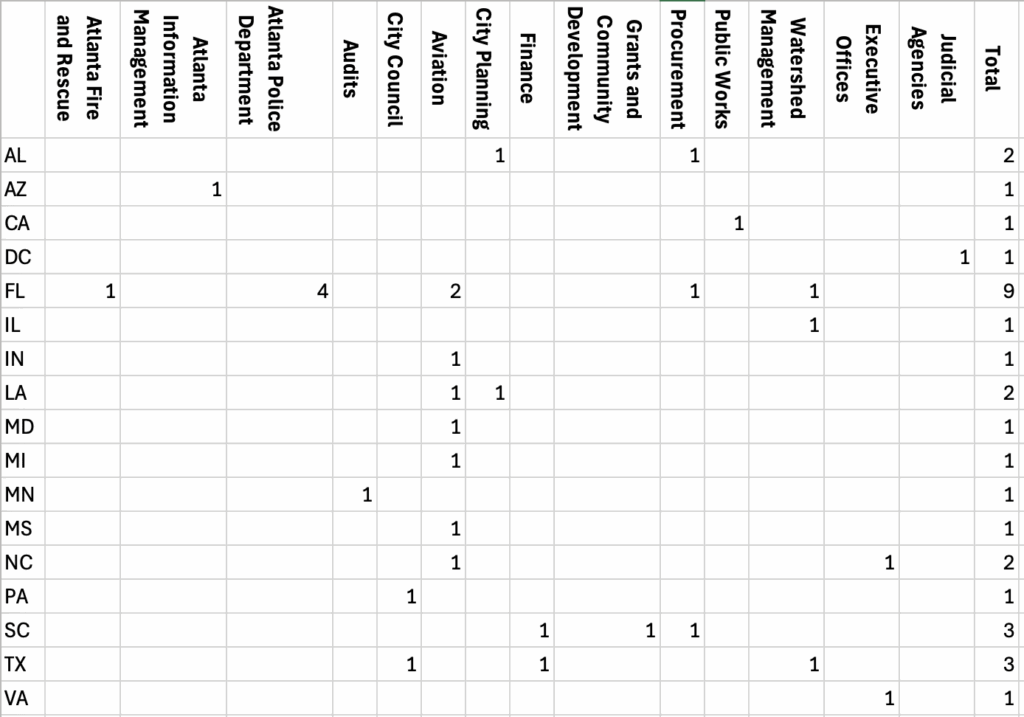
Now a deeper dive, county by county.
No surprise that Fulton and DeKalb have the two highest headcounts; Atlanta does happen to be in those two counties. I do not envy the person from Camden County or the three folks up in Walker County; that’s a long drive. Or maybe they are like the legislature, and they have a condo in town and go “home” on the weekends. Either way, that’s a very distributed workforce for a city. Especially one that was brought to its knees by a cyber-attack in 2018. Oh, and Fulton County in 2024. Don’t click strange links in emails. It’s worse than candy from strangers.
Let’s look at some departments. I am curious how one fights fires in Florida or enforces the law in Florida. Presumably, they are not sworn firefighters or law enforcement officers. Or maybe they are, and they only spend their working days in Atlanta and the rest of their time at home. Managing our notoriously bad water infrastructure from Chicago seems like an interesting idea as well.
But really, I’m more interested in city planning. Or the department to prevent development and infringe on private property rights. I have it on good authority (former high-placed mayor’s office employee) that Commissioner Prince was brought on board to “block and tackle.” Not sure what that means other than block reasonable density and zoning reforms (Atlanta Zoning gets really damn specific and pedantic, overly so if you ask me) and tackle homeowners who want to make their land more pervious for water and fix a driveway that made you apologize to the car every time you took FK to school. I know, bitter party of one, my table is ready.
Anyway, there are 267 employees at the department of city planning. A decent-sized department to oversee development and zoning issues. Not sure they plan much, but they sure do get in the way of a good idea. Looking at you, zoning reform that left out adding more R-5 (duplexes) lots in the city. But hey, Buckhead and North Atlanta got accessory dwelling units (R-1, R-2, and R-3). Dickens is running ads for his campaign, talking about building 10,000 affordable homes in the city. It’d probably be a bigger number if you allowed more hidden density in more areas of the city than just around Piedmont Park.
I digress. City planners surely want to live in the city they are planning, right? Negative ghost rider. There are 110 employees who live outside of Fulton and DeKalb. Getting more specific, there are about 98 that have a high likelihood of living within the city limits. See the methodology explainer at the end of the post. That means that a third of the city planning department is willing to live in the city they make planning decisions for. Conversely, 2/3 of the people make decisions about buildings, home renovations, additions, driveways, signs (the biggest sign I can have in my yard opposing Andre Dickens or Jasion Dozier is a total of 6 square feet and it can only be up for 180 days), just exactly how much lawn you have on the rear setback of your single-family detached residence, and exactly what you can place on that area of rear set back, have decided “to hell with that, I’m living in Clayton/Cobb/Gwinnett/Henry County.” Hell, one person said, screw it, I’m living in Alabama.
I realize we are in the era of remote work, and that, due to many decisions made by the City Council and the Department of City Planning, we have a city that people don’t want to live in. They only want to work here. These two facts definitely color the data. The four individuals working for APD are likely analysts or remote staff, rather than sworn officers. Same with the one from AFRD. Can someone do planning stuff from Louisiana? Sure, but it says a lot that they’d rather live in Iberia Parish, Louisiana, over Atlanta. BTW, I know a great little crawfish shack in Jeanerette.
This data doesn’t mean the same thing it would have meant pre-COVID-19. But it’s still enlightening that the Capital City has so many employees who either can’t live in Atlanta or don’t want to live in Atlanta. And that should prompt a few people at 55 Trinity Ave to take a moment to consider the issue.
And this is just the beginning. There’s an entire saga thanks to Jahnee Prince. I’ll bring you along for the journey. I’ll also be writing about solutions to some of these problems we face.
A quick note: although the HR Department didn’t respond within three days regarding the request’s scope and costs (which turned out to be free and entirely doable), Jamar Brown was a solid guy to work with. He apologized for the time delay, and my first contact with him was actually my complete request. I had a follow-up regarding some abbreviations used in the data set, and Mr. Brown was very responsive and provided the list I needed. I also want to note that Mr. Brown sent this data set to me at 9 pm on a Friday, while I was at a football game for FK’s school. I hope he doesn’t regularly work that late; if he does, I need the city to reevaluate its treatment of its employees.
A note on methodology. Because the post office cares absolutely zero about county and city boundaries, just look at the Cobb County Braves and their Atlanta address, the zip code 30075, which is for “Roswell” but includes parts of Cobb AND Cherokee counties -counties with zero Roswell city limits, or 30087, which straddles Gwinnett and DeKalb. There are others, but you get my point. To get a better estimate of the number of people in the actual city limits, I only considered Atlanta addresses that were in Fulton or DeKalb as real Atlanta. Does this mean that someone in Brookhaven or Sandy Springs might be counted in actual Atlanta? Yes. But it also keeps out the Atlanta address, like the Braves, who are in Cobb, Clayton, Gwinnett Counties, or the random one in the data set that’s in Henry. Additionally, there were neighborhoods included in the data like Adamsville, West End, and Cascade Heights. These were included because I know from my time in the Neighborhood Planning Unit system that these are actual Atlanta.
