
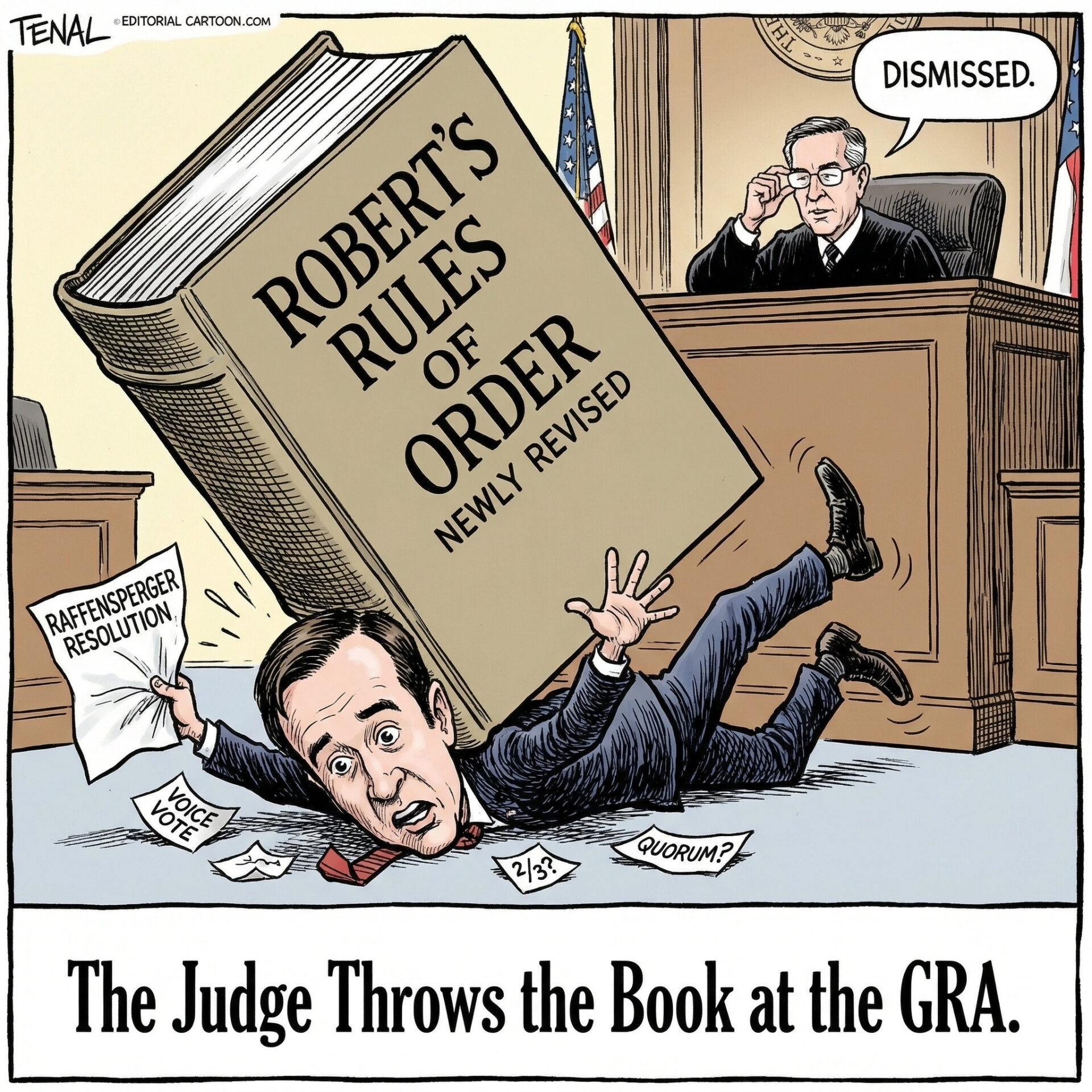
The Raffensperger Resolution That Probably Isn’t Worth the Paper It Was Printed On
Every convention has its moment of high drama. At the Georgia Republican Party’s June 2025 convention, that moment came when delegates adopted a resolution – backed by Alex Johnson and the Georgia Republican Assembly (GRA) – declaring that Secretary of State Brad Raffensperger should not be allowed to qualify as a Republican candidate in the future.
Leaders of the Georgia Republican Assembly have publicly argued that the convention’s resolution should prevent Raffensperger from appearing on the Republican ballot at all. In a post on the GRA website, Chairman Alex Johnson noted that activists had “successfully supported a motion… that prohibits the Republican Party from qualifying him as a Republican.” The same post quotes the resolution itself, stating that the party “shall not qualify… Brad Raffensperger… unless and until a GAGOP convention removes this restriction.”
At the same time, Johnson has insisted that the GRA is not currently pushing litigation over the issue.
That leaves an interesting question hanging in the air: if the party leadership refuses to enforce the resolution, and Raffensperger has now been allowed to qualify for Governor as a Republican, what would actually happen if someone tried?
Even if no lawsuit is currently planned, the legal question is worth examining.
And once you start examining it, the resolution quickly begins to look far less dramatic than it did on the convention floor.
The Curious Case of the Missing Two-Thirds
Under Robert’s Rules of Order Newly Revised, measures that discipline a member or restrict a member’s rights generally require a two-thirds vote. The reason is simple: organizations are supposed to protect members from having their rights curtailed by a bare majority.
Robert’s Rules is explicit on this point. Disciplinary measures that limit a member’s rights require either a two-thirds vote or formal disciplinary procedures with due process (RONR, 12th ed., §§63–64).
Here’s the problem: the Raffensperger resolution passed by voice vote.
And that matters.
Robert’s Rules specifically warns that when a two-thirds vote is required, the chair should use a rising vote or counted vote if the result is in doubt, because a voice vote makes it impossible to determine whether a supermajority actually exists (RONR §44:1).
In plain English: if you really needed two-thirds, someone should have been counting.
Instead, the convention simply shouted its way through the moment.
Is This Actually Discipline?
Supporters of the resolution argue it doesn’t technically expel Raffensperger from the party.
True enough.
But the distinction may not save the resolution.
The measure declares that the Georgia Republican Party will not allow Raffensperger to qualify as a Republican candidate for public office.
For a member of a political party, the ability to run in that party’s primary isn’t some minor privilege. It is arguably the central participatory right of party membership.
Robert’s Rules treats measures that deprive a member of rights of membership as disciplinary in nature (RONR §63). When that happens, the rules require basic procedural protections: written charges, notice, and an opportunity for the accused member to defend himself.
None of that happened here.
Raffensperger was not charged with anything. He was not given notice. He was not given a hearing.
Instead, a convention simply passed a resolution about him.
That’s not exactly due process.
The Quorum Problem
Then there’s the awkward question of whether the convention even had enough people in the room to conduct business.
During the convention, delegates reportedly called for a quorum check amid concerns that attendance had fallen below the required threshold. That request was apparently ignored.
Under Robert’s Rules, if the presence of a quorum is questioned, the chair must determine whether a quorum exists before proceeding with business (RONR §40).
Georgia law adds another wrinkle. Under O.C.G.A. § 21-2-153, party conventions and committees must conduct their proceedings in accordance with their adopted rules. If those rules establish a quorum requirement, as the Georgia Republican Party’s rules do, business conducted without a quorum lacks authority.
As a reminder, as the convention was nearing its end, severe weather, including a tornado warning in the area, resulted in delegates streaming out the doors to get on the road before the extreme weather hit.
In other words, if the convention had dropped below the required number of delegates, the body had no authority to adopt anything at all.
Not resolutions. Not motions. Not even the time of adjournment.
That brings up a serious question as well: Was the voice vote conducted merely out of expediency, or was it to help obscure the lack of quorum?
Either way, the result is the same: serious questions persist about the validity of the resolution.
The Curious Silence Since
Another detail makes the whole episode even more curious.
Shortly after the convention, Georgia Republican Party Chairman Josh McKoon publicly stated that the resolution would not be enforced. His reasoning was straightforward: Georgia election law governs candidate qualification, and the party cannot override those statutory procedures through a convention resolution.
Since that statement, the State Committee has met.
If Alex Johnson or the GRA believed the chairman was wrong, legally, procedurally, or politically, they had every opportunity to challenge that interpretation.
They could have raised the issue from the floor. They could have moved to direct enforcement. They could have asked the committee to overrule the chair.
To date, none of that appears to have happened.
For a resolution that supposedly represents a defining stand for the party, the silence since the convention has been… notable.
Could Party Members Sue to Enforce It?
Because political parties are treated as voluntary associations, members sometimes bring what is essentially a derivative action, a lawsuit on behalf of the organization, when they believe leadership is refusing to enforce the organization’s governing rules.
Georgia courts recognize this concept in disputes involving voluntary associations. Members may sue when officers act ultra vires, that is, outside the authority granted by the organization’s governing rules.
Courts in Georgia have repeatedly stated that they will generally not interfere with the internal affairs of voluntary associations, but they will intervene when the organization fails to follow its own rules or denies fundamental fairness. Cases involving professional associations and similar organizations have recognized that members may seek judicial review when leadership ignores the organization’s governing procedures.
A derivative-style suit would likely name the party chairman and other officers in their official capacities, because they are the individuals responsible for implementing – or refusing to implement – the convention’s directives. The State Committee, which functions as the party’s governing board between conventions, might also be implicated, though courts often allow claims to proceed against the officers responsible for the disputed action rather than requiring every committee member to be individually named.
Why Stuckey v. Richardson Doesn’t End the Conversation
Supporters of the status quo might cite Stuckey v. Richardson, where courts declined to intervene in a political party dispute.
But Stuckey involved a political decision within the party’s discretion, not a claim that leadership was refusing to follow a directive adopted by the party’s governing body.
That distinction matters.
Courts generally refuse to referee political disagreements.
But they are more willing to examine whether an organization followed its own governing rules.
If party members argued that the convention adopted a binding directive and leadership refused to implement it, the dispute would look less like a political disagreement and more like a classic voluntary-association governance dispute.
That at least opens the courthouse door.
The Election Law Problem
Even if plaintiffs cleared the standing hurdle, they would face another obstacle: Georgia election law itself.
Candidate qualification for party primaries is governed by O.C.G.A. § 21-2-153, which establishes the statutory process for appearing on a party’s primary ballot. Courts in Georgia have repeatedly treated that statute, not internal party resolutions, as the controlling authority on qualification.
A recent example arose in Catoosa County, where local Republican officials attempted to block several candidates from appearing on the GOP primary ballot unless they first received approval from the county party. The candidates obtained a court order requiring election officials to place them on the ballot after the court found that the county party’s refusal to qualify them rested on “subjective determinations and substantive issues like disagreements on tax policy and property rights.”
In other words, the court concluded the candidates met the statutory requirements, and the party’s ideological objections were not a valid procedural basis to deny qualification.
Supporters of the effort have pointed to subsequent federal litigation as evidence that the party ultimately “won.” But that characterization leaves out a critical detail.
The Eleventh Circuit did not rule that the party had the authority to exclude candidates from the ballot. Instead, the court addressed only a preliminary procedural issue: whether the plaintiffs had standing to bring their constitutional claims, and sent the case back to the district court for further proceedings.
As the court itself emphasized, the question before it was limited: determining whether the plaintiffs had alleged a sufficient injury to seek relief, not whether they were entitled to win the case on the merits.
Meanwhile, the practical result remained unchanged: the candidates appeared on the Republican primary ballot.
That distinction matters. Clearing the standing hurdle simply means a case may proceed; it is not a judicial endorsement of the underlying legal theory. And the state court’s earlier ruling remains a reminder that Georgia’s statutory qualification system leaves very little room for local party officials to substitute their own ideological screening process for the one established in state law.
Which brings us back to the Raffensperger resolution.
If the legal theory struggled to survive in a county-level dispute over local offices, it is difficult to imagine it suddenly becoming stronger when applied to a statewide race for Governor.
If a county party cannot exclude candidates over ideological disagreements under Georgia’s statutory primary system, it is difficult to see how a convention resolution could suddenly create that authority statewide.
How a Court Would Probably Rule
Even assuming a court allowed the case to proceed, the resolution itself would still face serious procedural scrutiny.
A judge would likely ask the same basic questions:
Was the required two-thirds vote actually established?
Did the convention have a valid quorum when the vote occurred?
Did the resolution impose a disciplinary restriction without due process?
Courts reviewing voluntary associations typically apply a simple standard: Did the organization follow its own rules?
If the answer appears to be “not really,” courts are unlikely to compel enforcement.
The Attorney’s Fees Risk
And that leads to the final wrinkle.
Georgia courts have authority under O.C.G.A. § 9-15-14 to award attorney’s fees when a claim lacks substantial justification.
If a judge concluded that the resolution was procedurally defective from the start, defendants could plausibly seek attorneys’ fees.
Which would create the ultimate irony: a lawsuit intended to enforce the resolution could end up paying the legal bills of the very people who refused to enforce it.
The Bottom Line
Political conventions are emotional affairs. Delegates want to send messages, and resolutions are one of the easiest ways to do it.
But organizations that adopt parliamentary rules and legal structures are supposed to follow them – even when the crowd is fired up, and the microphones are hot.
If the Georgia GOP wanted to formally bar Brad Raffensperger from running as a Republican, there were ways to attempt that within the rules.
What happened at the 2025 convention looks less like a carefully executed disciplinary action and more like a moment of convention-floor catharsis.
Which is perfectly fine, as far as catharsis goes.
But if anyone is planning to march into court demanding that the resolution be enforced, they may discover something uncomfortable:
It’s very hard to force the enforcement of a rule that probably wasn’t adopted correctly in the first place.
And it’s even harder when the people shouting “follow the rules” didn’t follow them at the convention either.
In the end, the lesson from both Robert’s Rules and the Catoosa case is the same: passion on the convention floor is not a substitute for law. You can pass a resolution on a voice vote, declare victory on a blog, and promise that the party will never allow a candidate on the ballot again…but when the issue finally lands in a courtroom, judges tend to look for things like counted votes, quorums, due process, and actual statutory authority. And if those things aren’t there, the result is usually predictable.
The resolution may have sounded powerful in the moment, but once the legal dust settles, it risks being remembered less as a decisive act of party discipline and more as a case study in what happens when political theater collides with procedural reality.
