
The State Election Board’s $50,000 “Win” For Transparency
I just spent a whole bunch of money suing the Georgia State Election Board, so you will forgive me if I am a little salty watching the same board turn around and light another pile of taxpayer money on fire because one member could not bear the thought of anyone else touching her Gmail.
And then, in the final minutes of yesterday’s meeting, she celebrated it as a “win.”
If you did not watch Wednesday’s SEB meeting, treat yourself to the last 20 minutes or so.
After coming back from executive session, board members started sniping at each other like it was a church committee fight that accidentally got livestreamed. I am not going to transcribe that whole mess, but if you want to understand how dysfunctional this board is, go watch it yourself.
What I do want to focus on is what happened right before adjournment.
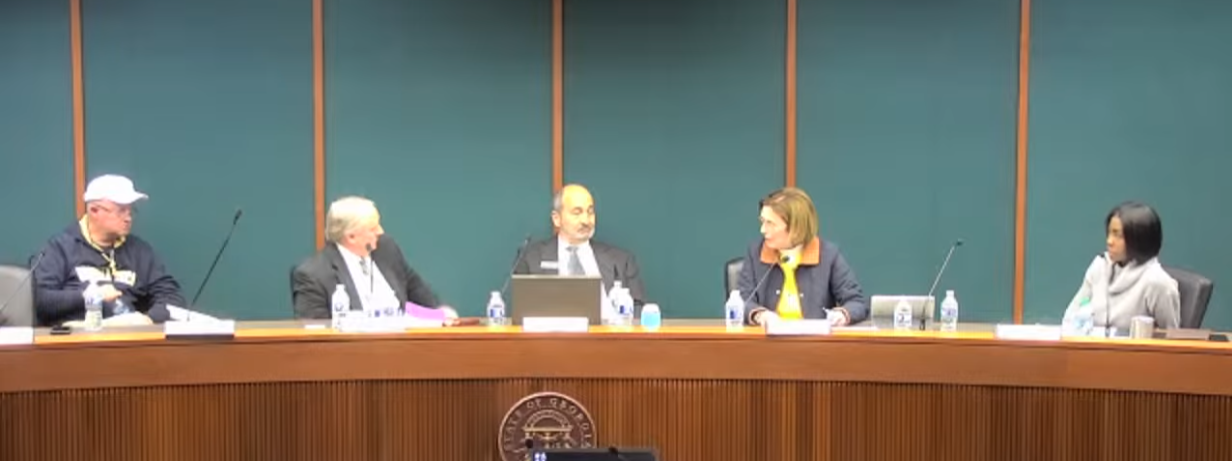
Board member Janice Johnston used the last few minutes of the meeting to drag Atlanta Journal-Constitution reporter Caleb Groves into an on-the-record dressing down. Not in a press gaggle, not after the meeting. During the meeting. On the record. As if the committee room was her personal court room show and she was Judge Judy.
She:
- Called him out by name from the dais.
- Quizzed him on AJC subscription numbers in 2005 vs today, as if she were running a focus group on the decline of local journalism.
- Asked if the drop in print subscribers was “because of the writing or the content.”
- Complained that his front-page story about her GiveSendGo legal-defense fundraiser talked too much about the lawsuit she said she “could not speak about.”
- Demanded that he explain who her “critics” were and whether calling GiveSendGo “extremist-associated” was “fact or opinion.”
- Chided him for not telling her who his boss is.
- Finished by telling him whoever edits his work should fix his grammar.
Watching a sitting state official call a reporter to the figurative witness stand in the middle of a public meeting and expect a back-and-forth debate was surreal. It was unprofessional and it was a perfect snapshot of how completely out of touch this board has become with its actual legal duties.
Because here is the thing: this is not really about how Caleb Groves writes his ledes. It is about why Janice Johnston was in the paper in the first place.
What this fight is actually about
The showdown with the liberal watchdog group, American Oversight did not drop out of the sky.
In August 2024, American Oversight filed a series of open records requests for State Election Board communications, including messages about EagleAI, mass voter challenges, and citizenship verification. Those requests covered all five board members.
Here is what happened next, according to the complaint and contemporaneous reporting:
- All five SEB members were using private Gmail accounts for official SEB business.
- The SEB’s paralegal – the person actually responsible for pulling records – was able to search the Gmail accounts of three members:
- Chair John Fervier
- Sara Tindall Ghazal
- Rick Jeffares
These three all allowed the staffer to log in and run searches for responsive records.
- Janice Johnston and Janelle King refused to allow that same employee to search their Gmail accounts, even though those accounts were being used for board business.
American Oversight started getting responsive records that showed Johnston’s Gmail address on email chains that came from other people’s accounts, but not from hers. When they asked why, they were told SEB staff did not have access to her account and could not search it.
In one request for communications involving Johnston and Jeffares, American Oversight paid a $1,300 fee and still did not receive the requested records, “in part because of Johnston’s refusal to turn over documents or provide staff access to her private email.”
So let us be very clear:
- All five members were using Gmail.
- Three of them did what the law contemplates and let the board’s paralegal search for responsive records.
- Two – Johnston and King – refused.
- The one at the center of the lawsuit was Johnston, because she chose to gatekeep.
This is not a story about a technical glitch or an overzealous reporter. It is a story about one board member who decided her personal sense of control mattered more than the public’s right to know.
Johnston’s excuse, in her own words
When the AJC asked Johnston about this back in January, she did not claim she never got the requests nor did she claim staff hid them from her. Her argument was about control, telling the AJC about why she would not let the SEB paralegal search her Gmail account:
“How could I be sure that my emails were secure – not deleted, not edited or not leaked to bad actors? … I have been very diligent in my ORR (open records request) searches.”
Let us take that apart, point by point.
If that is your concern, the last place you want your official correspondence living is on a personal Gmail account that only you control. I have heard election integrity activists rail about a lack of transparency and failure to follow best practices. Failing to follow standard operating procedures by a member of a board that is tasked with… making sure people follow procedures… is… troubling.
On a proper state system:
- Your mailbox is on a state-managed Outlook server.
- IT can apply access controls, logging, and backups.
- The records custodian and agency counsel can export and search your mailbox directly when there is an Open Records request, litigation hold, or investigation.
- There are audit trails and retention policies.
On your personal Gmail:
- There is no institutional logging of what you delete.
- There is no independent record if you decide to “clean up” your inbox before anyone looks.
- If you get hit by a bus tomorrow, the agency is locked out and so it can comply with the law.
Which system is more vulnerable to “deleted, edited, or leaked” emails? It is not the one managed by state IT.
The settlement with American Oversight requires SEB members to conduct board business “solely on official state email accounts” and to forward any board business from texts, personal emails, or apps to those accounts so it can be preserved and produced.
In other words: the fix for her fears is the thing she resisted. A state-run system with institutional custody of the records. This means state employees will now be able to gain access to her Outlook account without her consent for all future open records requests. It makes the whole reason she resisted allowing someone access to her Gmail account ridiculously moot.
“I have been very diligent in my ORR searches.”
This is not comforting.
Open Records compliance is not supposed to rely on how “diligent” one elected or appointed official feels like being. The law puts the obligation on the agency, not the individual, and gives the agency the tools to verify that the search was complete.
If her work email, documents, or messages are on:
- SEB / Secretary of State email servers
- A state-issued laptop or desktop
- State file storage (shared drives, SharePoint, etc.)
Then:
- IT and the records custodian can pull her mailbox.
- They can search shared drives and archived emails.
- They can do it without needing her to remember what to forward or what keywords to use.
Her “diligence” is not a substitute for institutional control. It is a way to keep that control in her own hands.
And here is the key point: those emails are not hers, they belong to the people of Georgia.
If she is using an account to conduct public business, those communications are public records. They belong to the people of Georgia, to be managed by the agency under state law. Not by whichever board member feels the most strongly about her inbox.
Using Gmail was a choice, not a hardship
It also appears this entire mess was avoidable.
A source with knowledge tells me that when SEB members were offered state email accounts back in 2022, they initially declined because the addresses would have been under the ga.sos.gov domain. They didn’t want the stench of the Secretary of State on them, so they preferred their Gmail.
If that is accurate, then let us recap:
- Members were offered state email accounts.
- They declined and chose Gmail instead.
- Three of them still let the staff paralegal search those Gmail accounts.
- Johnston and King chose not to.
There is no world where that choice justifies blocking a state employee from searching for public records.
Even if you insist on using Gmail, there is no excuse for saying “only I am allowed to search it.” Not when you are conducting state business. Not when other members are complying. And not when the result is months of delay and a lawsuit.
The $50,000 “win” that taxpayers lost
Now fast-forward to this week.
After a year of litigation, the Georgia State Election Board agreed to settle American Oversight’s lawsuit and the board ratified that agreement in yesterday’s meeting. The settlement does three big things:
- Requires SEB members to use official state email accounts for all official business.
- Requires them to forward and preserve any board-related communications from personal accounts, texts, or “ephemeral” messaging apps.
- Requires the board to pay $50,000 in attorneys’ fees to American Oversight, using state funds.
No admission of liability or wrong doing by the SEB and no findings. Just a board forced to change its behavior and cut a tax payer funded check.
Now go back to Johnston’s little speech at the end of the meeting. Here is the part she wanted on the record:
“Fortunately we won that lawsuit which is great and and no dollars will be needed for my legal defense. So, um, I have the hopes to either return that all of that to its donors or contribute it to a lawfare defense fund.”
She is technically correct about one narrow thing: no dollars will be needed for her personal defense.
Because the rest of us already paid.
Fifty thousand dollars in taxpayer money is going out the door to a liberal watchdog group’s lawyers because she would not let an SEB employee search her Gmail account like three of her colleagues did. That is not a “win.” That is a settlement structured around her refusal to comply with the spirit of the law, dressed up in happy talk about “no dollars needed for my defense.”
We, the taxpayers, lost and the board got forced into doing what it should have done from day one. And somewhere along the way, a chunk of her donors’ money was raised off the idea that she was a victim of “lawfare” – money she now says she might repurpose for some future “lawfare defense fund.”
If you are wondering whether this board takes its stewardship of public funds seriously, that quote should answer your question.
A pattern of dysfunction, not a one-off
This is not an isolated episode.
- According to the Atlanta Journal-Constitution and subsequent reporting by outlets like Georgia Recorder and GPB, Attorney General Chris Carr’s office emailed all State Election Board members before the July 12th 2024 ‘emergency’ meeting warning that it could violate Georgia’s Open Meetings Act. They held the meeting anyway, and the case is still pending.
- The same board whose 2024 rules on hand counting and county certifications were struck down in the EVA case after a constitutional challenge – a case I have more personal experience with than I ever wanted.
- The same board that cannot even get through a meeting without throwing elbows at each other on live video.
Taken together, this is not just a run of bad luck. It is a board that consistently tests the boundaries of the law and then acts aggrieved when courts, watchdogs, or the press hold them to it. And now we know that when it comes to emails and record-keeping, three members were willing to do what the law clearly contemplates. Two were not. The lawsuit was the consequence of those two.
How much is this clown show costing us?
We know about the $50,000 in fees in the open records case. We know my own EVA case required the state to bring in outside counsel at not-insignificant cost. We know there have been other lawsuits swirling around this board and its decisions. We also know that each time there were respected people telling them that if they continued doing things they should not do, they would get sued and would lose… so they give no consideration to what they are costing us as taxpayers.
What we do not know, yet, is the full tally.
So I am going to do what they did not want to let anyone do with their email: I am going to ask for the records.
I have filed an open records request for:
- Total legal fees and costs associated with:
- The private-email lawsuit.
- The litigation over the July 12 meeting, which the Attorney General warned them was in violation of the Open Meetings Act.
- The EVA case over the 2024 SEB rules.
- Any other recent litigation where the SEB has been a named defendant.
When those numbers come back, I will publish them and start a running tally of how much this “election integrity” board has cost the taxpayers of Georgia in legal fees alone. So check back. because I suspect the $50,000 “win” is only one line in a much longer taxpayer funded bill.
Timeline: From records request to $50,000 settlement
August 2024
- American Oversight files multiple open records requests for SEB communications, including emails about EagleAI, mass voter challenges, and citizenship verification, covering all five SEB members.
September 2024
- A Secretary of State staffer sends a partial response that includes no emails from Johnston’s Gmail, explaining staff do not have access to her account.
October 2024
- The same staffer confirms that Johnston and Janelle King are not allowing SEB staff to search their private Gmail accounts, even though those accounts are used for SEB business.
- In a separate request involving Johnston and Jeffares, American Oversight pays a $1,300 fee but still does not receive the requested records, in part because Johnston refuses to provide documents or account access.
October 30, 2024
- American Oversight files suit in Fulton County Superior Court: American Oversight v. Georgia State Election Board and Janice Johnston (No. 24-3819), alleging “systematic obstruction” of public records requests and improper use of private email.
October 31, 2024
- AO issues a public statement detailing the timeline and the Gmail access issue.
- The AJC reports on the lawsuit and the private-email allegations.
January 14, 2025
- The AJC publishes a deeper dive on SEB Gmail usage.
- They say they comply with ORRs by doing their own searches, but refuse to share passwords or allow the board’s paralegal to search their accounts.
- Fervier, Ghazal, and Jeffares allow the paralegal to search their Gmail accounts.
April 9, 2025
- The court denies the defendants’ motion to dismiss, allowing American Oversight’s case to proceed.
Mid 2025
- Following the lawsuit, the SEB transitions from Gmail to state-managed Microsoft Outlook email accounts for board business so the open records officer can directly search mailboxes.
October 24, 2025
November 12, 2025
- At its regular meeting, the SEB votes to approve and confirm a settlement agreement in the American Oversight case.
- Settlement terms:
- SEB members must use official state email accounts for board business.
- Any official business conducted via personal email, text, or “ephemeral” apps must be forwarded to and preserved on state systems.
- The board must pay $50,000 in attorneys’ fees to American Oversight from state funds.
- In the closing minutes of the meeting, Johnston tells the public that “we won that lawsuit” and that no dollars will be needed for her legal defense, framing the outcome as a victory even as taxpayers pick up the tab.
That is where we are today: a board that calls this a win, a reporter getting lectured for writing about it, and the rest of us footing the bill for a lesson in basic public records law that should never have been necessary in the first place.
