

When the Ballot Becomes a Campaign Flyer
UPDATE: The Catoosa County Board of Elections and Voter Registration, in their meeting held today, March 13, at 4:00 PM, voted to disallow the three questions highlighted below.
Two years ago, I wrote about the Catoosa County Republican Party’s attempt to use the Republican primary ballot to block candidates they did not like. A court ultimately intervened, reminding party officials of a basic principle of Georgia election law: party leaders do not get to decide which candidates voters may consider in a primary election.
With the courts blocking their attempt to block candidates, the Catoosa GOP tried one desperate, last-minute tactic…to frame the Party’s ballot questions as a way to attack the candidates they did not like, effectively using the ballot itself to campaign against the candidates that they were forced to add.
It didn’t take long before the Secretary of State notified the GRA’s “volunteer grandmothers” who ran the GOP in Catoosa that their little stunt amounted to illegal electioneering.
“Please be advised that the intent of the political party questions is to ask voters about issues,” stated Charlene McGowan in her 2024 email. “The Secretary of State cannot publish party questions on the ballot that contain the names of candidates or commentary regarding those candidates, as that constitutes unlawful electioneering” <emphasis added>.
Apparently, that lesson did not stick.
The Ballot Questions Return
This year, the Catoosa County GOP once again tried to use the ballot itself as a political tool, this time not by attempting to keep candidates off the ballot, but by once again placing statements about specific individuals directly on it.
The questions submitted for the May 2026 Republican primary ballot include the following:
“Did you know that Colton Moore is the only candidate for Congressional District 14 endorsed by the Georgia Republican Assembly?”
“Did you know that Nick Millwood has opposed Republican Party efforts to prohibit Democrats from running on the Republican Party primary ballot?”
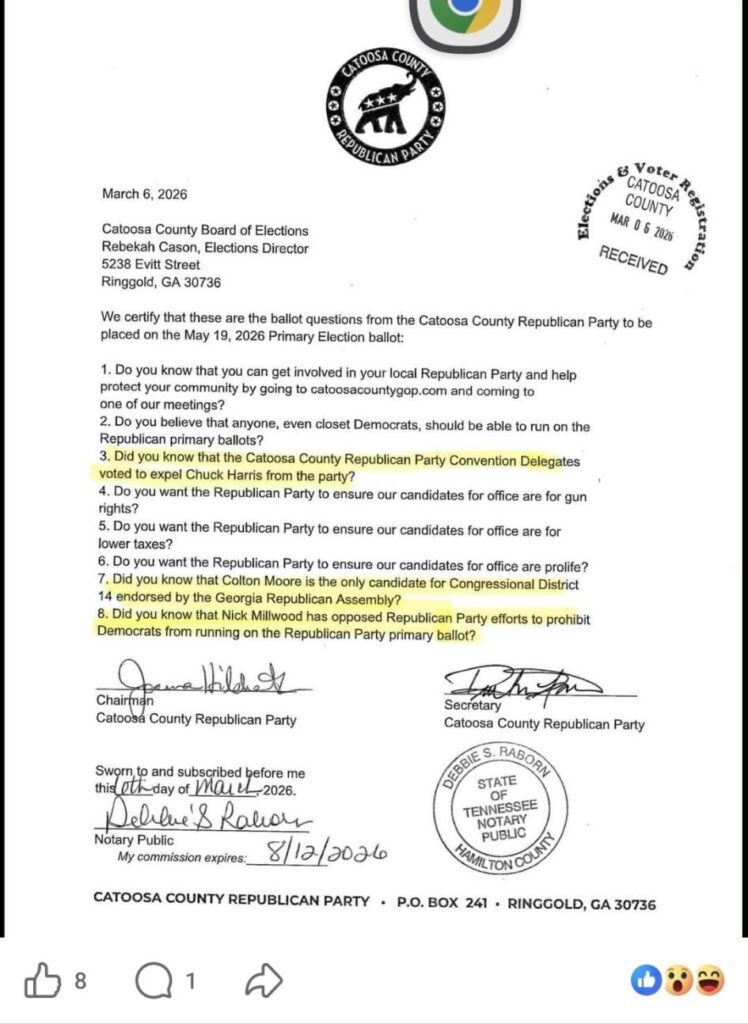
These are not neutral policy questions. They are statements about specific individuals printed on the ballot itself.
And that is where the problem begins.
Georgia law allows political parties to include non-binding advisory questions on primary ballots. Traditionally, those questions ask voters about public policy issues: taxes, immigration, education, or other matters of public concern.
But the ballot is not supposed to function as campaign literature.
Chuck Harris is running for re-election on the County Commission, while Nick Millwood is on the ballot in the primary for State House District 3.
As I noted earlier this week, convention resolutions that expel members are meaningless unless they follow due process. So, while convention delegates may have voted, Chuck Harris (and the others who were included in the resolution) was not expelled from anything but the delegates’ wishes and imagination.
What the Law Says About Ballots
The official ballot is the instrument by which voters cast their votes. It is printed and administered by government election officials using taxpayer resources. Its purpose is to allow voters to choose candidates, not to present editorial commentary about them.
As noted above, the Georgia Secretary of State’s office addressed this very issue two years ago.
That guidance could not be much clearer: Ballot questions are supposed to ask voters about issues, not comment on candidates.
Yet the questions submitted this year, once again, appear to do exactly that.
When the ballot itself begins to read like a campaign flyer, it raises serious questions about whether the election process is being used for political messaging.
Georgia’s election code defines the ballot as “the instrument by which an elector casts his or her vote.” O.C.G.A. § 21-2-2(7) <emphasis added>.
The ballot is not campaign literature. It is part of the official election machinery administered by government election officials.
For that reason, Georgia law carefully regulates the preparation and content of ballots used in elections. See O.C.G.A. § 21-2-284 (governing the form and preparation of official ballots). The ballot must present candidates and questions in a neutral format so that voters can make their own choices.
Electioneering, meanwhile, is tightly restricted in connection with the voting process. Georgia law prohibits electioneering activities that could influence voters in the act of casting their ballots. O.C.G.A. § 21-2-414.
That framework reflects a basic principle of election law: the ballot box is where voters express their views, not where political actors attempt to influence them.
Once the ballot itself becomes a platform for commentary about specific individuals, the election process stops being neutral. It becomes something else entirely: government-printed campaign messaging.
That is precisely the line the Secretary of State warned county party officials not to cross.
Yet the questions submitted for the 2026 primary appear to cross it again.
Bad Politics and Worse Process
Even setting aside the legal issues, it is simply bad politics.
Republicans believe in persuasion. We believe voters are capable of evaluating candidates and making their own choices. The purpose of a primary election is to let Republican voters decide who will represent the party in November.
When party officials try to manipulate the process – whether by blocking candidates from qualifying or by editorializing about them on the ballot – they undermine the very voters they claim to represent.
The ballot box should be where voters speak, not where party officials lecture them.
Who Owns the Ballot?
If party leaders believe a candidate is wrong on the issues, they are free to say so. They can write mailers, post on social media, hold press conferences, or debate the issue in public.
What they should not do is use the official election ballot itself – paid for with taxpayer dollars – as a messaging platform.
Georgia’s primary ballots belong to the voters, not to whichever faction happens to control a county party committee at the moment.
The sooner everyone remembers that, the healthier our elections will be.
