
Why Georgia’s Election System Still Needs a Legislative Fix
There is a good deal of confusion about what SB 189 actually did, what it did not do, and why further legislative action is still necessary. That confusion is understandable because election law is technical and the relevant provisions do not all sit in one place. Further, public discussion has often treated a narrow change in tabulation law as though it automatically transformed Georgia’s entire voting system. It did not.
The most important point is also the simplest one; SB 189 did not abolish Georgia’s use of ballot marking devices, and it did not abolish Georgia’s use of ballot scanners. What it did do was establish a deadline, July 1, 2026, after which the official tabulation count of a ballot scanner may no longer be based on a QR code, bar code, or similar coding. And while that is a significant change, it is also a limited one.
That distinction matters because some commentary has assumed that once the July 1 deadline arrives, Georgia will somehow have moved, by operation of law alone, into a different voting system. But that is not how the statute works. The provision dealing with the QR code addresses what may be used for official tabulation but it does not, by itself, repeal the broader legal structure that still governs how ballots are generated and scanned in Georgia’s statewide elections.
Under current law, Georgia’s election system still contemplates the use of ballot marking devices, commonly called BMDs, and ballot scanners. SB 189 did not repeal that framework. It did create a narrow exception for certain small county special elections, but that exception is limited and does not amount to a replacement of the statewide system used in general elections. So when people say SB 189 already moved Georgia away from BMDs, that is not quite right. The better way to describe it is this: SB 189 changed the rules governing what the scanner may rely on for official tabulation, while leaving the larger BMD-and-scanner structure in place.
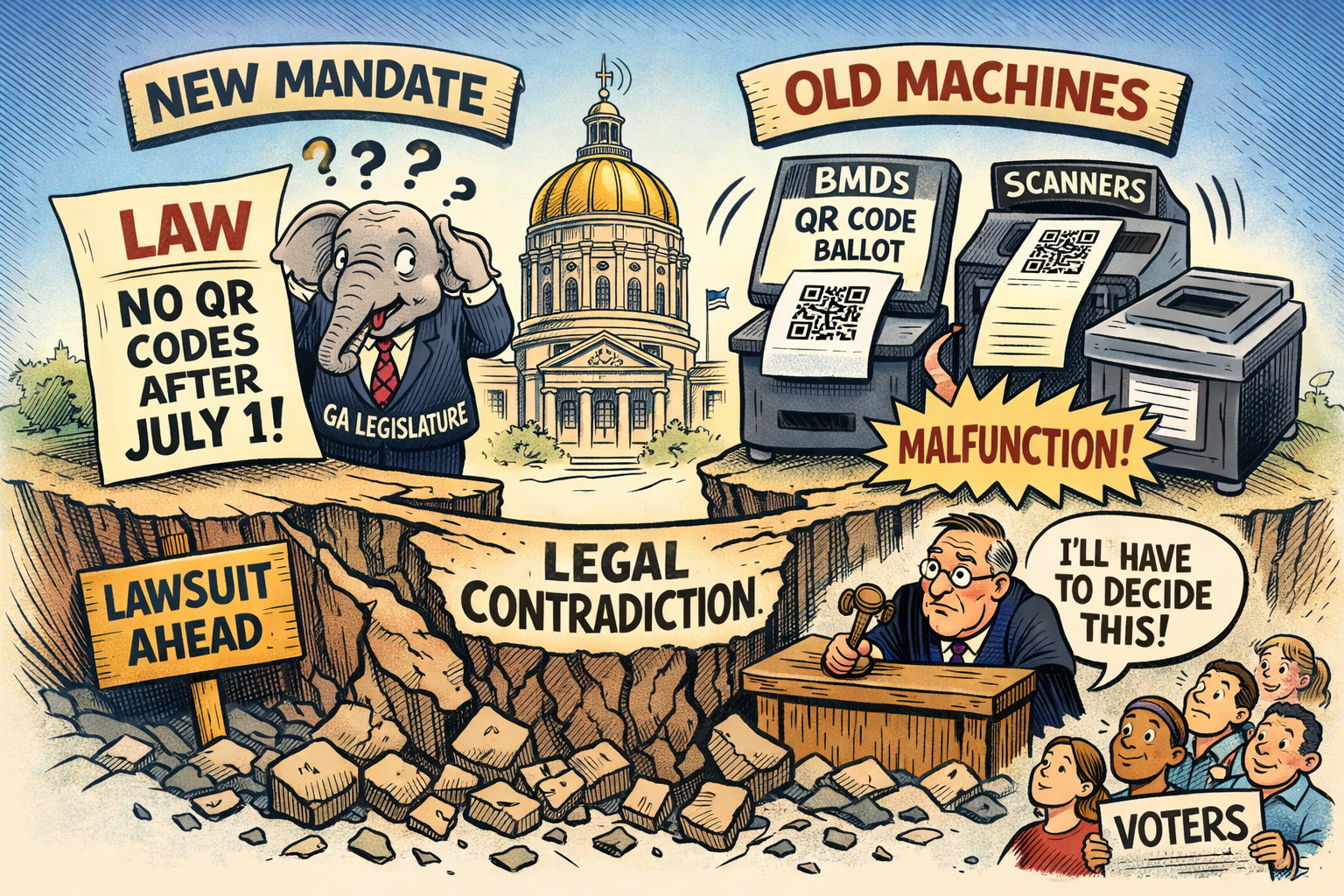
That is why the July 1 deadline presents a real issue. If the law says the scanner may no longer use the QR code for official tabulation, but the state still operates within a system that requires BMDs and scanners, then the obvious question becomes whether Georgia’s existing equipment can produce and count ballots in a way that satisfies both parts of the law at the same time.
The scanners can be configured to read ballots with bubbled ovals, but the existing BMDs are not capable of producing those ballots without a software upgrade. And with July 1st now just 14 weeks away, the time and money necessary to make that happen are not available.
To put this into a sharper focus, the issue is not simply that Georgia changed one part of its law and forgot another. The issue is that the state now faces a mismatch between what the law will require after July 1 and what the currently deployed system can realistically do.
This is why it is not enough to say, in the abstract, that scanners could read a different kind of ballot, which may well be true. The more important question is whether Georgia’s existing statewide system can lawfully and practically produce that different kind of ballot in time, using the equipment, certification, funding, and implementation timeline actually available. Based on what elections officials from across the state are saying, the answer is no.
That helps explain why legislation is still necessary. The argument for action is not that SB 189 was meaningless, nor is it that the General Assembly should abandon the goal reflected in the July 1 deadline. The point is more modest and more serious than that. If the state intends to require a different method of official tabulation, then it must also ensure that the voting system still required by law can actually comply with that requirement.
That is where SB 214 comes in, and it is important to understand what it is and what it is not. First, SB 214 is not a retreat from the policy of eliminating QR-code-based tabulation, it is the responsible way to implement that policy. A deadline written into statute does not, by itself, create the software, equipment, certifications, funding, training, and administrative capacity needed to make the transition work. If the present system cannot meet the July 1 deadline in the real world, then responsible lawmakers do not preserve the policy by ignoring that reality. They preserve the policy by creating a lawful, workable path to carry it out.
The substitute to SB 214 as passed by House Governmental Affairs appears to be an effort to do precisely that. It recognizes that the July 1, 2026 deadline arrives before the state is in a practical position to transition the system. It therefore attempts to postpone the operative deadline and provide time for a lawful and administratively workable path forward. Whether one agrees with every detail of that substitute is a separate question. What matters for present purposes is that it reflects an acknowledgment of reality: a statutory deadline is not self-executing if the machinery, software, certification, and funding needed to comply with it do not yet exist.
In that respect, SB 214 should be understood not as a reversal, but as an implementation bill. It does not repudiate the policy judgment that Georgia should move away from QR-code-based official tabulation. It recognizes that if the state wants to make that transition successfully, it has to do so in a way that election officials can actually administer and counties can actually execute. That is not a weakening of the policy. It is the only serious way to make the policy real.
If no bill passes, the most likely result is litigation. Once SB 189’s July deadline takes effect, Georgia will be left with a legal framework that still contemplates the use of BMDs and scanners, while also forbidding the use of QR codes for the scanner’s official tabulation count. That kind of internal contradiction is almost certain to invite a lawsuit, because candidates, parties, counties, and outside groups will all have strong incentives to ask a court to decide what the law now requires. At that point, the issue is no longer being resolved by the legislature in a deliberate and transparent way. It is being handed to judges on an emergency basis, under the pressure of an election calendar, with counties and voters caught in the middle.
I will go so far as to predict that anyone who wins election under such a litigated law will find it challenging to govern because there will be a cloud of illegitimacy hanging over their heads.
That is the point Peach Pundit readers should keep in mind. SB 189’s July 1 deadline affects the use of the QR code for official tabulation. It does not, standing alone, eliminate the use of BMDs. It does not eliminate the use of scanners. It does not automatically create a compliant substitute system for statewide elections. And it does not answer the very practical question of how Georgia is supposed to move from one regime to another without time, money, software changes, and certification work.
In that sense, the debate should be approached less as a fight over political symbolism and more as an exercise in sound governance. The state has already spoken on the policy question of QR-based tabulation. The remaining task is to make sure the law, the equipment, and the election calendar are brought into alignment. That is what the General Assembly is now being asked to do.
A responsible legislature should not ignore that obligation. If the current statewide system cannot meet the July 1 deadline as written, then lawmakers have a duty to address the gap directly and transparently. Doing so is not a retreat from election integrity. It is the necessary work of making election law coherent, administrable, and capable of being carried out in the real world.
Georgia can keep the policy goal and still acknowledge the implementation challenge. In fact, it has to. If the state is serious about eliminating QR-code-based tabulation, then it should also be serious about giving election officials a lawful and realistic way to get there. That is what SB 214 is trying to do.
