
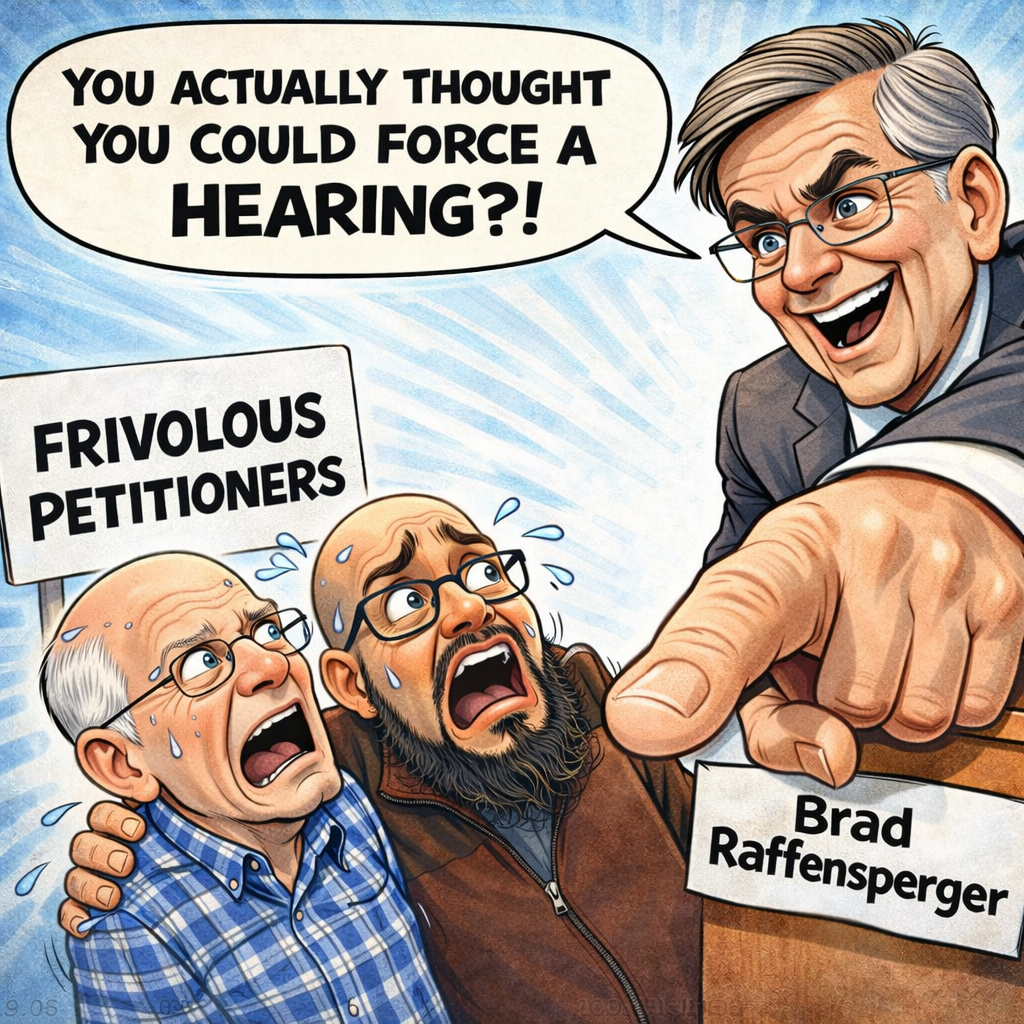
Writ It Down…You Still Need a Real Legal Claim
May it please the Court:
Respondent respectfully moves to dismiss the Petition for Writ of Mandamus because it rests on a fundamentally flawed premise: that the Secretary of State must treat any filing labeled a “challenge” as legally sufficient and automatically refer it for an administrative hearing.
Georgia law imposes no such duty.
Mandamus compels only the performance of a clear, ministerial act, not the abdication of an official’s obligation to interpret and apply the law. Because the Secretary determined that Petitioners’ submission failed to allege a cognizable statutory disqualification under O.C.G.A. § 21-2-5, no duty to refer was ever triggered.
The Petition seeks to convert that legal judgment into a mandatory act. It fails as a matter of law and must be dismissed.
Can anyone force Georgia’s Secretary of State to send any candidate challenge, no matter how flimsy, to an administrative law judge?
A new Fulton County lawsuit filed by two Republicans who just so happen to be Catoosa GOP Activists – yes, that Catoosa County – says yes!
Georgia law says absolutely not.
In justification for our Motion to Dismiss, we present the following argument in support.
I. THE LEGAL THEORY: FILE PAPER, GET A HEARING
The justification in the Petition for Writ of Mandamus boils down to this:
File something labeled a “challenge,” and the Secretary of State must automatically ship it off to an administrative law judge (ALJ).
No screening.
No legal analysis.
No adult supervision.
That’s not statutory interpretation. That’s a vending machine.
II. MANDAMUS IS NOT A TOOL TO ELIMINATE JUDGMENT
Mandamus is one of the narrowest remedies in Georgia law. It doesn’t exist to second-guess officials; it exists to force purely ministerial acts.
The Georgia Supreme Court has said exactly that:
As the Court of Appeals explained in Hill v. Kemp, “Mandamus shall not lie…to a public officer who has an absolute discretion to act or not to act unless there is a gross abuse of such discretion,” and even then, such abuse must be “arbitrary, capricious, and unreasonable.”
If an official must interpret the law or evaluate a filing, the act is not ministerial.
For many lawyers, mandamus is the legal equivalent of the “danger of quicksand” to GenXers. Mandamus was the core of the historic U.S. Supreme Court decision in Marbury v. Madison. That landmark case involved a writ of mandamus, so mandamus becomes a sought-after remedy wherever possible…sort of like growing up in the 1970s and 1980s made so many in my generation believe that quicksand would be a substantial hazard in our adult lives.
The danger of quicksand, as is the prevalence of mandamus, is vastly overrated.
Here, the Secretary necessarily determined whether the filing:
- alleged a legal disqualification, and
- fell within O.C.G.A. § 21-2-5
That is judgment. And once judgment is involved, mandamus fails...or sinks faster than Artax did in the Swamps of Sadness.
III. THE STATUTE REQUIRES A REAL CHALLENGE—NOT JUST A LABEL
O.C.G.A. § 21-2-5(b) requires:
- a written complaint
- stating reasons
- why a candidate is not qualified
That is a threshold requirement.
Georgia courts do not interpret statutes to produce absurd results:
Petitioners’ reading would require every filing, no matter how legally defective, to trigger a full administrative hearing. That’s not law. That’s procedural anarchy.
IV. THE SECRETARY OF STATE HAS THRESHOLD AUTHORITY
The statute confirms that the Secretary, not an ALJ, determines whether a candidate is qualified.
See:
In Handel, the Georgia Supreme Court made clear that the Secretary:
- is not bound by an ALJ’s findings, and
- independently determines whether a candidate is qualified
That structure necessarily includes the authority to determine whether a filing constitutes a valid statutory challenge in the first instance.
The Petitioners rely on O.C.G.A § 21-2-5(b) stating that “and shall advise the candidate that he or she is requesting a hearing on the matter before an administrative law judge of the Office of State Administrative Hearings pursuant to Article 2 of Chapter 13 of Title 50.”
But the Petitioners ignore the discretion given to the Secretary of State immediately below that: (c) The Secretary of State shall determine if the candidate is qualified to seek and hold the public office for which such candidate is offering.
In Handel, the Secretary, on her own motion, did request the hearing by the ALJ and, upon disagreeing with ALJ’s determination, vacated the decision.
Both the statute and case law give the determination to the Secretary, not the ALJ, to determine if a candidate is legally qualified. Otherwise, the State would be required to conduct hearings even where no legal issue exists.
Georgia law does not require meaningless proceedings. That purview only exists in the imagined grievances of the Election Integrity Industrial Complex ™.
V. THIS IS NOT A QUALIFICATIONS CHALLENGE…IT IS A POLITICAL DISPUTE
The alleged “disqualification” is based entirely on:
A Georgia Republican Party resolution.
That is not a legal qualification. It is a political grievance.
Georgia law addresses:
- constitutional eligibility
- statutory qualifications
Not internal party disagreements.
Courts have consistently refused to expand election challenges beyond actual legal qualifications:
You don’t get to bootstrap internal party drama into a statewide disqualification proceedings, blowing through Georgia tax dollars like it’s Monopoly money.
VI. THE PETITION RESTS ON AN UNPROVEN “ULTRA VIRES” THEORY
The entire claim depends on the assumption that the Georgia Republican Party acted ultra vires.
There is just one problem:
No court has ever said that.
The Petitioners had every opportunity to establish this since June of 2025. However, they:
- did not pursue internal party remedies
- did not seek judicial relief against the party
- did not obtain any ruling invalidating the certification
Instead, they attempt to convert an unproven allegation into a legal disqualification.
Neither the Secretary of State nor an ALJ has authority to adjudicate internal party governance. Neither has the Georgia Republican Party, its Executive Committee, its State Committee, nor any officer been made a party to this dispute…nor could they even be attached.
Courts will not intervene in internal party disputes when there are other non-judicial remedies that have not been sought.
See:
Without a judicial determination that the Executive Committee of the Georgia Republican Party acted ultra vires, there is no legal defect to adjudicate.
I already covered the fact that the Resolution itself was invalid, so no need to restate that here. But an invalid Resolution which was not enforced because it was…what was that again? Oh, yeah….INVALID! is not a credible basis for an eligibility challenge.
Instead, this is simply an act of lawfare against the Secretary of State by the usual members of the Election Integrity Industrial Complex ™ (and this time, they are openly seeking funding to pursue their waste of taxpayer resources).
VII. AGENCIES ARE NOT REQUIRED TO PROCESS NON-CLAIMS
Georgia law recognizes that agencies must interpret statutes and apply them to facts.
See:
That includes rejecting filings that:
- fail to state a claim
- fall outside statutory scope
The Secretary is not required to pretend that a legally deficient filing is valid.
VIII. THE PETITION ARGUES ITSELF OUT OF COURT
This is where things go from weak to self-defeating.
The Petition says:
“We have no legal remedy.”
Then immediately says:
“We are appealing the decision.”
Pick one.
Georgia law is brutally clear:
Mandamus is unavailable where another adequate legal remedy exists.
- If there’s a decision → appeal it.
- If there’s no decision → there’s nothing to compel.
Either way, this claim collapses.
IX. THE PURCELL PANIC BUTTON (THAT DOESN’T WORK HERE)
Petitioners try to sprinkle in a citation to Purcell v. Gonzalez like it’s some kind of legal emergency flare.
That’s…shall we say…ambitious.
Here’s what Purcell actually stands for:
Courts should be cautious about changing election rules close to an election to avoid voter confusion.
That’s it.
What it does not say:
- That courts must accelerate legally defective and frivolous claims
- That agencies must process meritless filings
- That a weak claim becomes stronger if you shout “election!” loudly enough
In fact, Purcell cuts the other way here.
Forcing:
- a last-minute administrative hearing,
- on a legally deficient theory,
- about a non-qualification issue
is exactly the kind of late-cycle disruption Purcell warns against.
So invoking Purcell here is like citing fire code to justify lighting a match in a crowded room.
X. THE CONSEQUENCES CONFIRM THE ERROR (A.K.A. WHY THIS ARGUMENT ISN’T SERIOUS)
Let’s follow Petitioners’ logic to its inevitable conclusion:
- Any voter files anything
- The Secretary must refer it to the ALJ
- The state must conduct a hearing
Congratulations! You’ve just created a system where:
- political opponents weaponize filings
- agencies are flooded with garbage claims
- and actual election administration grinds to a halt
Georgia courts do not endorse systems that reward abuse, even if that’s what the Election Integrity Industrial Complex ™ thinks that’s what the courts are there for.
Because once you eliminate gatekeeping, you don’t get fairness…you get chaos.
XI. THE ACTUAL RULE (FOR THOSE KEEPING SCORE)
Here’s the real rule under Georgia law:
The Secretary of State must refer a valid statutory challenge, not act as a courier for every document someone chooses to file.
No valid allegation of disqualification → no duty to refer.
It’s that simple.
THE HOLDING
Petitioners want this rule:
“File anything. Get a hearing.”
Georgia law says:
“State a real claim, or don’t get in the door.”
FINAL VERDICT
Motion to Dismiss: Granted.
Because the law does not require the State of Georgia to treat political theater as a justiciable controversy…and it certainly doesn’t require it to schedule a hearing for it.
