
James Mills, the DOJ, and an End Run Around the Georgia General Assembly
James Mills is not the State Election Board.
Over the past couple of weeks it has become increasingly clear that the Executive Director of the Georgia Election Board, James Mills, has gone rogue. He has taken a pair of actions, when combined with his previous outbursts of unprofessionalism, makes me question why those who appoint members to the board allow him to continue to serve in that role, because the man is doing some very serious damage.
And one of those rogue actions may have actually violated the law, but I will get to that.
TL;DR
James Mills sent one letter to Secretary of State Brad Raffensperger demanding access to sensitive GARViS voter data while claiming the request was “authorized at the direction of the State Election Board,” even though Janelle King later acknowledged the Board had never voted to send that direction. Mills then spent the next two meetings trying to get Board members to sign the letter after it had already been sent. If he knowingly misrepresented Board authorization, O.C.G.A. 16-10-8 may be implicated.
Mills then sent a second letter asking the U.S. Department of Justice to intervene in Georgia elections. The SEB did vote to authorize him to seek federal help, but the larger legal question is whether the General Assembly ever gave the SEB that power in the first place. The letter also misstated the effective date of Georgia’s QR-code ban, cited a double-voting statute in a records-retention argument, and was sent without legal advice from the Attorney General’s office.
On September 18, Mills sent Secretary of State Brad Raffensperger a four-page letter demanding access to GARViS, Georgia’s statewide voter registration system, for himself and State Election Board investigators.
This was waaaay more than asking for the voter file available to campaigns and the public. Mills wanted full dates of birth, driver’s license and state identification numbers, Social Security numbers or the last four digits, citizenship and eligibility codes, voting history, challenge and cancellation history, and identifiers used to match voters against other government databases. He also wanted ongoing read-only access to GARViS, recurring statewide and county data extracts and the ability for himself or an investigator to request additional targeted extracts.
Georgia law restricts access to much of that information for obvious reasons. O.C.G.A. 21-2-225 specifically protects Social Security numbers, driver’s license numbers and other voter information while allowing disclosure to another state agency under defined circumstances and confidentiality requirements. When we are talking about handing government employees the information that can unlock someone’s financial and personal life, following those safeguards is a pretty reasonable expectation.
That also raises a fair question about who the SEB is employing to conduct these investigations.
POST certification is the baseline Georgia uses to establish that a peace officer has met statewide standards for training, competence and professional conduct. POST describes its mission as ensuring Georgia has “qualified, professionally trained, ethical and competent” officers, and basic certification requires completion of the training established for Georgia law enforcement. Certified officers are also subject to continuing training requirements and an ongoing regulatory system that can address misconduct and certification status.
POST certification provides an independent, state established measure that the person has been trained to investigate within the law, preserve evidence, understand procedure and operate under professional standards and accountability. When an investigator is being entrusted with sensitive government data and potentially building cases that could be referred for prosecution, it feels like it should be a minimum requirement.
Chris Harvey, Executive Director of the Georgia Peace Officer Standards and Training Council, personally confirmed to me that neither Jason Frazier nor Larry Duckworth is POST certified. Strangely, that certification is not legally required to work as an SEB investigator. And while Duckworth is a licensed private investigator with previous (non law enforcement) investigative experience, Frazier is another story. The Atlanta Journal-Constitution reported that his résumé contains no law enforcement background. The two SEB investigators who resigned in March both had law enforcement backgrounds with POST certifications. Let that sink in.
The Secretary of State’s office has traditionally taken a different approach. It has publicly described its investigative staff as POST certified investigators, including a team of 23 investigators deployed on election cases in 2020. In fact one of the SEB investigators who left the employment of the board now works in the SOS’s office.
Why has the State Election Board moved away from that standard? Why did two investigators with law enforcement backgrounds leave, only to be replaced by investigators who are not POST certified, including one with no law enforcement background at all, while the agency is simultaneously demanding access to information as sensitive as Social Security and driver’s license numbers?
Those are questions worth asking, but there is an even more immediate problem with Mills’ September 18 letter.
At the bottom of it, beneath the signatures of Mills, Duckworth, Frazier and Compliance Specialist David Hancock, is this statement:
“Authorized at the direction of the State Election Board pursuant to O.C.G.A. 21-2-31(5) and 21-2-33.1(h).” Emphasis mine.
Ten days later, during the September 28 meeting, Mills told the Board that he had already hand delivered the letter to Raffensperger’s office. He had already asked for GARViS access and had already given the Secretary of State a deadline to respond. He then presented the letter to Board members and asked them to sign onto it.
Janelle King then supplied a fairly important piece of information when she said she remembered the Board discussing GARViS access, but also remembered the Board “not taking a vote” and said that it “did not move forward with the Board sending any type of direction.”
That creates a very simple timeline.
On September 18, Mills told Raffensperger that his request had been “Authorized at the direction of the State Election Board.”
On September 28, King acknowledged publicly that the Board had not voted and had not sent any direction.
During that same meeting, Mills tried to get the members to sign the letter after he had already sent it.
Mills pressed Chairman John Fervier particularly hard, telling him that he “ought to be the first signature on there.” When Fervier said he could not find the email containing the letter, Mills told him the document was sitting in front of him and was an “easy read.” Fervier declined to sign it.
Three days later, Mills tried again during the October 1 Zoom meeting and Fervier pointed out that the letter had already been sent to the Secretary of State. Mills acknowledged that it had, then asked Fervier again to sign and extended the same request to Salleigh Grubbs and Sara Tindall Ghazal. At that point, according to Mills himself, King and Carolyn Roddy were the only Board members who had signed.
Grubbs later told me that Frazier was also pressuring her for a signature. She refused because, as she put it to me, it felt wrong to sign a letter that had already been sent.
Good for Grubbs.
The significance of all this becomes clearer when you read the statute Mills was using to demand compliance from Raffensperger. O.C.G.A. 21-2-33.1(h) says the Secretary of State “shall” provide assistance “upon the request of the State Election Board” that “the State Election Board, in its sole discretion,” determines is necessary.
Mills even read that language during the September 28 meeting and King called his request “black and white.”
It might be, just not in the way she suggested.
The statute does not say the Secretary of State must provide anything James Mills requests. It says the Secretary must respond to a request of the State Election Board based upon a determination made by the State Election Board.
Mills and the three other employees who signed that letter are not the State Election Board, they are employees of the board.
There could be a previous delegation from the Board broad enough to authorize Mills to exercise this particular authority. Georgia law does permit the Board to delegate duties and powers to its executive director. If that delegation exists, Mills should produce it. What we know from King is that the Board itself had not voted on this request and had not directed that it be sent.
Until that question is answered, Raffensperger is on solid ground asking whether the statutory condition Mills cites ever occurred. The Secretary of State has an obligation to protect confidential voter information, and a letter signed by four employees does not automatically become a request of the State Election Board simply because they put it on SEB letterhead.
That timeline also creates a potentially much more serious issue. Remember when I empahsised the “direction of the board” language above? Yeah… about that…
O.C.G.A. 16-10-8 is titled “False official certificates or writings by officers or employees of state and political subdivisions.” It makes it a felony for a state officer or employee to knowingly make and deliver an official writing containing a statement the person knows to be false, punishable by one to five years in prison.
I am not accusing Mills of committing that crime. Knowledge would have to be established, and some valid prior delegation we have not yet seen could change the analysis. But if Mills knew the Board had not authorized or directed this request when he delivered an official letter stating that it had, 16-10-8 is a statute that deserves scrutiny.
So that is the GARVis letter, now we pivot to another letter James Mills sent, and this one really shows how this board has become an absolute embarrassment to the State of Georgia.
Two days after the September 28 meeting, Mills sent another letter, this time to the United States Department of Justice asking for federal intervention in Georgia’s elections.
The circumstances are different here because the Board did vote 3-2 for Carolyn Roddy’s September 28 resolution. That resolution purported to authorize Mills to seek assistance from DOJ, DHS and other federal agencies concerning Georgia’s voting system. It also gave him considerable discretion in carrying out the resolution.
Before that vote, however, Grubbs repeatedly expressed reservations about inviting the federal government into Georgia elections. She agreed that Georgia’s voting system had problems, but she was plainly uncomfortable with the remedy. Near the end of the discussion she also said she had been kept in the dark about other matters and wanted the Board to “do things right.”
Then she made a very specific request.
“If I vote for this resolution, I want to be included in the correspondence and I want to be copied on every single thing and I don’t want any surprises.”
Roddy responded by praising Mills and assuring Grubbs that she believed he would be responsive.
“I think that the executive director will let us all know as soon as a letter is developed,” Roddy said. “I look forward to seeing it.”
Grubbs immediately replied, “Member Roddy, with all due respect, that has not been my experience.”
Roddy is new to the Board, and my personal interactions with her have been pleasant. It is entirely possible she sincerely believed Mills would do what she had just assured Grubbs he would do. I hope that is the case, because Mills left her hanging after she went out of her way to vouch for him publicly.
According to Votebeat, Grubbs followed up within hours of the meeting by emailing Mills and asking to see the proposed letter before it was sent. Ghazal joined that request. Mills did not respond, and on September 30 the letters went out. Grubbs told Votebeat that she learned about them “with everybody else.” Fervier told the publication that members had not authorized the letters, had not reviewed them in advance and did not know they were being sent.
WABE has now reported on the same controversy. I told WABE that the SEB should have gone through the Georgia Attorney General’s office before sending a request of this magnitude to the federal government. WABE then reported that the Attorney General’s office said it did not provide legal advice about the letters sent to the federal government.
That lack of legal review becomes important once you read what Mills actually asked DOJ to do.
The September 30 letter asked the federal government to prohibit Georgia’s current QR-code method of vote tabulation, impose a binding six-month deadline for moving to a compliant system, compel an immediate voting-system software update, investigate the handling of election records and potentially hold Georgia officials accountable under federal law.
One of the legal premises Mills used to support those requests was wrong.
His letter states that O.C.G.A. 21-2-379.23(d), Georgia’s prohibition on using QR codes or similar machine-readable coding as the basis for vote tabulation, became effective July 1, 2026.
The General Assembly changed that date during this year’s special session. SB 3EX moved the effective date to January 1, 2028.
That is a significant error because Mills cited the supposed July 1 effective date while asking the federal government to prohibit the system Georgia is currently using. The General Assembly had just considered this exact issue and made the deliberate decision to move the deadline to 2028.
I do not know why Mills used the wrong date, and I don’t know for a fact whether it was intentional, but the implication of the error is enough. His letter could leave a federal official with the impression that Georgia was currently operating a voting system in violation of a state statute that is not actually effective until 2028.
And with that context, it feels very, very generous to call it an error.
There is another strange citation in the section asking DOJ to investigate alleged destruction, alteration or withholding of ballot images, Cast Vote Records and other election records. Mills cites 52 U.S.C. 10307(e).
That federal statute prohibits voting more than once in certain elections, not an election record retention statute.
Federal law has separate provisions governing preservation of election records, including 52 U.S.C. 20701 and 20702. That raises the obvious question of why a double-voting statute was included in a request that DOJ investigate the handling of Cast Vote Records.
The treatment of those Cast Vote Records also deserves considerably more nuance than Mills gave it. His letter accuses the Secretary of State of restricting access to and potentially altering election records. The Secretary of State has in fact begun redacting and scrambling identifying fields in publicly released CVRs. Its website says the original Record ID values are redacted and replaced with randomized characters.
There is a legitimate Open Records question about how much information can be removed while still providing the public meaningful access to election records. There is also a legal requirement that Georgia protect the secrecy of an individual’s ballot.
O.C.G.A. 21-2-379.22 requires Georgia’s electronic voting system to permit voting in “absolute secrecy so that no person can see or know any other elector’s votes.” The Open Records Act itself recognizes that information protected by law must sometimes be removed from otherwise public records, and in a variety of contexts specifically requires agencies to redact protected portions while producing the remainder.
The DVSorder problem is a concern becasue that information in election records can be combined to identify how a particular voter cast a supposedly secret ballot. If the Secretary of State is redacting an identifier because releasing it would expose the identity of a voter and that voter’s choices, there is a serious legal basis for protecting that information. Whether the particular mitigation the Secretary has chosen is the best solution can be debated. Describing the act of protecting ballot secrecy as possible criminal alteration of election records, without seriously grappling with that obligation, is a much bigger leap.
The biggest problem with the DOJ letter, though, is the power Mills was attempting to exercise.
The State Election Board voted to authorize him to seek federal assistance. The General Assembly is the body that determines what powers the State Election Board possesses in the first place.
That distinction is critical.
Last year, in Republican National Committee v. Eternal Vigilance Action, the Georgia Supreme Court reaffirmed that an administrative agency is a creature of statute with no inherent powers. The SEB can exercise powers granted by the General Assembly expressly or by necessary implication. It cannot decide for itself that a useful power ought to exist and then exercise it. And I have a hunch the General Assembly would never give a state agency the authority to request that their chosen policies be overridden.
Attorney General Carr told the Board essentially the same thing in a 2024 official opinion. When the SEB attempted to direct the Attorney General to conduct an investigation, Carr explained that the Election Code gave the Board authority to investigate itself or authorize the Secretary of State to investigate. It did not give the Board authority to order his office to conduct one.
That principle applies to delegation too. O.C.G.A. 21-2-30(h) allows the Board to delegate powers to its executive director, but the Board can only delegate powers it actually has.
I can find authority for the SEB to investigate election law violations, refer violations to the Georgia Attorney General or appropriate district attorney, adopt rules within its statutory jurisdiction and perform the other specific duties assigned to it by the General Assembly. I cannot find a statute authorizing the Board to ask the United States Department of Justice to compel Georgia to change its voting system, impose a six-month deadline on the state or override the timetable the General Assembly had just enacted.
If that authority exists, someone should cite it.
Everything in Mill’s letter to the DOJ is meant to be a end run on the General Assembly. Mills apparently did not like what the legislative branch has come up with and decided to counter the law by going to the federal government to force his preferred policy solutions on our state.
An unelected bureaucrat.
This is where my fellow Republicans need to think past the personalities involved and consider the precedent. The General Assembly made a policy decision to push the QR-code deadline to 2028. An unelected state employee then asked a friendly federal administration to force Georgia onto a different timetable.
A future administration will remember precedents like that.
If Republicans establish that an executive employee of a state agency can ask Washington to impose an election policy the legislature declined to enact, there will eventually be a Democratic administration perfectly happy to use the same theory of power against a Republican General Assembly.
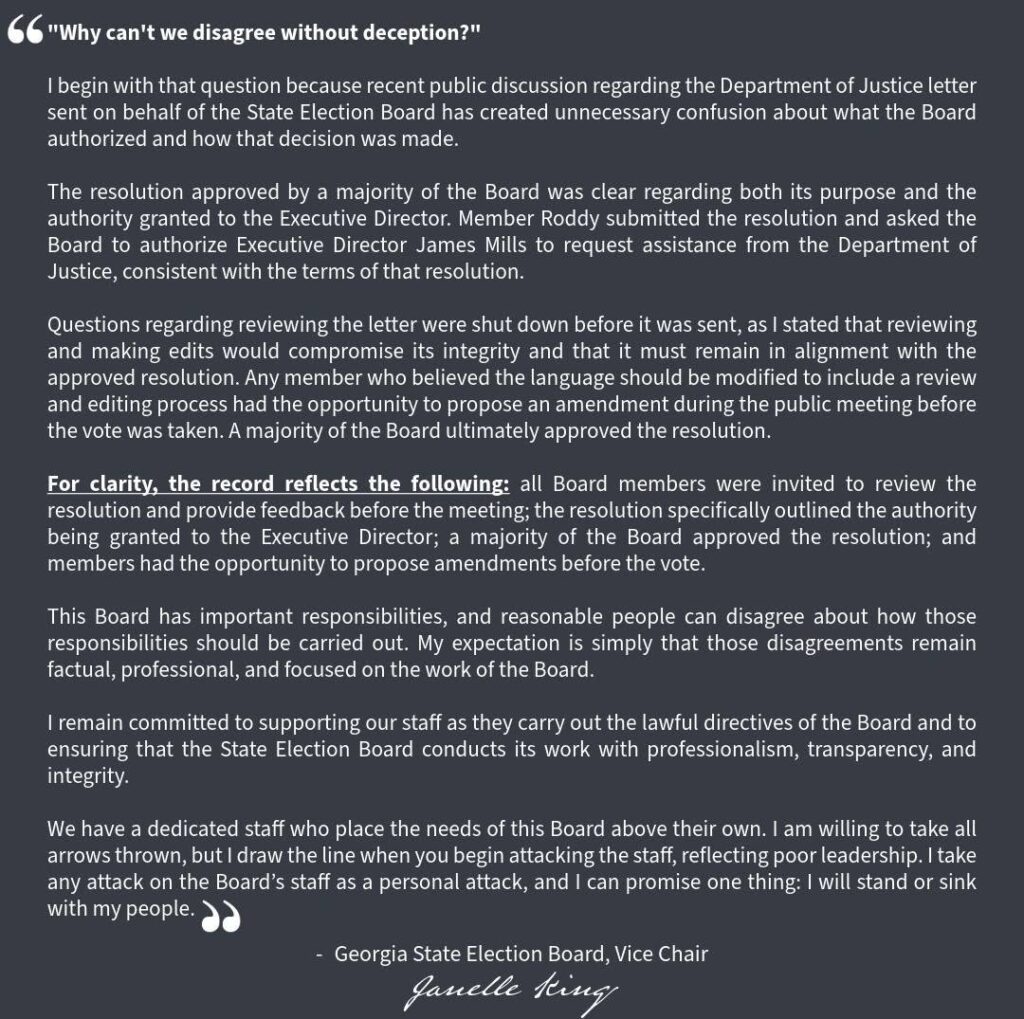
King’s social media response today does not resolve any of this. She argues that Board members had the opportunity to review and amend Roddy’s resolution before voting and that the authority to carry it out was then delegated to Mills. She also rejects the suggestion that members were blindsided by what followed.
The public transcript tells a fuller story.
Grubbs said before the vote that she wanted to be included in the correspondence, copied on everything and given no surprises. Roddy responded by assuring her that Mills would let the members know when a letter was developed. Grubbs then made the same request directly to Mills in writing after the meeting, and Ghazal joined her. According to Votebeat, Mills did not respond and sent the letters anyway.
King knew about Grubbs’ concern because she was sitting there when Grubbs expressed it. Whatever legal effect one wants to give Grubbs’ request, pretending the concern appeared only after the letters became controversial rewrites what happened in that meeting.
“Why can’t we disagree without deception,” has a different ring to it in that context.
There is a final consequence that has nothing to do with administrative law and everything to do with politics.
Georgia’s statewide races are close, and there are legislative races in play that should have Republicans concerned about every marginal factor affecting turnout. Mills has now handed the left a story about the Georgia State Election Board asking the Trump administration to intervene in Georgia’s elections weeks before Election Day.
Marc Elias and Democracy Docket immediately took advantage of it. A video Elias posted about the controversy had been viewed roughly 296,000 times when I checked it. Rahul Bali of WABE told me that Sam Park, the Democratic Whip in the Georgia House, was using it at Democratic rallies over the weekend.
The people watching that video or hearing Park on the stump are not studying O.C.G.A. 21-2-30(h) to determine which powers belong to the Board and which can be delegated to its executive director. They see Georgia State Election Board letterhead and a demand that the Trump Justice Department intervene in an election.
Mills can exceed his authority all by himself but Republicans will still get the political bill.
I have said before that this Board is dysfunctional, and the evidence continues to grow. The GARViS letter shows an executive director claiming Board authorization that the Board never gave. The DOJ letter shows the same executive director using a Board resolution to seek federal action that raises serious questions about whether the General Assembly ever gave the Board that power to begin with. Along the way, Board members who specifically asked to be kept informed say they were not, the Attorney General’s office says it provided no legal advice on the federal letters, and the resulting document contains significant legal errors.
Government process can be frustrating, especially when somebody is convinced the policy outcome they want is the correct one. The process is also part of what protects us from people who decide that their desired outcome is important enough to stretch their authority.
The legislature writes the law. The Board exercises the authority the legislature gives it. Employees of the Board carry out the authority properly delegated to them.
James Mills is not the State Election Board.
