
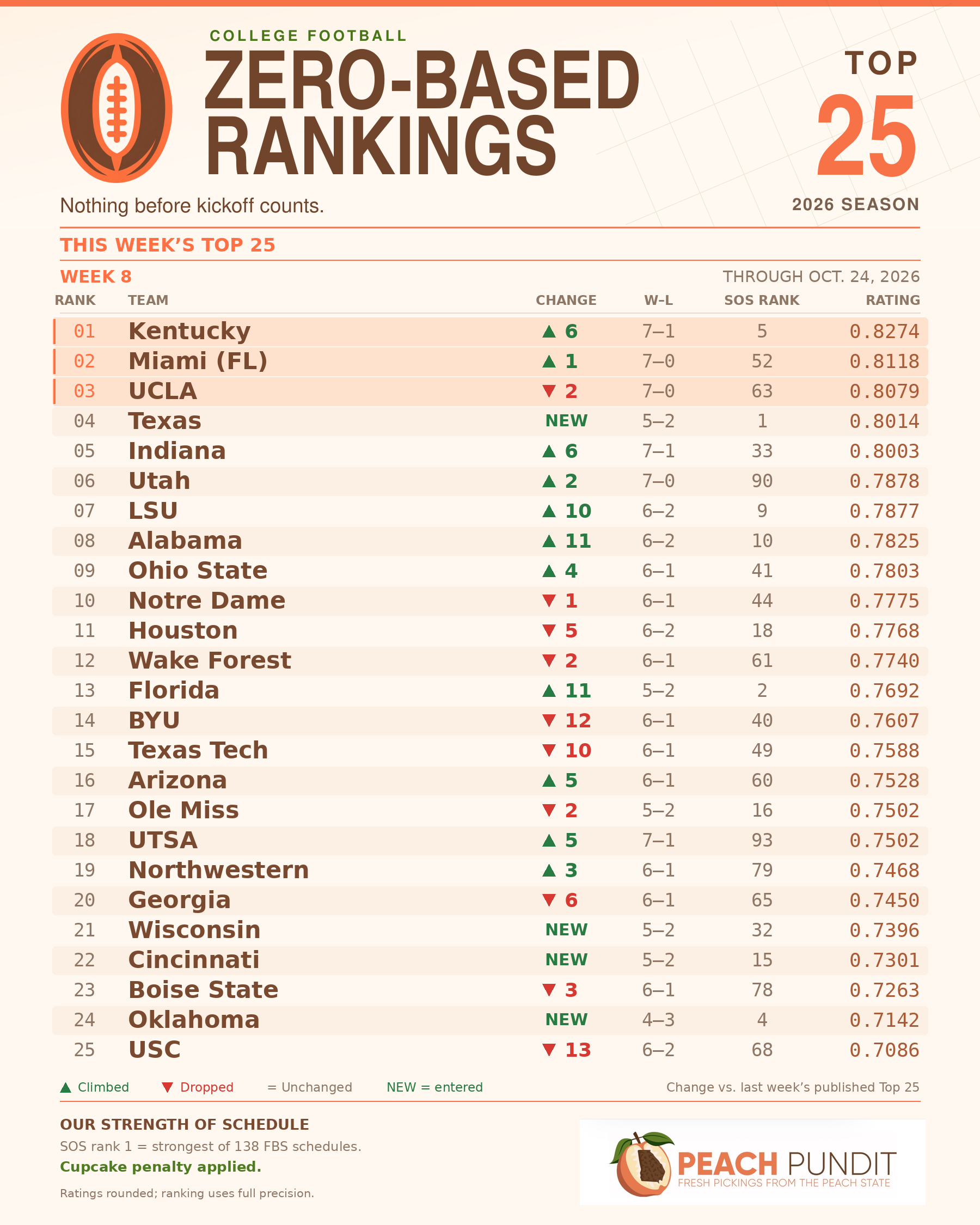
Kentucky Is No. 1. Please Remain Calm.
Kentucky sits atop this week’s Zero-Based Rankings. Texas is fourth. James Madison has disappeared from the Top 25. I look forward to everyone responding with the restraint college football fans are famous for.
Last week’s rankings generated some criticism, particularly from folks who took one look at James Madison and decided the computer needed to be taken behind the barn. Some of that discussion also made clear that people weren’t quite getting what we were trying to do. So we’ve added a strength of schedule column to the graphic for reference. We’re continuing to refine the exercise as the season develops, and that column gives readers something concrete to examine.
For somewhere between 25 and 35 years, I have been saying that preseason rankings are stupid and that we ought to wait until after Week Six to rank anybody. With the help of AI, I’m finally putting that argument through an actual season.
The waiting was always part of the point. Before the season, a supposedly brutal schedule depends on assumptions about teams that haven’t played a single snap. In October, those assumptions still do a considerable amount of work because it makes perfect since that everybody knows somebody is good because everybody said somebody was good in August. College football has managed to turn that into an entire business model that is nothing more than a built in bias machine.
By Week Six, we have enough actual results to begin building a useful measure of schedule strength from the season being played. It remains a developing picture. But we can start following who beat whom, how those opponents are doing, and what their opponents have accomplished. Conference logos supply very little useful information to that calculation.
The SOS column is our own calculation using that network of results. A lower number means a stronger schedule, with No. 1 representing the strongest among the 138 FBS teams. Nobody gets credit for the recruiting class his coach signed or the national championship his daddy remembers.
Kentucky fans, meanwhile, can enjoy their football team at No. 1 without asking permission from the basketball program. The Wildcats beat Vanderbilt 34–17 on Saturday, improving to 7–1. Their schedule ranks fifth in our calculation. Their only loss came against Alabama, now 6–2. That is a substantial body of work, even if it wasn’t the plot television executives had in mind.
Texas also has something worth discussing. The Longhorns beat Ole Miss 34–27 and land fourth with a 5–2 record against our toughest schedule. Those two losses remain on the books. So do the wins, including this one. The whole résumé deserves consideration, regardless of how much joy the phrase “Texas is back” has brought opposing fans over the years.
That result also reaches beyond Austin. As Texas strengthens its résumé, Ohio State’s earlier loss to the Longhorns carries less cost in our calculation. Every earlier game gets another look each week. Your September opponent does not remain frozen in whatever condition you found him.
Which brings us back to James Madison.
The Dukes lost 34–31 in overtime at Appalachian State on Thursday. They are now 7–1 and outside this week’s Top 25. Their schedule ranks 113th. App State apparently didn’t want to wait for our comment section to finish its deliberations.
JMU’s seven wins counted last week, and they still count. The schedule was a legitimate concern then, too. An undefeated record gave the Dukes a substantial accomplishment to put beside that concern. Losing changes the balance. That is a useful reason to keep playing the games instead of declaring the rankings finished whenever they happen to flatter your team.
BYU and Texas Tech also had unpleasant weekends. UCF beat BYU 39–31 in double overtime, while Cincinnati beat Texas Tech 37–24. The Cougars land 14th, the Red Raiders 15th, and Cincinnati joins the list at 22.
BYU’s loss also changes the evaluation of Notre Dame’s earlier loss to the Cougars. A result in Orlando can affect a résumé in South Bend. The season has a way of reaching across the country and knocking over somebody else’s beer.
That interconnectedness helps explain why a developing strength of schedule can produce some wild swings. A win over a team that keeps winning grows more valuable. A loss to a team that begins stumbling becomes harder to excuse. Several of those changes can hit the same résumé in one weekend.
Then there is the difference between a rating and a place in line. Teams can be closely packed together. Moving ten places does not necessarily mean the calculation suddenly thinks a team became twice as good. In this week’s graphic, Ole Miss and UTSA both display a rating of .7502. We retain the full precision to put them in order. Four printed decimal places don’t tell the entire story.
More games will give us more evidence. They will also give us more reasons to revisit what we thought we knew. Waiting until Week Six was never a promise that October would arrive with everything settled. It was a decision to let the players supply some evidence before the rest of us started handing out positions.
The comments are open. Please consult the SOS column before declaring the computer an employee of the SEC.
