

I must have hit a nerve…but Scot Turner didn’t bring hand-paper ballots to Georgia either.
Editor’s Note: I love this. Hopefully you, Dear Reader, are seeing that just because I own this site doesn’t mean I agree with the content of every post. When I recently wrote that I would rather put the tension of disagreement on display than just have my voice here, I meant it.-Scot
On Friday, our editor, Mr. Scot Turner, posted a piece taking issue with one that I published earlier last week on the Election Integrity Industrial Complex and Georgia Republican Party Chairman Josh McKoon, trying to finish the work Stacey Abrams had started by advocating for a voting system in Georgia that would utilize ONLY hand-marked paper ballots.
Mr. Turner starts his post with, “Remember when I told you I didn’t agree with everything that is posted on this site? Well, here you go.”
While Mr. Turner agrees with me that Abrams, “absolutely did advocate for hand-marked paper ballots,” he then goes on to fabricate some sort of narrative that I suggested that paper ballots began with Stacey Abrams.
Mr. Turner states, “But the larger framing is wrong, and it matters, because it rewrites Georgia’s actual timeline, and it erases the fact that the first serious push to move Georgia off paperless touchscreen voting, and toward hand-marked paper ballots with machine tabulation and meaningful audits, came from the right. And it came years before Abrams made it a talking point on the campaign trail.”
He then spends a good portion of his post patting himself on the back for legislation he introduced, which went nowhere, during an era before Georgia had a voting system that produced an auditable paper trail. I actually did mention this in my post to justify Abrams early advocacy, stating, “In 2018, Georgia voters were still voting on the Diebold machines, which, unlike the Dominion machines in use today, did not print a paper result of each voter’s ballot, which could then be compared to the electronic vote tally.”
I didn’t think I needed to go back and rehash the bipartisan advocacy against a system that no longer existed. Instead, I focused on the fact that when we did have a system that included both touchscreen voting along with an auditable paper trail, Abrams continued with her crusade, including lawsuits, through her second failed race for Governor, after which she has all but faded from the political landscape.
Mr. Turner mentions several times in his post, including through his headline, No, Stacey Abrams Didn’t Bring Hand-Marked Paper Ballots to Georgia, that I made the claim that Stacey Abrams brought this issue to Georgia.
He double-downs, seeming to quote my post, “So yes, Abrams advocated for hand-marked paper ballots, but no, she did not ‘bring the idea to Georgia,’ because Georgia already had Republican legislators pushing it, publicly and in bill form, years earlier.”
The problem is…at no time did I ever state that Abrams, “[brought] the idea to Georgia.”
I can defend a debate as to why I think a two-tiered voting system is better than a one-tiered voting system, but I can’t defend against made-up quotes that put words in my mouth that I never said (or typed). It isn’t even a paraphrase of something I said.
Mr. Turner mentions his long advocacy for paper ballots as a member of the Georgia House, bills that rarely went past First or Second readers, a lack of success that points to it being little more than a fringe issue at the time. While he claims, “[the first serious push to move Georgia off paperless touchscreen voting] came from me,” it depends on what you consider “the first serious push”. But let’s wait a moment on that claim as we review Mr. Turner’s own timeline:
2015: I introduced legislation to move Georgia away from our aging DRE touchscreen system and toward paper ballots, long before this became a trendy partisan talking point. I stated this plainly, on the record, in a sworn written statement to Congress describing my work starting in 2015.
While Mr. Turner types this, searching legislation from the 2015-2016 session, the only election-related legislation I could find introduced by him was HB 46, a bill that would have allowed a candidate to inspect absentee ballots up to two years after an election, at least according to the version on the General Assembly’s website. Nothing about moving Georgia away from our aging DRE touchscreen system. There were other election-related bills dropped in the House, some co-sponsored by Mr. Turner (I also checked and note that Sen. Josh McKoon did not introduce any legislation regarding paper ballots), but nothing that I could find to verify his claim. If someone does find something I missed, please put the HB number in the comments.
2017: After years of work and conversations with election officials, I introduced HB 641, which focused on requiring a voter-verifiable paper audit record for Georgia elections.
Here, Mr. Turner proposed legislation that would have required any DRE system the state purchased after July 1, 2017, to include an auditable paper trail. But again, this concerned having a two-tiered system, not hand-marked paper ballots only. What’s interesting about this legislation is that it was introduced at the end of the legislative session, on March 28, 2017, two days before sine die…not great timing if you hope for it to affect anything later that year. It did get a second reading in the House on January 8, 2018, when the legislature reconvened, but by then, Mr. Turner had other ideas:
January 2018: I introduced HB 680, a full-on attempt to replace Georgia’s touchscreens with a paper-ballot system, paired with audits, because paper without audits is just paper. That bill got covered at the time precisely as an effort to scrap Georgia’s touchscreen voting and return to paper ballots.
While this legislation, the first that I can find that State Rep. Scot Turner had introduced, which would have completely scrapped DRE voting and moved Georgia back to hand-marked paper ballots, the legislation didn’t make it past House second readers. Mr. Turner is correct that it was covered as an effort to scrap the aging system. Mr. Turner is also correct that the issue was, indeed, bipartisan, as three of the six listed co-sponsors of the legislation were Democratic House Members, and Sara Henderson, who was Executive Director of left-leaning Common Cause, GA, applauded the legislation, telling WRAL, “We don’t know what’s happening in our elections because we can’t audit them. We need a complete overhaul of our system. … This is an urgent situation.”
WRAL reported Mr. Turner as saying, “The most secure system in the world for conducting elections is pen or pencil and a piece of paper. It’s the same type of Scantron technology we’ve been using since we were kids filling out standardized tests.”
Mr. Turner’s Democratic co-sponsor, Rep. Scott Holcomb, told the press, “We have an outdated and insecure voting system. The system we have right now is effectively a computer system from 2002. How many of us are using phones from 2002? How many of us are using laptops from 2002? Not many people.”
The WRAL article also notes that Mr. Turner’s legislation would have left one DRE voting system in each precinct for one particular reason: “HB 680 wouldn’t rid the state of electronic voting machines entirely. Each precinct would also provide at least one touch screen that could enlarge text for voters with poor eyesight. The touch screen would then print a paper ballot.”
After 2018, I cannot find any new legislation introduced or co-sponsored by Rep. Scot Turner on the issue.
In 2019, the General Assembly passed HB 316, which provided for the same system Rep. Scot Turner advocated for in HB 641. While I may have missed another, and you can double-check my work, Rep. Turner was the only Republican out of the 69 Representatives who voted “NO”.
We now bring the timeline to where I started, Stacey Abrams’s campaign for Governor in 2018. And the reason we started there is simple…it’s not long after 2018 that we are now talking about the same system we use today, not an old, antiquated system that is likely now sitting in some scrap yard.
Abrams had actually very little to say on the issue of paper ballots until she ran for Governor in 2018. I was not able to find a mention in the media of her advocating for only hand-marked paper ballots prior to 2018. 2018, as I noted in my post, was the last statewide election on the previous system that was first used in 2002.
Once again, quoting WRAL:
Lawmakers and election officials say the need to replace Georgia’s voting system has been a long time coming.
The state’s touch screens use obsolete technology: the Windows 2000 operating system, which is no longer supported by Microsoft.
As such, not once did I state the issue began with Abrams or that she “[brought]” the issue to Georgia.
But unlike his claim to the contrary, the issue was not brought to Georgia by Mr. Turner either.
We can debate what is a serious push, as Mr. Truner describes his efforts. I personally don’t think it was legislation that went nowhere…not even to a committee hearing, let alone a hearing by Rules, a vote in the House, a sponsor in the Senate, passage through the committee process in the Senate to the Governor’s desk that could be called the most serious push, but rational minds can differ.
For me, the first serious push came even earlier, as the State of Georgia was considering its first purchase of the paperless, touch-screen voting system.
On March 1, 2001, the AJC reported that Republican Senator Mike Crotts had filed SB 212, “which would replace the state’s current patchwork of voting equipment with machines that read ovals filled out by voters.”
In the same article, it notes that Democratic Sen. Jack Hill had filed SB 213, which would “authorize a test of touch-screen voting machines in upcoming municipal elections.”
Both bills were referred to the Senate Governmental Operations Committee.
Crotts hits on an issue that seems to be at the heart of most of the criticisms of the touch-screen systems today: “Not everybody is computer-literate. A lot of people are even scared to death of ATM machines.”
By the 2004 election, more serious pushes were underway. After Republicans had won the Governor’s office and the majority in the State Senate (and were poised to win the majority in the State House), Georgia’s Democrats were already crying “foul” over the touch-screen system, producing headlines in the AJC, like this one on Feb. 15, 2004:
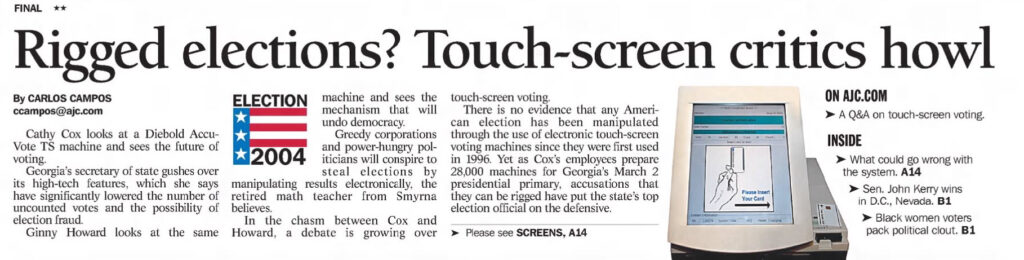
The AJC goes on to detail, “Computer experts at respected universities have sounded the alarm over the potential for high-tech chicanery. Grass-roots activists, leaders of alternative political parties and others have stoked the flames, mostly via the Web. Touch-screen related legislation is pending in Congress and the General Assembly. Some critics suspect the machines might have played a role in the surprise defeats in 2002 of two Democrats – Gov. Roy Barnes and U.S. Senator Max Cleland.”
The article goes on to quote one high-ranking Democrat, “Rep. John Lewis (D-Ga.) counts himself among the suspicious. The civil rights veteran is the co-sponsor of a bill to require machines to verify voters’ choices on paper. ‘The ballot is the most powerful nonviolent tool we have in a democracy,’ Lewis said. ‘And if that is threatened, we won’t have much left.'”
In addition to the serious push of federal legislation co-sponsored by Rep. Lewis, the article also points out what was happening in the General Assembly, and the issue was indeed bipartisan.
While Crotts may have been ahead of his time, as the touch-screen system had not been implemented yet, and I would have still given Mr. Turner the credit for introducing the first legislation to require a paper trail if Crotts’ had been the only legislation, that credit actually belongs to former Republican State Senator, Congressman, and HHS Secretary, Dr. Tom Price.
As mentioned in the same article, Senator Price dropped legislation that would have required a paper trail for voters. On Feb. 9, 2004, Sen. Price introduced SB 500, a bill, “as to provide all electronic recording voting systems to produce a permanent paper record of the votes recorded on such systems for each voter; to provide that voters have an opportunity to verify such record after voting; to provide that such paper records be retained for use in recounts and election challenge proceedings; to provide for related matters” <emphasis added>.
Unlike Mr. Turner’s legislation, Senator Price’s legislation made it through the Georgia Senate and was sent to the House, where, like Mr. Turner’s legislation, it died. While Mr. Turner may point out details as to why his and Dr. Price’s differ to support his claim that his legislation was the first serious push to move Georgia off paperless touchscreen voting, it’s hard to see Dr. Price’s legislation, dropped nine years before Mr. Turner was even sworn in as a Member of the Georgia House, as not serious.
The next serious push, and probably the first to seek a court remedy, came only two years later, in 2006, Garland Favorito and others filed the first lawsuit against Georgia’s paperless voting system.
On July 14, 2006, nearly 20 years ago, the AJC reported, “[Plaintiff Garland] Favorito said the machines lack a voter-verified paper audit trail that can be hand-counted. Such a mechanism would allow voters to match the selections made on the touch-screen with a paper ‘receipt’ produced by the machine. The receipt would drop into a locked box and could later be counted by hand, if necessary.”
The lawsuit eventually went all the way to the Georgia Supreme Court before the plaintiffs lost.
There are a lot more articles that detail the efforts by Georgia activists, mostly on the Democratic side, but with enough serious Republicans to make a strong case that the concerns with a paperless voting system was truly bipartisan (and for the record, I had my own concerns as well, just not the platform) that it’s clear that Mr. Turner’s self-congratulating article rewrites the debate timeline to make him the hero while ignoring the work that Sen. Mike Crotts, Sen. Tom Price, Cong. John Lewis, Cong. Cynthia McKinney (who in 2006 also introduced her own legislation in the U.S. House), Garland Favorito, and many others engaged in long before Mr. Turner was elected to the Georgia House of Representatives.
But now, as the historical timeline has been explained, re-explained, and corrected, let’s look at some of the other claims that Mr. Turner makes in his post:
Courts “declining” to order a remedy is not the same thing as experts “declining” to recognize risk. Shepherd argues there is “no credible evidence” that elections conducted exclusively with hand-marked paper ballots are categorically more secure than systems producing paper records and subject to audits, and he leans on the fact that judges declined to order hand-marked paper ballots as a litigation remedy.
But litigation outcomes are about standards of proof, jurisdiction, remedies, timing, and judicial restraint, not a scientific stamp of approval on whatever system a state happens to be using at the moment, and not a declaration that all “paper-backed” systems are equal in verifiability.
If you want to argue for ballot-marking devices, or against them, you can, but do it honestly: talk about usability, accessibility, throughput, chain-of-custody, audit design, and what exactly gets tabulated (human-readable text versus a barcode or QR code), and do not pretend that “a judge wouldn’t order it” settles the security debate. (emphasis added)
If you were to only read Mr. Turner’s post, you would reasonably believe that I settled the issue of security in the courts alone. Knowing that I am an attorney, a reasonable person may also assume that’s where I stopped. By the fact that Mr. Turner stops there, I have to assume that was the impression he wanted his readers to be left with.
It’s simply not true.
While the marginalization of court testimony by Mr. Turner could be excused, as an attorney, I know that any serious litigation into election security would also involve expert witnesses, each testifying to the very issues Mr. Turner is articulating. Here, the court would weigh the evidence of the election experts and decide if there is any risk as contemplated by the plaintiffs in the case.
However, I would not be doing my job in making my case if I did not bring in my own expert testimony into my post. First, I actually did write that paper ballots DO eliminate certain risks, “namely, fears of direct machine manipulation.”
Then I note that they introduce others, including:
- Ballot substitution
- Ballot destruction or “loss”
- Chain-of-custody vulnerabilities during transport and storage
- Hand-count manipulation or selective miscounting
- Increased opportunities for insider misconduct
- Delays that erode public confidence and invite post-election chaos
I then backed up my statement, not by quoting case law or the O.C.G.A., but with an article in Scientific American, which agreed “states that vote using electronic systems backed by auditable paper trails are the most secure.”
The article even highlighted Georgia’s model, stating, “Georgia’s polling sites used hand-fed optical scanners; an audit of the nearly five million votes cast in the state, the largest hand count of ballots in recent U.S. history, confirmed that President Joe Biden won. County error rates were 0.73 percent or less, and most had no change in their tallies at all.”
So, even though Mr. Turner makes a claim that I did not talk “honestly” only, “pretend[ing] that ‘a judge wouldn’t order it’ settles the security debate,” I certainly did not rely solely on a judge’s order as the sole scrap of evidence on which to rest my case.
Mr. Turner goes on to pontificate about QR codes (which were eliminated by legislation passed in 2025 and were not mentioned in my post) and other issues that he may have with the current Dominion voting system, but that was never the point of my post. The point of my post is that the current debate is not grounded in rational discussion, but in the false belief that somehow Dominion was responsible for Trump’s loss in Georgia SIX YEARS AGO when the hard fact is that TRUMP WON THE VOTES CAST ON THE DOMINION VOTING MACHINES.
Trump lost because of the absentee mailed-in vote…a vote conducted exclusively on hand-marked paper ballots.
And even here, I’m not suggesting fraud, but will continue to point to the fact that not only did the Georgia Republican Party and Trump campaign not have an absentee ballot chase plan or program (and, in fact, actively discouraged absentee voting during the height of a global pandemic), but the Democrats had the best plan and program I had ever seen in over 25 years in politics.
If I had wanted to write a criticism of the Dominion system, I could. I think there are better DRE/paper systems out there, but that was not the point of my post. The point was that in 2018, overwhelmingly, one political party in Georgia began advocating for a one-tiered system of paper ballots only. After 2020, based solely on Donald Trump’s loss in Georgia, the other party slowly started making hand-marked paper ballots the panacea to all of their election woes, to get us to where we are now, Democrats now against it, and Republicans now for it.
At one time, Mr. Scot Turner advocated for the two-tier system, but when it finally came up for a vote, he changed his mind, joined his Democratic colleagues, and voted against it.
It is clear my original post hit a nerve with Mr. Turner based on his past advocacy. But hitting a nerve does not excuse a response that fundamentally misstates, often completely ignores, and generally claims I made arguments I didn’t make.
Anyone who actually took the time to read my post could not have honestly reached the same conclusions Mr. Turner did. They certainly couldn’t have come up with the statements Mr. Turner attributes to me, that were never stated in that post.
I certainly do not mind disagreements with what I write, and very much welcome honest and spirited debate. Nor do I tend to engage in strawman arguments when I do disagree, as I do with Mr. Turner’s advocacy of ranked-choice voting.
What I do mind, do not welcome, and will not tolerate are complete and false fabrications, so I agree with Mr. Turner that we should stop “telling fairy tales,” and he can begin by correcting the “fairy tales” in his post.
Author’s note: When I first read Mr. Turner’s post, I was livid and called him to express my concerns and issues with his post; most have now been detailed above. We did not talk on Friday, as Mr. Turner said he was not available, but he would call this weekend. I sat on this piece all weekend, trying to decide if I would respond to Mr. Turner’s original post. After speaking privately with some of PeachPundit’s readers and supporters, I decided that the record needed to be set straight. As promised, Mr. Turner did try to reach out to me on Sunday afternoon, but I was unavailable. I am still trying to decide if this will be my last post on PeachPundit. That decision may also be made for me. If it is, I want to thank my readers for all of the positive feedback I have received, and to Scot Turner and Buzz Brockway for the opportunity to rejoin the blog that Erick Erickson originally founded and originally invited me to join as a contributor.
