
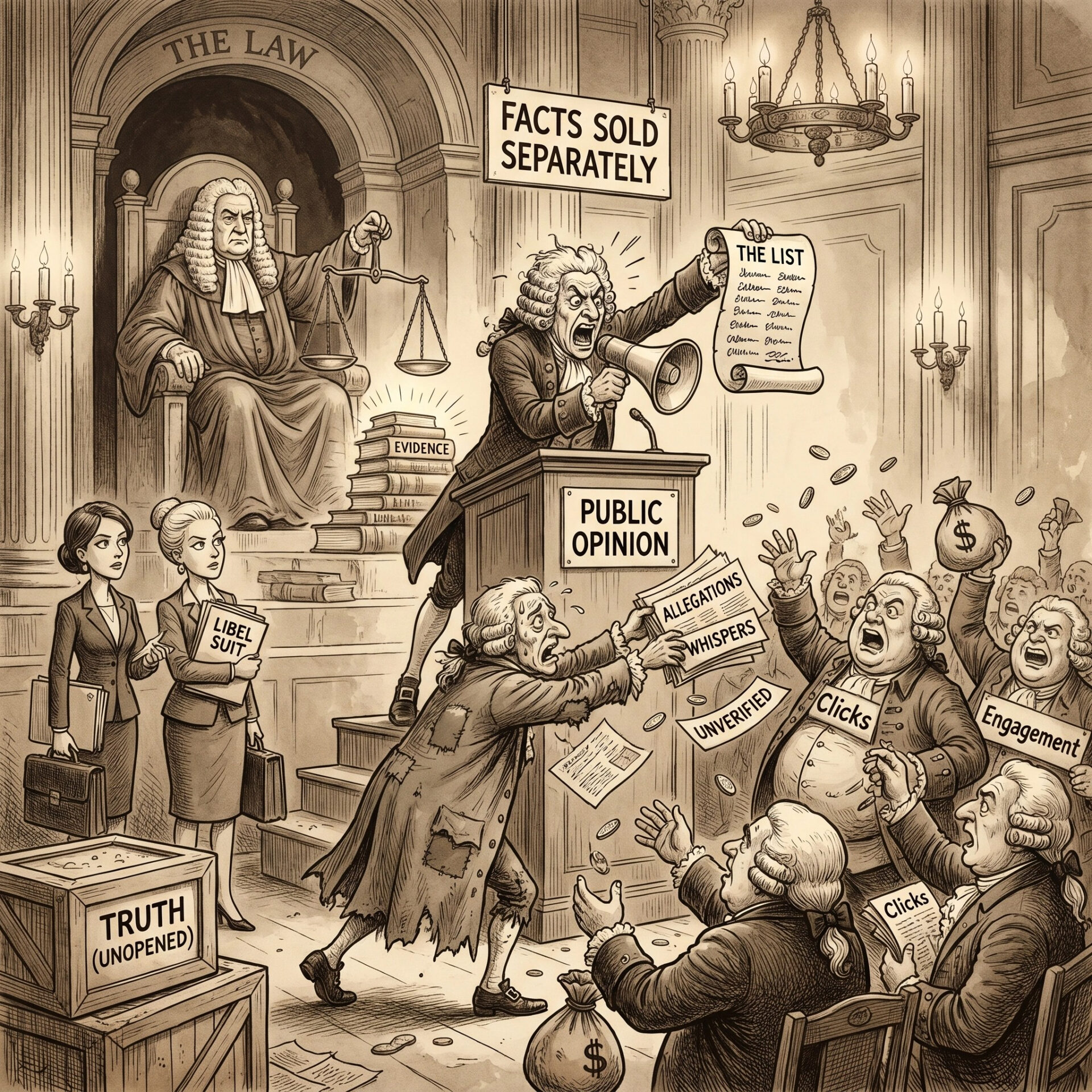
The List, The Lawsuits, and the Law That Doesn’t Care About Your Rumors
May it please the court…
Not long ago, January, to be exact, I stood on the winning side of a defamation case that never made it past the pleadings stage. It didn’t survive discovery. It didn’t get close to a jury. It died where these cases are supposed to die when the law is doing its job: under Georgia’s Anti-SLAPP statute.
That experience tends to sharpen your perspective.
Because once you’ve watched a defamation claim get tested against actual legal standards…not Twitter standards, not activist standards, not “I heard it from a guy who knows a guy” standards, you start to recognize very quickly when a case is posturing… and when it’s dangerous.
The lawsuits now pending in Clarke County against Scott Howard fall squarely into the latter category.
When Rumor Becomes Assertion
Georgia politics has always had its share of whispers. That’s not new. What is new is the speed at which whispers are laundered into certainty and blasted out to an audience that treats repetition as verification.
Enter Scott Howard. Howard presents himself as a retired chef, entrepreneur, author, restaurateur, and classic car enthusiast, but politically, he appears to be operating as a Forsyth County anti-establishment activist with an old-candidate’s eye for intra-GOP warfare.
Howard previously ran in a 2018 Republican primary for Georgia Senate District 47, losing to Frank Ginn, and more recently has been tied to ethics complaints and public allegations involving Forsyth County officials, with Greg Dolezal named among the “implicated individuals” in one complaint reported by The Georgia Record. Dolezal, meanwhile, is no longer just a Forsyth County state senator. He is on the May 19, 2026, Republican primary ballot for lieutenant governor, which means attacks on him now carry statewide political significance.
Scott Howard didn’t just repeat rumors about State Senator Greg Dolezal.
According to two separate legal complaints, one filed by Mallory Staples and the other by McKenzie Rhoades, he did something far more consequential: he named names and made declarative statements tying identifiable women to alleged affairs.
Not insinuation. Not “people are saying.”
Assertion.
In one exchange, he laid it out plainly enough that even the most distracted reader couldn’t miss the point:
“Rhodes, Shaw, Hanson, Staples, the list is growing…”
And when challenged, he removed all doubt:
“You dumb ass, that is his list of women…”
That moment – right there – is where this stops being politics and starts being law.
The Law Does Not Grade on a Curve
One of the first things you learn litigating defamation claims in Georgia is that the law is far less forgiving than the internet.
There is no “but everyone was talking about it” defense.
There is no “I was just asking questions” safe harbor when you’re not actually asking questions.
And there is certainly no exemption for activists who believe they’re on the “right side” of a political fight.
What matters is far simpler…and far harsher:
- Was the statement false?
- Was it published?
- Did it harm someone’s reputation?
And in certain categories, what we call libel per se, the law doesn’t even require the plaintiff to prove damages. They’re presumed.
- Accusing someone of adultery.
- Accusing someone of sexual misconduct.
- Making claims that strike directly at their professional integrity.
Those aren’t gray areas. Those are bullseyes.
The Defense Playbook, and Its Limits
To be clear, Scott Howard is doing exactly what any competent defense lawyer would advise at this stage.
Challenge service. Attack the pleadings. Raise Anti-SLAPP. Argue that the statements don’t meet the threshold for defamation per se. Suggest ambiguity. Suggest misidentification.
I’ve made those arguments myself…at least where it involved Anti-SLAPP…Successfully.
But here’s the difference…and it’s a critical one:
Anti-SLAPP protection is powerful, but it is not a shield for statements of fact that can be proven false.
It is designed to protect speech about matters of public concern, not to immunize the act of attaching specific, named individuals to alleged sexual conduct without a factual basis.
And that distinction becomes even more uncomfortable for a defendant when the complaint alleges something like this:
That he admitted he had no basis for at least some of the claims and still failed to retract them. (see page 9)
If that allegation holds, Anti-SLAPP doesn’t end the case.
It accelerates it.
The Circular Firing Squad Nobody Saw Coming
What makes this story uniquely Georgia, and uniquely 2026, is who’s involved.
Scott Howard is not some outsider lobbing grenades from across the aisle. He operates within the same broader political ecosystem that has rallied behind Dolezal’s candidacy for Lieutenant Governor, the same ecosystem often described, not always affectionately, as the Election Integrity Industrial Complex™.
And yet here we are.
- One faction amplifying allegations.
- Another faction demanding transparency.
- All of it unfolding while the courts quietly prepare to do what courts do best: strip everything down to evidence and credibility.
Because while political movements can survive on narrative…lawsuits cannot.
Transparency Meets Reality
Layered on top of all of this is the candidates’ letter authorizing the release of personal records, an attempt to cut through the noise by inviting scrutiny.
Peach Pundit has already sought those records.
And that’s where the stakes shift.
Because if those records produce nothing, the narrative doesn’t just collapse, it inverts. What began as an attempt to damage one candidate could end with significant legal exposure for the person making the claims.
That’s the risk when you move from implication to accusation.
What Happens Next
Right now, this is a procedural fight. Rhoades has answered. Motions to dismiss – a hearing is scheduled for today in Athens. Anti-SLAPP arguments. Technical defenses.
But if these cases survive that phase, and they very well might, everything changes.
Discovery begins.
And discovery is where narratives go to die.
Sources get named.
Communications get produced.
Assertions get tested against reality.
It is, in every sense, the exact opposite of social media.
A Word From Experience
Having just come off a successful Anti-SLAPP dismissal, I can say this with some confidence:
- The law is not interested in your intent to expose wrongdoing.
- It is not interested in your political alignment.
- It is not even particularly interested in how many people believed you.
It is interested in whether what you said about a specific person was true – or whether you said it with reckless disregard for whether it was true.
That’s it.
And when the answer to that question goes the wrong way, the consequences are not rhetorical.
They are financial. They are reputational. And they are very, very real.
Closing Statement
For years, Georgia politics has rewarded the loudest voice in the room.
Now the quietest room, the courtroom, is once again about to decide what those voices were actually worth.
Because once you put someone’s name on “the list,” you may find yourself on a different one entirely.
