

APS, the Beltline, and the TAD Trap
Atlanta and Georgia have both re-elected the same poor executive leadership we’ve endured for the last few years. Their swan songs have now been dropped- the Governor’s idea for more asphalt as a way to address McDonough’s lack of public transit and Mayor Dre’s lack of transit expansion is repeating the same shortsighted mistake on the other end of 75. All of Georgia suffers because these two men think asphalt and rubber are the only ways to move people and goods. This time, the Mayor’s pivot is away from the Eastside Beltline rail and focusing on the longer-term goal of Southside rail. My guess is, this is Mayor Dickens’ attempt at visionary leadership. Unfortunately for him, Sara Gregory’s piece in the AJC didn’t do much to help the Beltline, MARTA, or the City of Atlanta’s public image in reference to transparency. In the midst of both of these elections was the less glamorous Atlanta Board of Education election. I’d like to share how the Atlanta Public Schools Board of Education plays a part in the Mayor’s plans and I wanted to take a moment here to note it, tell you why I think it’s a dumb idea using progressive and conservative sources (because who doesn’t like bipartisanship?) and a recording, and ask you to continue to pray for better leadership, vision, and some breaking of history textbooks in some Executive offices.
Some weeks ago, I sat through two performances of community engagement in Atlanta, one on Wednesday evening and the other on Thursday evening. If you want a play-by-play from that Wednesday night’s Board of Education Meeting, here’s the thread I wrote while sitting in the meeting. Ironically, I missed the actual vote because I got a call from Eric the Younger regarding FK at the time. Thursday night was a meeting to hear about Mayor Dickens’ new plan for TADs across the city via his Chief of Staff, Courtney English. The Mayor wants to make Atlanta the best place to raise a child. I think that’s a noble endeavor and one I’d really like to see happen. I’d like to talk about both performances I watched, point out how they missed their intended marks, remind folks how we got here & make a few recommendations myself. Those recommendations are:
- Remove Atlanta from the Development Authority of Fulton County. Other cities have; why can’t we? We already have Invest Atlanta. We have no need for more tax abatements to steal money away from Atlanta Public Schools.
- Implement Beltline rail on the Eastside Trail and the Southside Trail. We can walk and chew gum at the same time. Further, pitting parts of the city against one another is so Jim Crow. I didn’t sleep in history class.
- Atlantans will need to be vigilant and advocate to their Atlanta Board of Education members that extending the Beltline TAD is a loss for their families and for Atlanta Public Schools.
- Look to other school districts across the country to see how they have addressed the challenges Atlanta faces. Baltimore’s Thread is a way to connect and empower a city around children rather than develop and displace families.
Let’s start with December’s Board of Education meeting. I’ve written a couple of times previously about the issue of the APS consolidation, namely how I am opposed to it, the Board of Education’s performative art of community engagement rather than actually taking the community’s voice into account, and how I propose we will see the negative effects of this decision in the years to come. Unsurprisingly, I learned earlier this week that FK’s Principal will be consolidating both campuses of Frederick Douglass High School into one this summer, and so the behaviors that are currently present in the cluster’s middle schools will now be combined with senioritis of the upperclassmen.
Great. Parents don’t have enough to worry about as is in this cluster, I guess. *sigh*
This consolidation will deeply affect my neighborhood and section of the city, not just FK’s school. Closing down a school (F.L. Stanton Elementary), our neighborhood elementary school, that enables me to take multiple kids who are not mine before the 11 AM cut-off ensures attendance and enrollment numbers, which are how Georgia currently determines school funding via our QBE funding formula that is literally as old (maybe older) than me. Mike Dudgeon told me years ago that meaningfully reforming QBE in Georgia is a pipe dream because there isn’t enough political capital to do so. I see that to be true, no matter the party. So instead of fixing the problem with a completely new formula to meet our present-day needs, our state has decided through minor formula tweaks and a wholesale embrace of vouchers to further line the pockets of private schools rather than doing the work they were elected to do in order to keep our public schools in working order and cut the small school supplemental budget while they’re at it. Then we wonder why Mississippi is leading in education. This feels like trying to fix a fax machine in the age of AI.
This makes me angry. Georgia is better than this.
While I reside in our most populated city, I grew up in a small town, in a small community, where people knowing my family name and expectations meant not only was I expected to succeed, I was expected to give back. I grew up in a family that did not own a home of their own until I was 12 years old, but my parents valued the social mobility via education so much that they chose to forego the local public school and paid tuition to a private, segregation, academy established after integration, originally in an even smaller portion of the county than where I grew up- a township called Good Hope, that (to this day) has only a flashing light. Education represented economic and social mobility to my family, just as it represents to so many other families today.
I am unwilling to stop advocating for better for the kids around me in our state.
In my current community, F.L. Stanton is a historic school, originally built in 1927, that absorbed the neighboring Black elementary school after integration. To now consolidate it, along with more schools in predominantly Black neighborhoods…that had to be a difficult pill to swallow for the Black Board of Education members in Atlanta. It is exactly what their white predecessors did. History is repeating itself here, this time with Black folks in places of power in the Black Mecca.
Turns out, it doesn’t matter your skin color as much as the color of your money in Atlanta. It is the American story of crony capitalism, is it not?
I don’t say that with maliciousness toward the Board of Education members. I say that to call attention to the patterns we repeat when history shows us otherwise. I think the APS Board of Education knows this as well. The shame that hung in the air the night the consolidation vote occurred was visceral.
At the last public hearing I attended in preface to the vote, when I took cell phone pictures of the screen, the Superintendent told me that wasn’t necessary because they were sending the slides out to everyone. There was no dissemination of information following the consolidation vote. There were no follow up timelines showing up on my iPhone inbox a moment after the decision was made after the vote, and to my knowledge, there was no publicity other than earned media after the decision, publicizing the decision. APS Board of Education wanted to have as little public knowledge of their vote as possible.
The looks on the Board members’ faces recalled the image of a beaten dog with its tail between its legs. This was the unshakable image in my head as I walked away from the Board of Education meeting.
It made me think of a previous pastor who always encouraged us with the words of Martin Luther (the German one, not Atlanta’s native son) saying that if you’re going to sin, “Sin boldly”. These board members and the Superintendent not only knew this decision was a gamble, they did it in their own shame. This was not a decision they wanted to say with their chests, and that is a disappointment all of its own. They know they’ve sold southwest Atlanta again, and their own shame was the pall that fell on that room.
“Shame” was also the chant the audience yelled at them, repeatedly, during the meeting from the public. We were not silent.
In some interesting nods to the Gold Dome, I noticed a couple of traits the APS Board of Education shares with the state legislature. First, they use time the same way, waiting until the last possible minute to take the vote. It was as if the Superintendent and Board were unable to read the room, taking up meeting time to watch videos praising the outgoing board members and (twice) watching a self-congratulatory video on how APS had conducted community engagement. I cringed for them. It was kind of like watching a mentally ill person believing his/her own delusions. That’s what it felt like- I was watching an asylum where the patients were running the prison and expecting something other than a dystopia. More Oregon State Hospital, less Arkham.
I was so grateful for the Washington cluster parent, Brie Owens, wife of the previous school board candidate for our district/GBPI education analyst, Dr. Stephen Owens, who said in her public comments that in these public meetings, there were often more APS employees than parents or community members. This was my experience as well, and I wrote about that here. The fact that Cluster Superintendent Forestella Taylor told the parents gathered at Douglass’s meeting that she would take our remarks to the board when we knew she’d already met with them and told the board she would not contest consolidation told me all I needed to know about her. When I later pointed out to Superintendent Johnson that there was almost no publicity about the meeting from Douglass and not even signs outside the door, he asserted that was because our principal was a man, and men just don’t think about those things.
Isn’t it refreshing to see how latent sexism persists, harms us all with these stupid gender roles, even in the bluest parts of the state, in the highest offices, AND in the year of our Lord 2026!
Blessedly, on the local level my Board of Education representation wisely chose not to run again, and while Dr. Stephen Owens was unsuccessful in the General, literally any candidate is better than the previous representation. I did not vote for Tony Mitchell Jr. because of his problematic endorsement from Mayor Dickens. Frankly, a school board member who aligns himself with a man who, like President Trump, gets visibly angry when folks do anything other than praise him, and aligning oneself with a Mayor whose main accomplishment so far has been furthering the school-to-prison pipeline with a newly minted Cop City didn’t seem like the best candidate to me. But, to his credit, later in the evening, I saw Board Members-elect Mitchell and Dr. Kaycee Brock, and Royce Mann, who impressed me the most because he showed up even after he lost.
I’m sure Mayor Dre’s 85% win indicated a mandate to him from citizens. In reality, it’s because he didn’t have any serious candidates to challenge him.
Mayor Dickens endorsement of the school board candidates also alludes to his development and transportation plans as well, IMHO.
Mayor Dickens endorsed candidates took seven of the nine races he endorsed in and if he calls upon that favor of the board members when he introduces that TAD idea for a board vote, he already has his votes in hand for the TAD extension. Similar to President Trump, if there’s one thing I know about Mayor Dickens, he does not do well when he is openly criticized. He takes it very personally, so he’s using the Old Atlanta regime politics game to line up a future ‘win’.
See how that works?
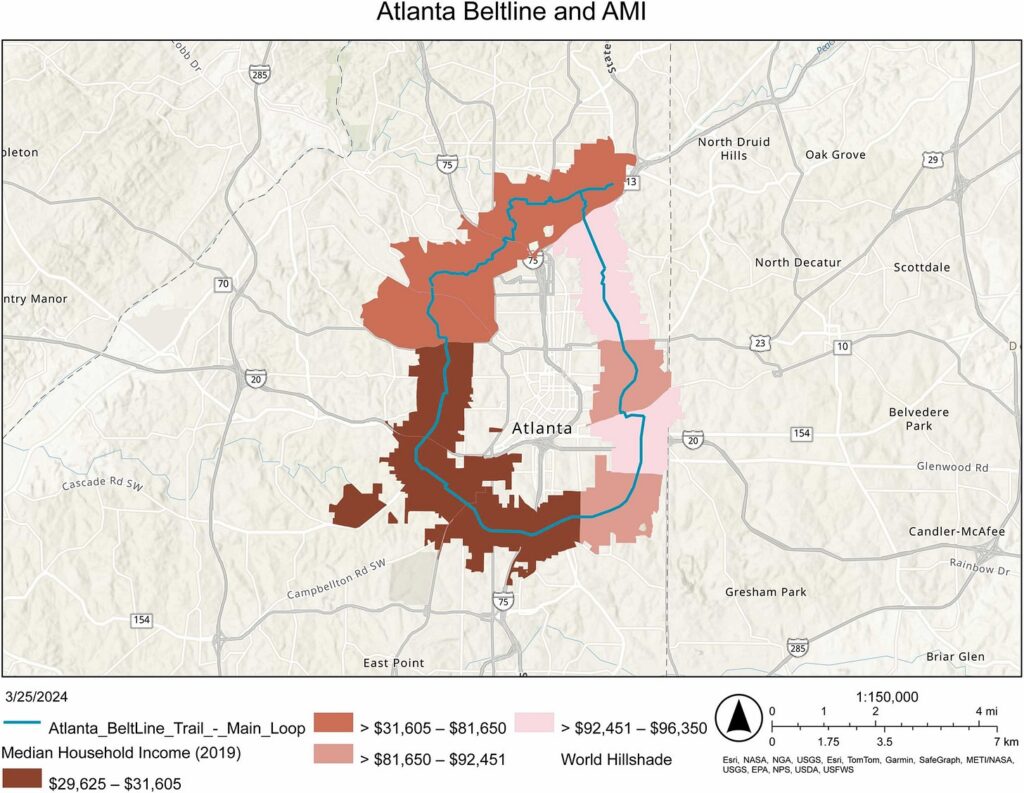
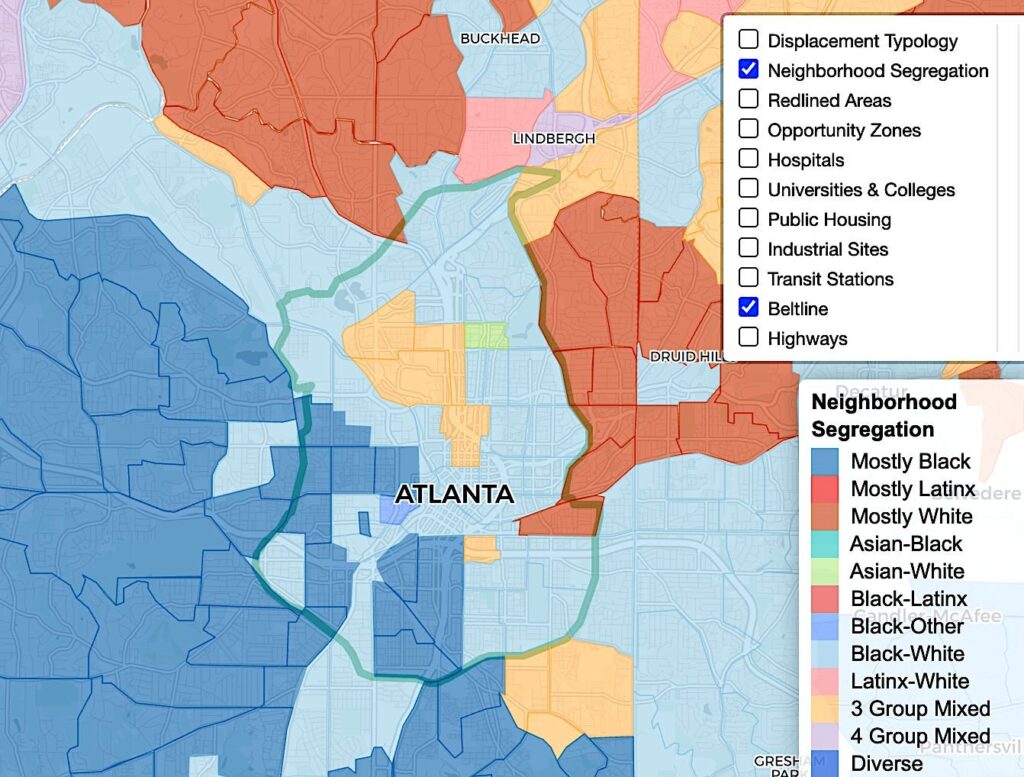
First, let me say that I think the pitting one side of the city against the other like this speaks to the days of Ivan Allen Jr. and before, where white and Black elites decided the future of the city instead and perpetuated exploitation of the working poor. Like the Board of Education consolidating schools predominantly in Black areas of town, this smacks of using process to oppress rather than empower or reform. But I think Darin Givens, of Thread ATL, a group of urbanists in Atlanta, displayed this information better in a visual here where the Beltline should be a literal rail engine for change, bringing the city together. Instead it is perpetuating class divide.
“Indeed, you can see it play out on this map, which shows the lower income groups on the southwest portion of the Atlanta Beltline loop. This loop is an emerging ring of parks and pedestrian/cycling trails that was originally envisioned as a rail line to improve equitable access to transit across neighborhoods. (Source)”
Ivan Allen Jr. had his Peyton Road wall, Mayor Dre has his Beltline to perpetuate class differences. To each their own, I suppose. Both are wrong.
Aside from the fact that they literally do not work, the matter of extending the TADs is problematic because it will take longer to bring about development AND that development will not include the very families and schools that Mayor Dickens is promising it will help. You don’t have to believe my anecdotes. The Partnership for Southern Equity did a five year study on this.
The Cato Institute points out that this funding mechanism is really just another way for crony capitalism to be employed.
This tracks with Atlanta, where developers already dominate the transportation and economic landscape.
The Beltline TADs were supposed to be the great hope of Kasim Reed “the doer of things”, and it was ALWAYS supposed to ultimately lead to rail. The idea that the Beltline was to connect disparate neighborhoods was to remove the economic barriers of the past and to integrate the city more fully. We were supposed to have ample “affordable” housing, all along the Beltline! We were supposed to have particularly workforce housing that made it easier for teachers and city workers to get to their jobs! Neither have come about. The fact that Mayor Dickens is coming back to Atlantans and asking us to believe another Beltline myth is really amazing. I will agree with my Governor and Mayor on the fact that transportation is a key factor for economic mobility. I probably know more about that firsthand than they do! As a young adult, I drove 90 miles round trip from Walton County for better pay and grad school at night. I moved to Atlanta to avoid that, gain access to MARTA, and give up my car as much as possible. Asphalt is expensive, y’all, public transit is a great approach to equity and accessibility, and it would connect my neighborhood to Inman Park in a real and direct way.
Maybe that’s the fear, right?
Like MARTA in Cobb and Gwinnett, maybe Inman Park residents don’t REALLY want to connect with me and my neighbors. That’s tacky with a capital “T”, y’all. And a Mayor that supports that arcane thinking has not familiarized himself with his own city’s history. I feel like a boy from Adamsville should be familiar with what damage White Flight has rendered. If not, that’s its own shame.
Is Inman Park worried that folks of my social class are going to move into their sculpted yards? Are they worried that what happened to my neighborhood in the 50s and 60s is going to happen to theirs? My neighborhood has gentrified to the point that my husband and I barely recognize it anymore. While the neighborhood used to be more neighborly, it’s now much more of a bedroom community for yuppies. Those yuppies are also in a baby boom, and sadly, now will not even have the chance to engage in the neighborhood school- because APS consolidated it into something other than a school. It remains to be seen what F.L. Stanton Elementary shall be. So we are repeating one of the harms the SPLC warned of,
Lining up his Board of Education votes for a future TAD extension is a redevelopment plan that will not only harm Southwest Atlanta, but will doubly harm APS. Superintendent Johnson wasn’t here for the first round of Beltline negotiations, nor does he reside in Southwest Atlanta. He has a “very nice house”- his words, not mine- in Midtown. I find no fault in where the man chooses to live, but I do find fault in the Board of Education replicating harm on families in Southwest Atlanta that have been promised increased property values and better schools. This TAD extension is selling Atlanta a bag of goods and telling the already gentrifying Southwest families that they’re going to get all of the pluses of better schools with none of the displacement or higher taxes.
Years ago, I had the pleasure of working with Bill Bozarth, who ran for HD 54 in Buckhead after serving on Invest Atlanta’s board. He, Julian Bene, and Fred Smith, have been some of the stalwarts against the profuse gifts of tax abatements provided by Invest Atlanta and the Development Authority of Fulton County to attract new business. The reality they and most Atlantans know is that Midtown and the north and eastside of the city do not need economic tools to boost investment anymore. It is the south and west sides that have needed focus, but abatements as a whole are unnecessary in these areas. Why? Because land in previously red-lined areas is already undervalued. But hey, those tax abatements US Treasurer Beach gave Elon courtesy of the Development Authority of Fulton County were the clincher for his nifty new title, amirite or amirite? Now that the Secretary has moved on, can Atlanta also divest from the DAFC?
But again, don’t believe me, or SPLC. Here’s the Cato Institute’s take on Tax Increment Financing (another name for TADs).
I sat through Southeast Atlanta Neighborhood’s meeting with Mayor Dickens Chief of Staff, Courtney English’s presentations on extending the TADs. Here’s a one pager from it. In his presentation, he touted Atlantic Station as a win-repeatedly. I’m not sure how many of you have been shopping at Atlantic Station recently, but FK loves Target and H&M there, so our family has patronized it repeatedly. What I’ve noticed over time is that the shops are dwindling. As our society has moved from a store oriented consumer model to predominantly online-only, the need for these stores has also declined. Eric the Younger and I have noticed the condo prices have fallen, too. And if we wanted to purchase something for either rental property or for a future kid’s crashpad through the college years, it’s not out of the question. I remember when those 1/1s were $350K! No more! So if Mr. English wants to tout this as a success, he is relying upon Atlantans not having access to Zillow or a working memory.
The rags vs. riches story Chief of Staff English is painting is one I’m fairly familiar with and can frankly quote at this point. He’s not wrong, and I live in the midst of this. Anyone who has lived in any previously red-lined part of Atlanta for any amount of time could repeat these stats back to him- there would be no debate. We know this because we live here. Interestingly, though, on page 12, Chief of Staff English also somehow attributed the increased graduation rate of APS as a win for the Mayor. His correlation was something to do with the Mayor’s Summer Youth Employment program- of which I’m a fan, and FK has participated in twice. How the two correlate remains a mystery to me, though. This seemed to be an attempt at reminding the public of the “good” Mayor Dickens has done. Gotta do more things than Kasim “Doer of Things” Reed.
After many long-winded comments thinly disguised as questions, English promised he would take questions rapid fire and would reply back to them in writing. Here is the recording of that meeting. If you follow along on the transcript, at 52:51, I posed the question, “How does your TAD plans work with a 50 year lease with APS retaining land rights, and what is, how do you define affordable? I would define it as 20% AMI, but I would like to know how this, how affordable is defined within TADs.” Here are the questions to which English responded in writing.
Please note my question about how affordability was defined was answered. However, conspicuously, my question about how the TADs would work with a 50 year lease with APS retaining land use rights was not answered. This wasn’t a hypothetical. Some years ago there was a movement to preserve the historic Lakewood Heights Elementary School. A local developer sued community members over their efforts to gather support for the school preservation. The lawsuit was picked up by the ACLU and the University of Georgia in an anti-SLAPP case. The community members won and worked with APS to ensure that whatever development occurred, the land would be held in a 50 year lease by APS. Here’s the master plan. Here’s the most recent coverage. To my knowledge, this has never been done in APS history and Lakewood is a test case. I know some of the people involved in the lawsuit and even some of the community members who were supportive of the developer, which is why I posed this question. It wasn’t to trip Chief of Staff English up, but more to inquire how the City of Atlanta intends to deal with this entity that did not exist when he first went through the Beltline TAD process previously.
Please note this isn’t Chief of Staff English’s first Beltline TAD rodeo. Please remember that he began his public service life as an APS Board of Education member and was the APS Board of Education Chair when the Board of Ed and the City of Atlanta became involved in a legal dispute with the City of Atlanta over money owed to the school system. He was on the other side then, and he knows how the City of Atlanta can be reluctant to pay its TAD bills.
My, how those tables have turned!
I hope you take the time to listen to the person who speaks after me, a resident of Atlantic Station, noted in the transcript as Speaker 9, who offers caution. Maybe the Dickens Administration is fooling someone other than themselves, but my guess is that it would be the new-to-Atlanta folks, not the folks who’ve lived here for the past twenty years.
Now rather than just being cynical and leaving you all with this sad tale of poor leadership, I want to give you dear readers something for which to hope. Bonus: It doesn’t cost anything in tax money or pocket votes! I’m really interested in solving problems rather than the kabuki theater of politics. I recently learned about the City of Baltimore’s approach to its youth. Thread is their organization that connects disconnected communities (sound familiar?) by creating connections (and it isn’t a transportation plan or TSPLOST!!) Effectively, the schools look at their most vulnerable kids and surround them with four adults who agree to not stop showing up. By showing up they mean:
“This might include packing lunches, providing rides to school, tutoring, connecting students and their families to existing community resources, and coordinating clothing, furniture, or appliance donations. Thread commits to our young people for ten years, the remainder of high school and six years thereafter.”
I’d encourage you to take a look at their success rate and ask yourselves how we can do this in Georgia. A version of this has already been employed in Atlanta Public Schools, with social workers, not community members and not across the district. I can’t promise you that it will reduce blight, gentrify neighborhoods, or be any other statistic Mayor Dickens can share in one of his presentations, but I also know it’s a helluva lot cheaper, doesn’t require crony capitalism, or even a promise for a future TAD vote.
What I hope you further draw from all of this is that connections help- they help kids, they help economics, they help social mobility, and gosh darn it- they helped me write this piece! Throughout this piece I’ve pulled from actual journalists, urbanists, and organizations that (love ‘em or hate ‘em) are part of the social fabric of the city and state. I am more informed because these people and organizations exist and publish. If you aren’t already following them, you should do that now.
