

There’s A New Space Race, And Georgia Could Be At The Center Of It.
As you all know, we went to the moon for the first time in fifty years back in April. The Artemis II mission’s goal was to take fresh pictures of the moon to pave the way for landing on the moon again and then begin building a moon base. The ultimate goal is to go to Mars.
As WSB reported in April, Georgia Tech and 17 Georgia companies were involved in Artemis II.
“This is one of the reasons I got into spaceflight to begin with,” Georgia Tech Professor John Christian said.
Helping make the launch possible were 17 Georgia companies and several researchers.
Christian used to work with NASA, helping develop the navigation algorithms used during the first Artemis launch.
He said the mission is about setting up to make the moon a resource for Earth.
“Making it really an extension of humanity, an extension of our economy, an extension of everything that we do to not just be Earth, but to really include the moon for the first time,” Christian said.
As it was in the 1960s and 1970s, the benefits of going to space benefit all of society and create thousands of good-paying jobs.
“The technologies we create, the money we spend on this, benefit life on earth,” said Jud Ready, executive director of Georgia Tech’s Space Research Institute, who oversees tens of millions of dollars of space research.
Everything from Velcro to modern television can trace its roots to space exploration.
“Space is involved in almost every second of your life,” Ready said.
Experts believe this iteration of deep space travel offers a chance to develop new technologies.
What will Georgia’s role in this new space race be? Well, it’s up to us.
I’m training a forecasting model using Google’s Gemini AI. I asked it to forecast several possible future roles Georgia could play in the space race between now and the year 2045. I hope that, by welcoming new investment and companies while maintaining a pro-growth business climate, we’ll see Georgia’s aerospace industry thrive and become a key factor in America winning this new space race.
Here is the forecast:
Below is a strategic foresight analysis exploring the future role of the state of Georgia in the aerospace and space sectors over a 20-year horizon (2026–2045).
Phase 1: Framing (Domain & Horizon)
Domain Definition: The trajectory of Georgia’s aerospace ecosystem, encompassing commercial aircraft manufacturing, defense/military aviation, advanced air mobility (eVTOL/drones), commercial space launch/hardware, and space research.
Geographic Scope: State of Georgia (with primary nodes in Atlanta, Savannah, Warner Robins, Columbus, and Camden County) in the context of the global aerospace economy.
Time Horizon: 2026–2045 (20 years).
Phase 2: Scanning (STEEP Analysis)
To map macro-drivers across non-obvious lenses without bias, we conduct a STEEP Analysis:
Lens Current Signals & Driving Forces in Georgia
Social
- High-tech engineering workforce pipeline anchored by Georgia Tech (producing ~10% of U.S. aerospace engineering PhDs).
- Demographic shift and military-to-civilian labor transitions around bases like Robins AFB and Kings Bay.
Technological
- Rapid advancement in Advanced Air Mobility (eVTOL) prototyping and drone logistics.
- Expansion of satellite design, propulsion, and entry/descent/landing research via Georgia Tech’s Space Research Institute.
Economic
- Aerospace as Georgia’s #1 export ($12.6B+ annually) and second-largest manufacturing sector ($57B+ economic impact).
- Major corporate footprint: Gulfstream Aerospace, Lockheed Martin, Pratt & Whitney, Delta Air Lines.
Environmental
- Decarbonization pressure driving hybrid-electric and hydrogen flight developments.
- Coastal environmental and zoning debates surrounding commercial spaceports (e.g., Camden County).
Political
- Pro-business state policy and active defense commissions (Georgia Joint Defense Commission).
- Federal defense procurement shifts and FAA regulatory evolution for autonomous flight and commercial launch.
Phase 3: Forecasting (Baseline & Scenario Planning)
- The Baseline Forecast (Business-as-Usual)
In the baseline trajectory, Georgia maintains its status as a top aerospace manufacturing hub. Growth remains concentrated in corporate aviation (Gulfstream), defense MRO (Warner Robins/Lockheed), and commercial airline hubs (Delta/Hartsfield-Jackson). Space endeavors grow steadily through academic R&D and specialized sub-component manufacturing rather than primary orbital launch facilities.
- The Cone of Plausibility
Applying the Cone of Plausibility allows us to evaluate the divergence of alternative futures from the baseline:
Probable Future: Georgia solidifies its position as the premier Southeastern hub for Advanced Air Mobility (AAM) testing, electric aircraft assembly, and specialized space hardware design.
Plausible Future: Atlanta and Savannah become major manufacturing nodes for autonomous commercial space habitats and cislunar satellite constellations, driven by university-led IP commercialization.
Possible Future: Georgia hosts a major inland/coastal space-port network operating hypersonic point-to-point suborbital freight across global routes.
Preferable Future: A fully integrated “Aerospace & Deep-Space Tech Ecosystem” where Georgia transitions from an assembly/manufacturing state to the primary global brain trust for autonomous flight algorithms, space architecture, and green propulsion systems.
- Scenario Matrix (Key Uncertainties)
Constructing scenarios across two key axes of uncertainty:
Axis 1 (Horizontal): Regulatory Pace for Autonomous & Commercial Space Operations (Strict/Fragmented vs. Streamlined/Global).
Axis 2 (Vertical): Capital Flow into Next-Gen Aerospace Infrastructure (Concentrated in Traditional Defense vs. Decentralized Commercial/Venture).
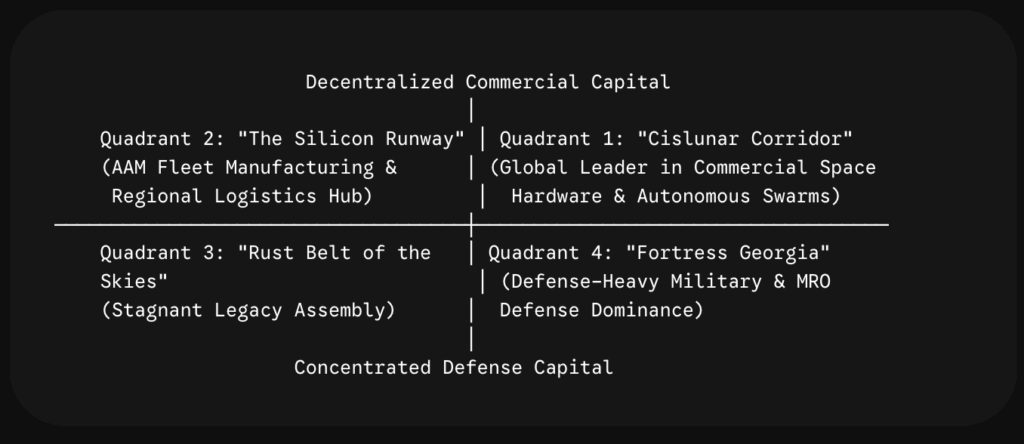
Quadrant 1: “Cislunar Corridor” (Preferable High-Growth)
Outcome: Georgia Tech’s Space Research Institute and regional manufacturers establish Georgia as the primary supply-chain and flight-software hub for lunar/orbital logistics vehicles.
Quadrant 2: “The Silicon Runway”
Outcome: Commercial space lags, but Georgia becomes the nation’s leader in eVTOL urban air mobility manufacturing, automated air cargo corridors, and battery-electric flight testing.
Quadrant 3: “Rust Belt of the Skies”
Outcome: Stagnant Legacy Assembly
Quadrant 4: “Fortress Georgia”
Outcome: Commercial space/AAM face regulatory bottlenecks. Georgia defaults to military sustainment (F-22/C-130 support, hypersonic missile assembly, defense AI).
Phase 4: Causal Layered Analysis (CLA)
To examine why entrenched dynamics persist or how new paradigms take root in Georgia’s aerospace space, we apply Causal Layered Analysis (CLA):
Litany (Headlines): “Georgia ranked #1 state for aerospace manufacturing attractiveness.”
Systemic Causes: Deep academic-to-industry workforce pipeline (Georgia Tech, university system), low corporate taxes, strong logistics infrastructure (ports, air cargo hubs, rail), and military base proximity.
Worldview: Industrial pragmatic view that manufacturing, logistical efficiency, and defense readiness drive regional economic sovereignty.
Myth / Metaphor: “From Civil War Crossroads to Cosmic Port” — transforming Georgia’s historic role as the transportation crossroad of the American South into the hub for humanity’s orbital pathways.
Phase 5: Planning (Backcasting & Strategic Milestones)
To achieve the Preferable Future (“Cislunar Corridor & AAM Leadership”), we perform a Backcasting analysis working backward from 2045 to the present:
[2045 Target State] ───► Georgia is recognized globally as the primary supplier of autonomous space systems, propulsion modules, and next-generation green commercial aircraft.
[2038 Milestone] ───► Integration of fully autonomous regional air mobility networks connecting Atlanta, Savannah, and rural transit centers; Georgia-built satellites forming 30%+ of low-Earth orbit constellations.
[2032 Milestone] ───► Construction of advanced prototyping and testing facilities for electric/hypersonic aircraft and commercial space payload manufacturing.
[2026 Action Step] ───► Immediate Action: Establish statewide public-private partnerships uniting research universities with private aerospace ventures to fund dual-use defense/commercial space incubators.
Phase 6: Acting (Signposts & Strategic Options)
To institutionalize this foresight effort and monitor vector shifts over time:
Early Warning Indicators (Signposts to Track):
Rate of venture capital investments into Georgia-based space startups vs. traditional coastal hubs (LA/Florida/Texas).
FAA regulatory approvals for autonomous BVLOS (Beyond Visual Line of Sight) flight corridors in Georgia airspace.
State legislative incentives targeting space payload manufacturing and satellite software development.
Strategic Options & Stretch Goals:
Hedge Strategy: Maintain robust defense MRO capability to shield the economy if commercial space investment experiences a “space bubble” contraction.
Stretch Goal (BHAG): Position the state as the nation’s premier incubator for space systems software, AI flight control, and satellite robotics—capturing high-value IP rather than solely lower-margin assembly.
Food for thought for policymakers, but you can be sure the members of the Georgia Aerospace and Defense Alliance have been thinking about this for some time now.
