
Preseason Rankings Are Stupid. So I Put AI to Work.
I have been preaching this for at least 25 years, and possibly 35: preseason college football rankings are stupid. Everybody ought to start from the same place, and nobody ought to be ranked until Week 6 is finished.
Play some football. Then tell me what you have earned.
Instead, every August we hand out gold stars before anybody has taken the test. Somebody decides a team is No. 7, that team loses in September, and the winner gets to brag about a top 10 victory. What if the team they beat turns out to be lousy? Apparently, the summer guess still gets a seat at the table.
I have complained about this long enough that I figured I ought to put something behind the complaint. With the help of ChatGPT, I built a ranking system using only this season’s results. I chose the rules and AI helped collect the games, do the arithmetic, and keep track of how the pieces fit together.
I’m calling it Zero Based College Football Rankings. The first edition uses completed games through October 10, after Week 6. That means six weeks of football, even though byes and different opening schedules mean everybody hasn’t played the same number of games.
Every team starts equal. Last year’s record gets no vote. Neither do recruiting rankings, betting lines, conference reputation, or the name on the helmet. We check the scores to establish who won, but running up the score earns nothing extra.
The computer does the calculations using team identifiers rather than school names. We also compare versions using anonymous team labels. That helps keep me from putting a thumb on the scale because I like one team or can’t stand another. It doesn’t make me incapable of bias, especially once I’ve seen the results. Any rule we change has to apply to everybody, and we keep the earlier versions so the changes can be inspected.
We began with an existing mathematical approach called the Colley Matrix, which uses wins, losses, and the connections between opponents. We tried versions that leaned more heavily on a team’s record, then moved toward giving different wins and losses different values.
The question kept coming back to the schedule. A win over a 5-1 team sounds pretty good. But who did those five wins come against? If that team spent September beating a bunch of chumps, its record needs a little more examination before we throw a parade.
And we have to keep following the trail. Who did those opponents play? Who did they beat? A good-looking record can have some pretty flimsy boards underneath it.
That is what the current system tries to account for. A team’s rating reflects its wins, its losses, and the strength of the teams it played. Those opponents are evaluated by the same rules, with their own schedules and results feeding back through the whole thing.
Think about Ohio State losing to Texas. Then Oklahoma beats Texas. That lowers Texas’s rating and makes Ohio State’s loss to Texas more costly. UTSA, which also lost to Texas, feels the same effect. Texas’s win over Ohio State also depends on what Ohio State accomplishes. Nobody gets to cash a September victory and pretend the rest of the season never happened.
It works the other way, too. Beat a team that goes on to beat strong opponents, and your victory becomes more valuable. Lose to a team that keeps winning against strong opponents, and that loss does less damage than losing to a team that falls apart.
We also added a cupcake penalty. Beat a lower division opponent, and you receive half the credit that win would otherwise earn. Lose to one, and the ordinary loss penalty doubles, with a minimum penalty equal to two losses against average opponents. Buying yourself a comfortable Saturday comes with a smaller reward while getting embarrassed that Saturday comes with a bigger bill.
For an FBS team, that penalty applies to an FCS opponent. A weak FBS opponent is still evaluated through its results and schedule. We aren’t calling every school outside the big conferences a cupcake just because we don’t recognize the mascot.
FCS teams remain in the calculations, so their results help us judge the teams that played them. Only FBS teams appear in the published Top 25.
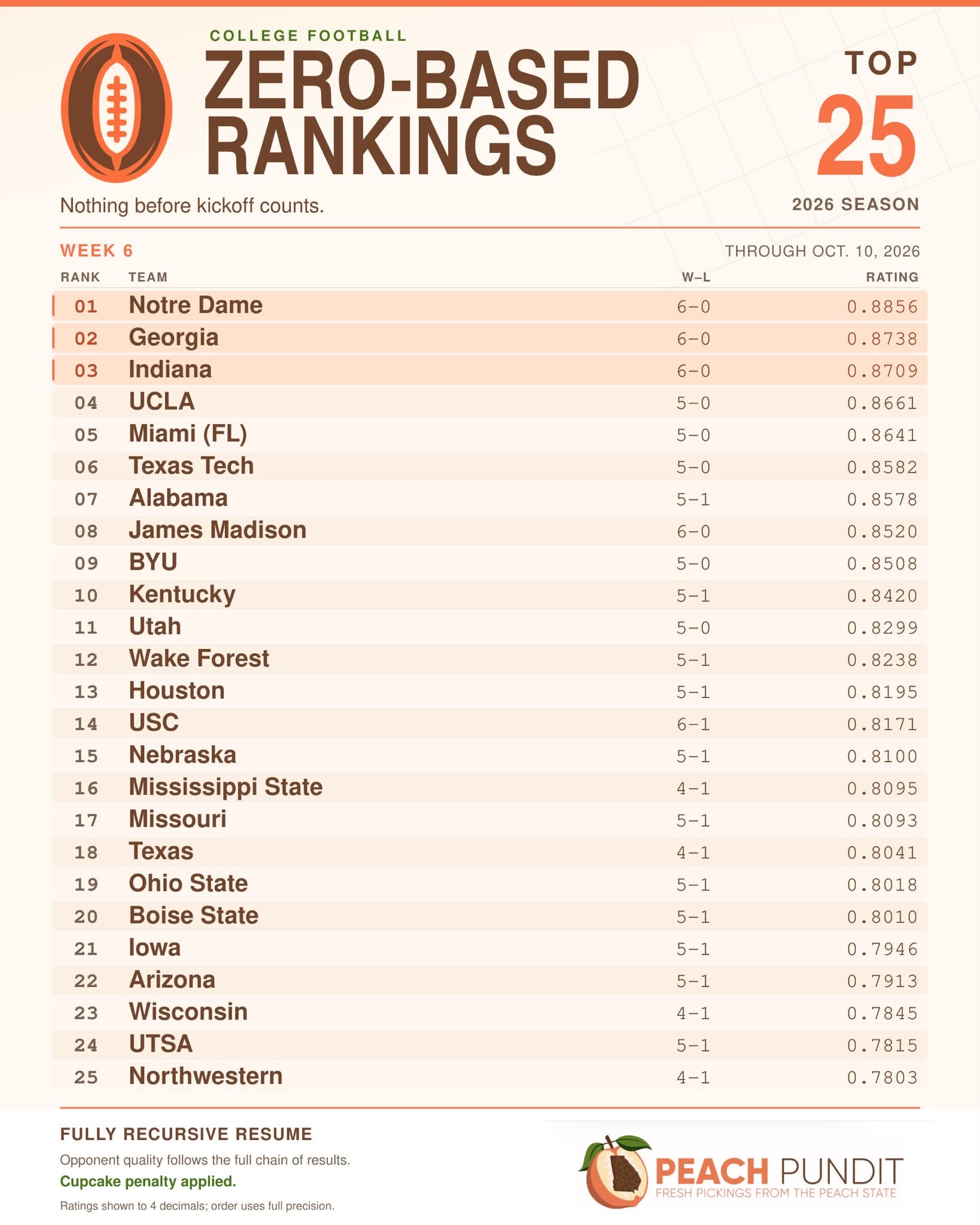
Here is where those rules put everybody after Week 6:
The first comment on my Facebook post was, “Notre Dame at 1, lol.”
Fair enough. I knew posting college football rankings on the internet was going to invite a calm and thoughtful exchange of ideas.
Notre Dame is 6-0 and has played six FBS opponents. Georgia is also 6-0 and has the stronger individual win over Alabama, but its Tennessee State victory receives reduced credit. Once every opponent’s results and schedule are factored in, Notre Dame has more accumulated win credit and finishes narrowly ahead. The formula doesn’t know which fan base is going to yell at me.
James Madison at No. 8 will raise some eyebrows, too. JMU is 6-0, has beaten 5-1 Liberty, and has already received the cupcake adjustment for its win over Wagner. Its opponents’ combined record is 15-21. The schedule is being counted, but the undefeated record still carries substantial weight under our current rules.
That is a fair place to question the experiment. Does the formula give unbeaten teams too much protection when their schedules are weak? I am not opposed to tweaking this but if we do, we should examine that using anonymous resumes and controlled comparisons. Moving a team because its name makes the ranking look funny would put us right back in the business of handing out opinions.
This is a formula I chose, with judgments about how much different accomplishments should count. AI makes the work practical. It doesn’t turn those judgments into commandments.
We will update the rankings as the season continues, evaluating the games again from opening day through the latest completed week. Earlier wins can gain value, earlier losses can become more costly, and last week’s ranking gives a team no head start. Meaning it is possible for a team to win and still lose spots in the rankings if their past opponents collectively tank.
I’ve spent decades asking college football to let everybody start equal, play some games, and then judge what they earned. Now I have an experiment that does it, and a set of results people can argue with.
Nothing before kickoff counts.

Sorry, Scot. We know this poll is flawed because only 6 SEC teams are represented, and only 3 of them are in the top 10. We know, because we watch ESPN, that all 16 SEC teams should be ranked.
Back to the drawing board, ChatGPT.