
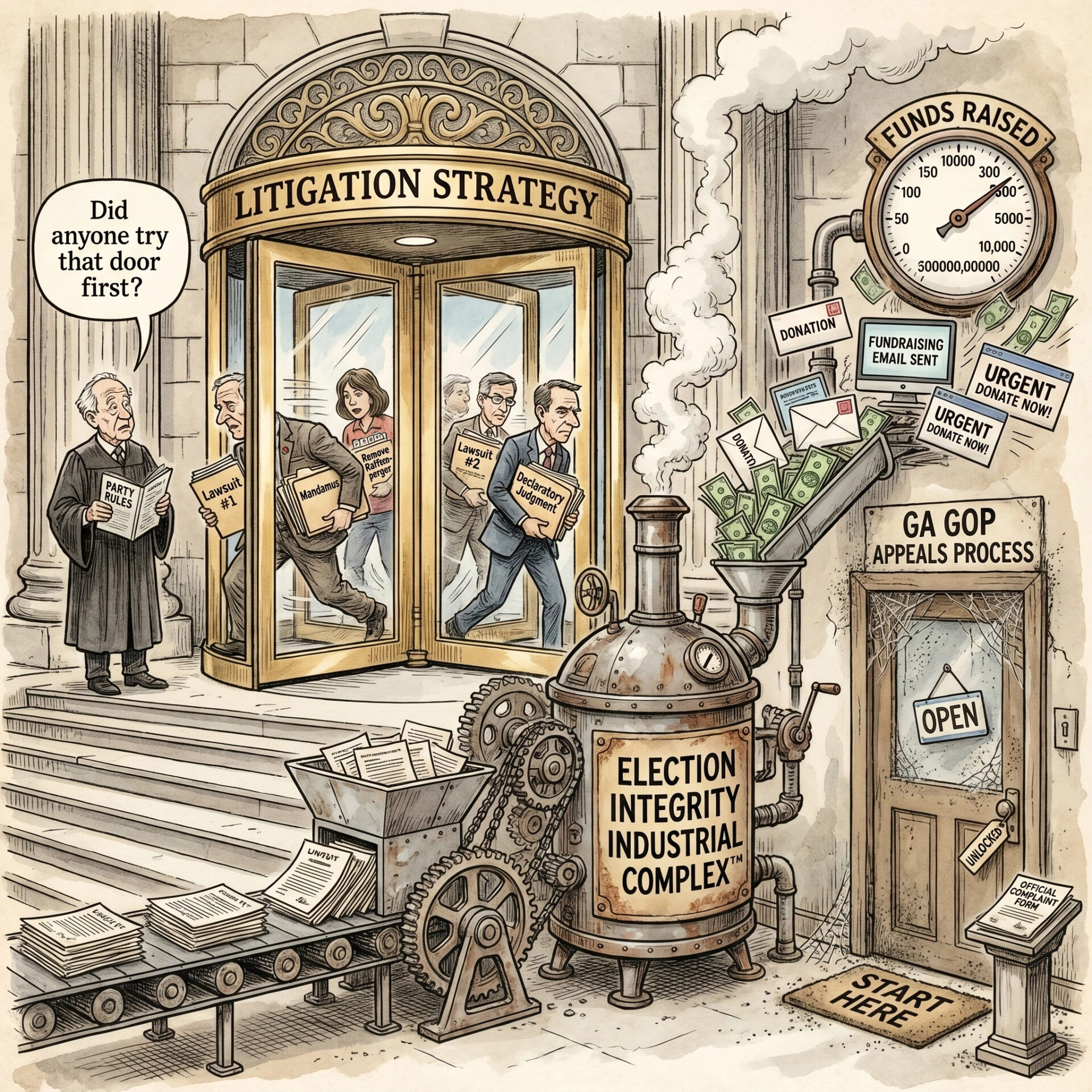
The curious case of the process advocates who skipped the process
For those keeping score at home, the Georgia Republican Assembly (GRA) has now entered what appears to be the second phase of the “Let’s Sue Somebody Until We Get the Answer We Want” strategy.
You, my dear readers, may recall the first installments. Earlier this year, activists attempted to use the courts to force Secretary of State Brad Raffensperger off the Republican ballot. As I explained at the time in No Duty, No Writ, No Case, that effort suffered from a fatal defect: the Secretary of State had no legal duty to enforce a Georgia Republican Party convention resolution. No duty means no mandamus. No mandamus means no case.
The lawsuit failed.
At the time, I pointed out what should have been obvious. If anyone had authority over Republican candidate qualification, it was not the Office of the Secretary of State. It was the Georgia Republican Party itself.
Curiously, the Chairman of that lovable group of Goofballs, Rejects, and…well…the GRA Alex Johnson disagreed with me. In an exchange I had with him on social media in the run-up to qualifying, he claimed that suing the party itself was not the answer.
Fast forward a few months, and the GRA is now trumpeting just that… suing the party itself.
Sometimes life writes the punchlines for you.
Johnson even states in his own GRA newsletter, “The convention said ‘no.’ The Party did it anyway. Whatever one thinks about Raffensperger, who thankfully lost in the primary, that institutional problem should concern every Republican… when its decision became inconvenient, its vote was treated like a public opinion survey.”
The new lawsuit, which includes two plaintiffs from the previously failed lawsuit, seeks a declaratory judgment that the Georgia Republican Party violated its own rules when it allowed Brad Raffensperger to qualify for Governor despite a convention resolution declaring that the party should not permit him to run as a Republican.
I have already addressed the underlying resolution in a previous article and explained why I believe it is likely not worth the paper it was printed on. But after reading the complaint itself, I found a different problem that may be even more amusing.
In a nutshell, the plaintiffs are suing because they claim the party ignored its own process.
However, the plaintiffs themselves ignored the party’s own process.
According to the complaint, this is simply an internal governance dispute. The plaintiffs are not challenging election results. They are not seeking damages. They are merely asking a court to interpret the party’s rules and determine whether party leadership followed them.
That naturally raises a question.
Did the plaintiffs use the Georgia Republican Party’s internal appeals process before running to court?
No.
The Georgia Republican Party Rules establish a Committee on Appeals (Rule 6.3). The rules provide a mechanism for internal disputes to be reviewed, investigated, and ultimately decided by the State Committee. The rules even specify that the State Committee’s decision is final.
- The complaint does not allege that the plaintiffs filed an appeal.
- The complaint does not allege that the Committee on Appeals refused to hear the matter.
- The complaint does not allege that the State Committee refused to act.
- The complaint does not allege that an appeal would have been futile.
Instead, the plaintiffs skipped the process entirely and filed suit in Fulton County.
That is a curious approach for people who insist they are defending process.
One might think that before asking a Superior Court judge to resolve a dispute about party governance, the party itself should at least be given an opportunity to resolve the dispute through the procedures established for that very purpose.
Apparently not.
The irony here is difficult to miss.
The plaintiffs are effectively asking a court to declare that party leaders failed to follow party rules while simultaneously demonstrating no interest whatsoever in following the party rules governing appeals.
That is a bit like suing your HOA because the board failed to follow the covenants while admitting you never bothered to read the section explaining how to file a complaint.
The reason I bring this issue up is that even a 3rd year law student should have easily found that the courts have already ruled on whether or not they can intervene in an internal party dispute (hint…I’ve already mentioned it here on Peach Pundit).
In Stuckey v. Richardson, 188 Ga. App. 147 (1988), the Georgia Court of Appeals declined to allow the courts to intervene in what was essentially an internal party dispute: “The instant case concerns the selection of delegates from the State of Georgia to the 1988 National Republican Convention. Appellee-plaintiffs filed a petition for declaratory judgment, seeking a declaration that they were the validly selected delegates to the convention and that the delegates who had been selected by the appellant-defendant State Executive Committee of the Georgia Republican Party (Executive Committee) were not… [I]t is not for the courts to mediate the merits of this dispute…. [A] State, or a court, may not constitutionally substitute its own judgment for that of the Party.”
The Court of Appeals went on to rule, “It follows that the instant dispute concerning the internal affairs of the Georgia Republican Party is a non-justiciable controversy which must be resolved by the 1988 National Republican Convention rather than by the courts of this state. Accordingly, the trial court erred in failing to grant appellants’ motion to dismiss appellees’ petition for declaratory judgment.”
So, before the court ever reaches the question of whether the Raffensperger Resolution was binding, it may ask a much simpler question:
Why are you here?
Just like in Stuckey, the answer appears to be because the plaintiffs never bothered to pursue the remedy available inside the organization they claim to be protecting.
And that is before we get to the lawsuit’s other problems.
The election is over.
Raffensperger lost.
No election result can be changed.
Like in Stuckey, the plaintiffs seek a declaration about future conduct. In other words, they want a judge to issue guidance regarding future internal party governance after bypassing the very internal governance mechanisms that already exist.
That is a bold strategy.
The entire episode is beginning to resemble a sequel nobody asked for.
The first lawsuit failed because the Secretary of State had no duty to enforce a party resolution…let alone a resolution of questionable validity.
The second lawsuit will likely fail because the plaintiffs never used the party’s own appeals process before filing it.
At some point, one begins to wonder whether the objective is actually to win these cases or merely to keep the fundraising emails flowing.
Indeed, after several paragraphs extolling the courage of the plaintiffs and the importance of party integrity, the press release concludes with what has become the customary call for donations. At this point, that is showing over $10,000 raised (let’s face it…the GRA has to find a replacement for the funding pipeline that previously came from the Frosts).
And they may need every dollar they raise and then some if the Georgia Republican Party seeks and is successful in accessing attorney fees and court costs against this likely frivolous filing.
As regular readers know, I have long referred to this ecosystem as the Election Integrity Industrial Complex™. It is a remarkably durable business model. Lose an election. Pass a resolution. File a lawsuit. Send a fundraising email. Repeat as necessary.
What remains unanswered is the simplest question of all…
If the plaintiffs truly believed process matters, why didn’t they follow the process?
