
Georgia’s Ballot Questions: Should Judges Have Party Labels?
In the second installment of our examination of Georgia’s proposed constitutional amendments, we’re looking at whether probate judges should be elected as Republicans and Democrats or without party affiliation. To read the first installment on Amendment 1, go here.
Georgia voters will find the following language on their November ballot:
Shall the Constitution of Georgia be amended so as to require that all probate court judges be elected in nonpartisan elections?
A YES vote would require every county in Georgia to elect its probate judge without a political party designation. A NO vote would preserve the existing system, which allows counties to conduct either partisan or nonpartisan elections.
Georgia’s 159 probate courts handle some of the most personal matters that come before our judicial system, including wills, estates, guardianships, marriage licenses, and weapons carry licenses. Depending on the county, they may also handle certain misdemeanor and traffic cases.
For many Georgians, their first encounter with probate court comes following the death of a loved one or when an aging parent can no longer manage their own affairs. The decisions made in those courtrooms can have profound consequences for families.
Georgia already elects its Supreme Court justices, Court of Appeals judges, superior court judges, and state court judges in nonpartisan elections. Probate judges are the exception, although most counties have already made the change through local legislation.
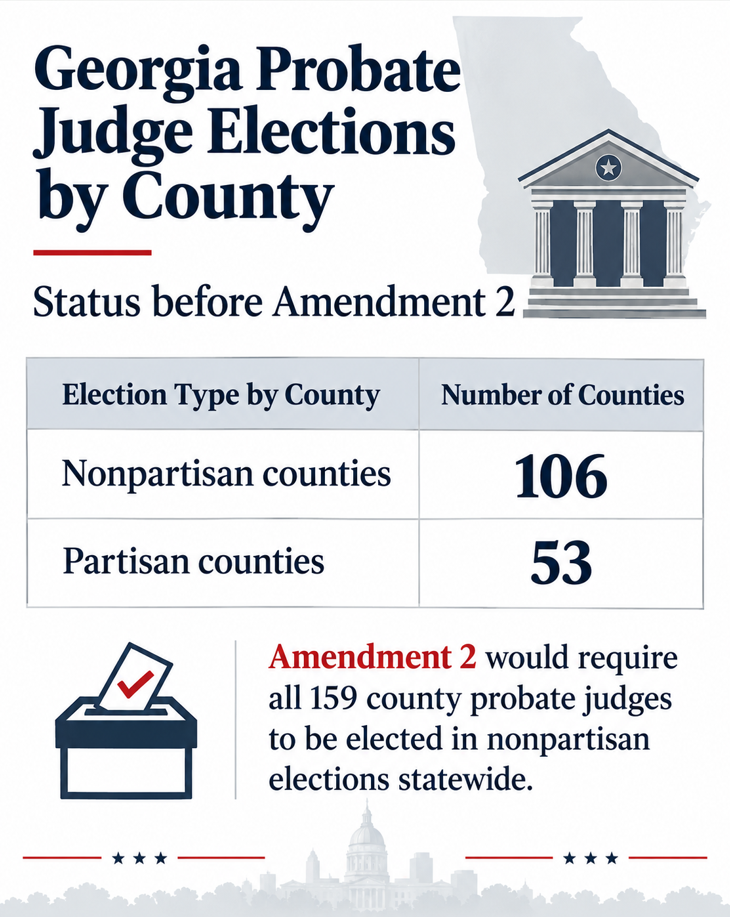
According to the Georgia Recorder, 106 counties currently elect their probate judges on a nonpartisan basis, while the remaining 53 conduct partisan elections. Under existing law, counties can seek to change their election procedures through local legislation. Amendment 2 would establish a uniform system statewide.
The proposal has attracted support from an unusually broad collection of Georgia political figures, including former Republican Governor Nathan Deal and former Democratic Governor Roy Barnes. More than 60 leaders signed a letter supporting the amendment, arguing that removing party affiliations would strengthen public confidence in an independent judiciary.
Georgia Supreme Court Chief Justice Nels Peterson has also advocated for the change, emphasizing that judges must act impartially and maintain public confidence in that impartiality.
There’s a sound principle behind that argument. Judges are expected to apply the law as written, regardless of their personal political beliefs or the political affiliations of the people appearing before them. Someone administering an estate or seeking guardianship of a family member should reasonably expect the same treatment regardless of how they vote.
Political parties also provide information to voters, particularly in races that receive relatively little attention. Most people probably couldn’t name their probate judge without looking it up, much less tell you anything about the qualifications or judicial philosophy of someone challenging the incumbent.
Dr. Ben Taylor, a political science professor at Kennesaw State University, recently reminded me of that reality when we appeared together on Atlanta News First’s On the Record. In races farther down the ballot, party affiliation may be the only meaningful information a voter has about a candidate.
Oddly enough, my own state representative, Charlice Byrd, has been outspoken against Amendment 2, arguing that removing party labels deprives voters of useful information. She was also a cosponsor of the 2021 legislation that made Cherokee County’s probate judge elections nonpartisan.
During the debate over the statewide amendment, Byrd said, “It makes my skin go crawling and my hair stand up because I believe that we need to know as individuals where you stand on issues.”
I resisted similar efforts when I served in the legislature because I’d heard our Cherokee County probate judge make what I considered problematic public comments about the Second Amendment. You know, the guy who issues Concealed Weapons Carry Licenses? I believed the best way to hold him accountable was through a Republican primary.
It probably isn’t a coincidence that the first year I was out of the legislature, they made the position nonpartisan.
But honestly, the whiplash.
The General Assembly ultimately approved Amendment 2 by substantial bipartisan margins, with the House voting 147 to 20 in favor and the Senate approving it unanimously.
The change would also affect when elections are decided because Georgia’s nonpartisan judicial elections generally take place alongside the May primary, while partisan probate judge races proceed through party primaries and the November general election.
That means counties switching to nonpartisan elections would also be moving the final decision into an election that typically attracts considerably fewer voters than November. Someone could win the office in May, months before the broader electorate returns to vote in the general election, making the winner less representative of the full electorate.
Supporters of nonpartisan elections sometimes point to the opportunity for conservative candidates to compete in heavily Democratic communities without a Republican label working against them. Clarke County, for example, already elects its probate judge on a nonpartisan basis. The theory is that voters may be more willing to consider a candidate whose party affiliation isn’t displayed on the ballot.
But that tradeoff cuts both ways. A Democratic candidate running in a heavily Republican county could benefit from exactly the same circumstances. Removing party labels doesn’t eliminate political affiliations, and it doesn’t prevent political organizations from supporting their preferred candidates.
Georgia’s existing nonpartisan judicial elections have hardly been free of political controversy. Just look to the 2024 Georgia Supreme Court race involving former Congressman John Barrow generated considerable attention over abortion and the restrictions judicial candidates face when discussing issues that could come before their courts.
Judges will continue to have personal beliefs, political histories, and relationships regardless of what appears next to their names on the ballot.
I also find it interesting that roughly two thirds of Georgia’s counties have already chosen nonpartisan probate elections through local legislation. That suggests considerable acceptance of the practice, but it also raises the question of whether the remaining counties should retain the ability to make that decision locally.
I’ve long believed voters ought to have as much useful information as possible when they enter the voting booth. I also believe judges should be held to a standard of impartiality that extends well beyond whatever political beliefs they may personally hold.
Amendment 2 asks voters to weigh those considerations while also changing when these elections are conducted and eliminating a choice that Georgia counties have exercised individually for years.
Whether those tradeoffs are worthwhile is a decision voters will have to make for themselves.
We’ll look at Amendment 3 and its proposed dedicated funding mechanism for Georgia’s emergency 911 systems in our next installment.
